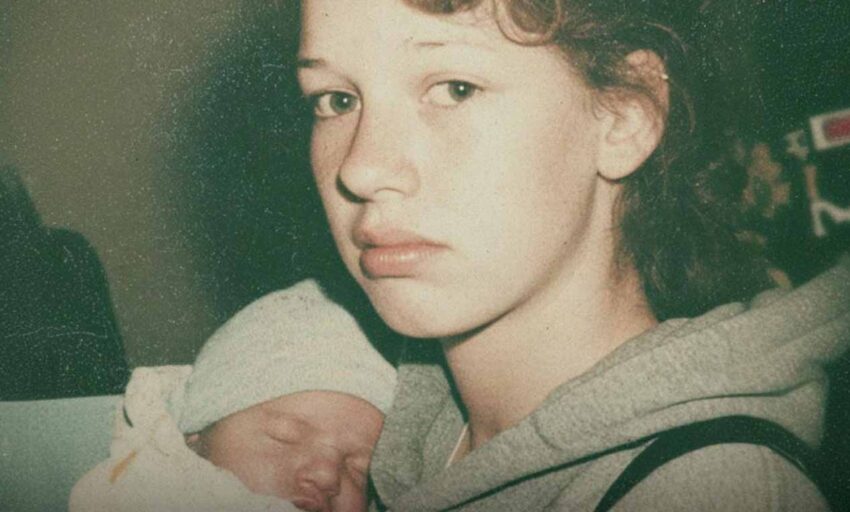
There are moments you think you’ve buried so deep they’ll never find their way back. And yet, here I am: 48 years old, married with two kids, living a life that looks nothing like the one I had all those years ago. I’m standing in my hallway, staring at the front door, half-expecting it to open on its own.
It’s strange how memory works.
How something can be folded away in the neatest corner of your mind for years, until one knock pulls it wide open.
That knock came yesterday.
But to understand that moment, I have to go back. Way back.
I was 20 when I had her. A baby I never spoke about again.
Back then, I was barely hanging on.
I was sick, not the kind that a week in bed and a few pills could fix. The doctors told me it was incurable. My body was shutting down, and so was my life. The diagnosis felt like a life sentence delivered in clinical tones: no promises, no plans, no future.
I was alone. The baby’s father? He disappeared before she was even born. One day he was there, then he wasn’t. No explanations. Just gone.
I didn’t have money. I didn’t have a family. I didn’t even have a place I could truly call home.
Every breath I took back then came with fear.
Fear of hunger, of homelessness, of dying with a baby in my arms and no one to help her.
So I made a choice. The hardest, most soul-tearing decision of my life.
I left my newborn daughter at an orphanage.
Not because I didn’t love her. God, I did. I loved her with the kind of fierce, terrified love that only someone completely broken could feel. I loved her enough to admit that I couldn’t save her while I was falling apart myself.
I signed the papers. I kissed her once.
And I walked away.
And that decision still haunts me.
Five years later, something unthinkable happened. I got better.
No one could explain why, not really. One day, I was sick. Next, I was healing. My body responded to treatments they hadn’t expected to work. It wasn’t a miracle, but it came close.
I started over. Piece by piece, I rebuilt my life. I found work, stability, and eventually, a rhythm.
And as soon as I could, I did the only thing I had thought about every single day for those five years.
I tried to get my daughter back.
But when I called the orphanage, they told me what I never wanted to hear.
She had already been adopted.
They didn’t offer details. Just the cold, legal truth. She had been placed with a family. She belonged to them now. She was no longer mine.
Could I have fought? Maybe. Could I have tried to find a way, pressed harder, demanded more? Yes. But what would it have changed?
She didn’t know me.
And the family who adopted her had done all the things I couldn’t. They had held her, loved her, and watched her grow. I told myself that staying out of her life was the most loving thing I could do. Letting her live peacefully, without confusion or pain, was my last act of motherhood.
So I stayed away.
Life, somehow, moved on.
I met Ryan a few years later. He was a kind, solid man who loved me without needing to know every scar I carried.
I never told him about her.
Not because I was ashamed, but because I had convinced myself it was a closed chapter. One that I didn’t have the right to reopen.
We married and had two kids of our own.
Claire, our daughter, is 20 now. She’s bold, brilliant, and opinionated in a way that makes me both proud and slightly terrified. She’s away at college, finding herself.
Elijah, our 16-year-old, still eats cereal at midnight and forgets to put his socks in the laundry. He’s quieter, more introspective. They are my world.
The second chance I never thought I’d have.
And yet, not a day passed that I didn’t think about the one I gave up.
Where she was. Who she became. If she ever wondered about me.
Then, yesterday, 28 years after I left her, someone knocked on my door.
It was mid-morning. Ryan had just left for the hardware store. Elijah was upstairs playing music through his headphones, oblivious to everything. I was in the kitchen, folding dish towels, when I saw a shadow through the window.
A woman stood there.
Maybe in her late 20s. Slim, with brown hair pulled back. Her hands clutched a small purse, and she looked like she was talking herself out of leaving.
Then she knocked.
I walked to the door slowly. Something about her face — unsure but determined — made me pause.
I opened it.
She didn’t smile. Just looked me square in the eye.
“Hi,” she said, voice soft but steady. “Um… I’m sorry to just show up like this. I — I wasn’t sure if I should.”
I blinked, trying to place her.
“It’s okay. Can I help you with something?”
She nodded, took a shaky breath, and then said the words that made my heart stop:
“First of all, I’m your daughter.”
The ground shifted under me.
She watched my face carefully, then added, “My name is Amy.”
My legs nearly buckled.
Amy.
I hadn’t heard that name spoken aloud in 28 years — but I whispered it to myself every birthday, every sleepless night, every time I walked past little girls in playgrounds and wondered.
“Amy,” I repeated, voice barely above a whisper.
She nodded. “I know this must be a shock. I’m sorry. I didn’t want to… I just needed to see you.”
I stepped aside automatically. “Please, come in.”
She walked in slowly, taking in the room: the coat rack, the framed photos of Claire and Elijah on the hallway table, and the scent of coffee still lingering in the air.
Once we were seated, she reached into her purse and pulled out a document.
It was yellowed and worn at the edges.
It was a birth certificate.
Her birth certificate.
And there it was, typed neatly across the top, Mother’s Name: Davina.
She handed me another item: a photo. It was me at 20, in a hospital gown with flushed cheeks, holding a newborn swaddled in pink.
I couldn’t speak or breathe.
Amy watched me with cautious eyes. “My adoptive mom gave me that when I turned 18. She said she held onto it in case I ever wanted to find you.”
My hands trembled as I held the photo.
That moment. That face. That life I left behind.
“I’ve imagined this so many times,” Amy said quietly. “But I never thought it would hurt this much.”
I looked up at her, really looked at her. And for the first time in 28 years, I saw my daughter again.
She sat across from me at the kitchen table, her hands wrapped tightly around a mug of tea she hadn’t touched. Her eyes moved between mine and the framed photos behind me on the wall. The house was quiet, except for the low hum of the fridge and the occasional creak of floorboards from Elijah’s room upstairs.
I wanted to say something.
Anything. But every word I reached for fell short.
“Do you hate me?” I finally asked. My voice came out more fragile than I expected.
Amy looked up quickly, her face startled. “What? No. God, no. I… I don’t even know you. Not really. I mean, I know of you. I’ve imagined you. A thousand different versions.”
I nodded, unable to speak.
She glanced down at the photo she had brought, the one of me holding her as a newborn. “I used to stare at this when I was little. I’d make up stories. That you were a spy. Or a doctor in another country. That you had to give me up to protect me. Sometimes, I imagined you were dead, and that’s why you never came.”
The breath caught in my throat. I reached for her hand instinctively, but stopped halfway.
“I never stopped thinking about you,” I whispered.
She nodded slowly. “I know that now. I think I always hoped that was true.”
There was a pause, the kind that carried weight.
Something unspoken lingered in her eyes.
“I didn’t come here just to meet you,” she said softly. “There’s more.”
My stomach clenched.
“I was adopted by a couple in Vermont. Susan and Mark. They were good people. They loved me, gave me everything. My childhood wasn’t perfect, but it was safe.”
I listened, hanging on every word.
“But when I was 15, my mom — Susan — was diagnosed with early-onset dementia. It progressed fast. Too fast. By 17, she didn’t know who I was anymore.”
“I’m so sorry,” I murmured.
She nodded. “And my dad… he was never the same after that. He tried, but when she passed away a year later, he kind of shut down. He started drinking. He was a good man once, but grief hollowed him out.”
She paused to sip the now-lukewarm tea, then continued.
“I moved out at 19. I worked through college. Took student loans. Graduated with a degree in sociology. And for a while, I thought I had moved on. Built a life. A name. I even had a boyfriend for a few years. We talked about marriage.”
Something shifted in her expression — a flicker of hesitation.
“But then things started falling apart. I had panic attacks. Bad ones. I’d wake up in the middle of the night feeling like I couldn’t breathe. I couldn’t connect with people. Even the man I was with said I always seemed like I was ‘waiting for the other shoe to drop.’ And he wasn’t wrong.”
I felt like my heart was slowly being peeled open.
“I tried therapy,” she went on. “And that’s when it started — the need to know. The questions I had tried to ignore just got louder. I realized I couldn’t understand myself fully until I knew where I came from. Who I came from. Why I was given away.”
Tears burned at the corners of my eyes. “I didn’t give you away,” I said gently. “I gave you a chance. I didn’t think I was going to live. I had nothing. No money. No support. I was terrified. And I loved you so much it physically hurt to let go.”
Amy was quiet for a long time.
Then she nodded.
“I believe you.”
I exhaled shakily, tears now rolling freely down my cheeks.
“I’m sorry,” I whispered. “I’m so, so sorry, Amy.”
She reached out this time, her fingers brushing mine. “I’m not here for an apology. I mean… part of me wanted one. But mostly, I came because I needed to see you. I needed to know you’re real. That you didn’t just vanish into some hole in the earth.”
“I’m here,” I said. “I’ve always been here.”
There was another pause, gentler this time.
“I have a family now,” I said quietly. “I got married. His name is Ryan. We have two children. Claire — she’s 20, in college now. And Elijah, 16. He’s upstairs, probably still in his pajamas,” I added with a soft laugh.
Amy’s expression shifted, not with anger or jealousy, but with something deeper. Curiosity. Longing. Thoughtfulness.
“So,” she said after a moment, “do Claire and Elijah know?”
I froze. “No. I never told them.”
“Not even your husband?”
I shook my head. “I told myself it was too late. That it would only complicate things. That you’d been adopted and had your life. I buried it.”
She leaned back, her eyes moving again to the hallway, where the edges of a family portrait peeked from the wall. “You must’ve been a great mom to them.”
I swallowed hard. “I tried. I poured everything into them. Every ounce of love I couldn’t give you, I gave to them.”
Amy smiled faintly, though her eyes shimmered.
“Then maybe I got the best version of you after all.”
I laughed. “You’re much kinder than I deserve.”
She glanced at the clock. It was nearing noon.
“I should go soon,” she said. “I didn’t mean to just drop a bomb on you.”
“You didn’t,” I said quickly. “You did what you needed to do.”
There was a beat.
“Would you like to meet them one day?” I asked. “Claire and Elijah. Ryan.”
Amy looked surprised.
“You’d want that?”
“I don’t know how or when. But yes. If you want that too.”
She nodded slowly. “Maybe not today. But one day. Yes.”
We stood. I walked her to the door, heart pounding with so many things I hadn’t yet said. But I knew this wasn’t goodbye, not this time.
At the threshold, she turned.
“Can I call you sometime?”
“Please do,” I said, nodding. “Anytime.”
Then she walked down the steps and back toward the car. She was the woman I once held in a hospital room I never returned to. The daughter I loved more than my own survival.
And this time, I didn’t watch her disappear.
I watched her begin.