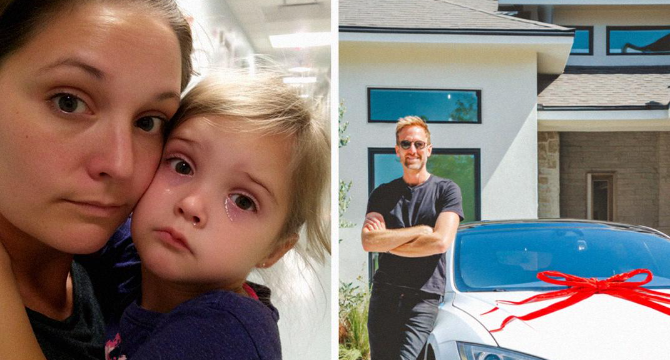
I was 24 when I fell in love with Derek. Back then, he had a way of making big promises sound easy.
By 26, we had Molly, a tiny bundle, and what I believed was a steady marriage.
Two years later, Derek was promoted to regional sales director at his company, and that’s when things changed.
…what I believed was a steady marriage.
The new title came with a raise, longer hours, and business trips that stretched from two to four days.
It also came with secretive smiles at his phone and a password I suddenly didn’t know.
I remember standing in the kitchen one evening, stirring a pot of soup and watching him type quickly with his back turned.
“Who are you texting?” I asked, keeping my tone light.
He didn’t look up. “Work.”
At the time, I wanted to believe that answer.
“Who are you texting?”
By the time I turned 29, I learned the truth the hard way.
The woman’s name was Tessa. She was seven years younger than me, worked in marketing, and had bright blond hair.
I found out because I chose to look when the suspicions wouldn’t go away.
I borrowed Derek’s laptop one afternoon when he left it open on the dining room table. My hands shook, but I opened his email anyway. I told myself I’d stop if I saw nothing.
I didn’t stop.
The woman’s name was Tessa.
There were hotel confirmations. Dinner reservations. Messages that began with “Can’t wait to see you again.”
When I confronted him, he didn’t even try to deny it.
“I didn’t mean for it to happen,” he said, running his hand through his hair. “You and I… we’ve been distant.”
“Distant?” I laughed, but it sounded like something breaking. “We have a three-year-old. That’s called being parents.”
The divorce was quick and bitter.
“Can’t wait to see you again.”
Derek moved in with Tessa within a month.
I stayed in our small house with Molly and learned how to stretch every dollar. I picked up freelance bookkeeping at night after she went to bed, folded laundry while answering emails, and clipped coupons as if it were a competitive sport.
Derek paid child support.
Only the bare minimum and always on time, like a generic bill.
He rarely called unless it was his scheduled weekend.
Derek paid child support.
Molly would sit by the window waiting for his truck. Sometimes he’d text 15 minutes before pickup.
“Something came up. Rain check.”
She’d nod as if she understood. She was five but was already learning how to swallow disappointment.
The day everything shifted started like any other Saturday.
It was bright and warm, and Molly begged to ride her pink bike in the driveway.
She’d nod as if she understood.
“Mommy, watch me go fast!” she shouted, her helmet sliding slightly over one eye.
“I’m watching,” I said, smiling as I wiped down the patio table.
It happened in a second. The front tire caught on a crack in the concrete. She flew forward and landed wrong.
It should’ve been a Band-Aid-and-ice-pack kind of afternoon, but it was much worse.
I ran to her. “Molly, baby, don’t move!”
Her leg bent at an angle that made my stomach flip. I scooped her up while she cried, trying not to panic.
“I’m watching.”
At the emergency room, the doctor spoke gently but directly.
“It’s a clean break, but it’s severe. She’ll need surgery to place pins. The sooner we do it, the better.”
I nodded as if I understood medical terms, but all I heard was surgery.
Insurance covered part of it.
The specialist, a well-known pediatric orthopedic surgeon, was out of network.
The woman at the billing desk handed me a printed estimate.
The numbers blurred.
Insurance covered part of it.
The bill made my hands shake.
I drove home that evening with Molly’s leg in a temporary cast, my mind racing.
I sat at the kitchen table long after she fell asleep on the couch with her stuffed rabbit.
I hated asking Derek for anything. But this wasn’t about pride.
I called him.
“Our daughter needs surgery,” I said after a polite greeting, keeping my voice steady. “I need help to cover it. I sent you the bill.”
There was a pause on the line, long enough for me to hear faint music in the background.
The bill made my hands shake.
“I don’t have that kind of money right now,” he finally replied, sighing.
I gripped the phone tighter. “Derek, this is Molly.”
“I said I don’t have it,” he repeated, his tone flat. “Maybe ask your parents.”
My parents were retired. They helped when they could, but they weren’t a backup plan.
“Okay, I’ll figure it out,” I said quietly and hung up before my voice betrayed me.
I didn’t cry right away. I sat there, staring at the wall.
If I did nothing, it meant more pain for Molly.
That wasn’t an option.
“Derek, this is Molly.”
So I started making calls.
I asked the hospital about financial assistance. I looked into short-term loans. I even listed some old furniture online. Every step felt like a small defeat, but I kept moving.
Three days later, my friend Carla texted me.
“Are you sitting down?” she wrote.
I called her instead. “What is it?”
“I know I’m not supposed to snoop, but I still follow Derek on Instagram,” she said carefully.
“I’m blocked,” I replied.
“What is it?”
“Yeah, well, I wish I hadn’t seen this. He posted a picture this morning. And you need to see it. I sent the screenshot.”
My chest tightened. “Okay?”
When the screenshot came through, I stared at it until the edges of my vision blurred.
There he was, grinning as if he’d won a prize, one arm around Tessa.
A brand-new car, cherry red, with a big bow on the hood, gleamed in the sunlight.
The caption read, “Surprising my girl!”
For a moment, I couldn’t speak. My hands went cold.
I wish I hadn’t seen this.
I felt something inside me shift. Not just anger, but clarity.
I thanked Carla for bringing the post to my attention and called Derek immediately.
“You said you didn’t have money for Molly’s surgery,” I said without greeting.
“It’s not like that,” he snapped. “The car’s a gift. For my wife. That’s different.”
“Different?”
I repeated.
“It’s my money,” he shot back.
I almost laughed at the irony. It was “my money” when it came to a luxury car, but Molly was “my daughter” when it came to medical bills.
I hung up before I said something I couldn’t take back.
“The car’s a gift.”
Then I sat very still for a moment.
If I yelled, nothing would change. If I begged, he’d dismiss me again. I needed leverage.
And I knew exactly who might listen.
I dug through an old memory box until I found the wedding invitation. The RSVP number was still there. My heart pounded as I typed it into my phone.
If I did nothing, Derek would keep choosing convenience over responsibility.
If I made this call, I risked humiliation and being called bitter.
I pressed “dial” anyway.
I needed leverage.
“Hello?” The voice was calm, measured.
“Margaret, this is Emily. Derek’s ex-wife.”
There was a pause. “Emily! I remember you. Is everything all right?”
“No,” I said honestly. “It’s not.”
And that’s how it began.
I explained everything about Molly’s accident and the need for the surgery.
My voice remained steady until I mentioned Derek.
I explained what he’d said, then revealed the news about the new car he bought for Tessa.
“Is everything all right?”
Margaret exhaled slowly. “Don’t worry, I’ll check his Instagram. Send me the hospital bill.”
I hesitated.
“I don’t want to cause trouble —”
“Emily,” she cut me off firmly. “If what you’re saying is true, the trouble already exists.”
I texted her the hospital bill.
My hands trembled while I waited.
Finally, after 20 minutes, my phone rang.
“I saw everything,” Margaret said. Her voice had changed. It was colder. “I’ll handle this. Thank you, Emily.”
Margaret exhaled slowly.
Within the hour, my phone started buzzing nonstop.
Carla called first. “Emily, what did you do?”
“What do you mean?”
Carla told me that Margaret had commented publicly under the car photo.
The message read, “How could you afford a luxury gift but refuse to help pay for your five-year-old daughter’s surgery, Derek? Children’s needs should always come first; you know that’s how I raised my children.”
“What do you mean?”
The comment was calm, direct, and unapologetic.
It exploded.
Coworkers began replying with shocked emojis.
One of Derek’s cousins wrote, “Is this true?” Someone from his office commented, “Wow.” Another wrote, “That’s not a good look, man.”
Tessa’s younger sister liked Margaret’s comment.
The post had more activity than any of Derek’s previous updates. Screenshots started circulating. Carla sent me three different group chat reactions.
“Is this true?”
You see, years ago, when Derek married Tessa, I received a formal invitation.
I didn’t attend, but I kept the card out of some strange need for closure. On the back was a contact number for Tessa’s mother, Margaret.
Margaret had met Molly once at a birthday party before the divorce was finalized.
She’d crouched down in her crisp linen suit and said, “You little humans are the best!” while squishing Molly’s giggly face.
…I received a formal invitation.
Turning to me, she said, “I was a pediatric nurse in the trauma unit for 30 years. I’ve held children’s hands before surgery and watched parents pace hallways, praying for good news. A parent who chooses anything over their child’s care doesn’t understand what truly matters. Remember that.”
I remembered.
Back to reality, my phone rang.
Derek.
I let it go to voicemail.
“I remembered.”
He called repeatedly, and on the fourth attempt, I answered.
“You called Margaret?!” he demanded.
“I needed help, so I told the truth,” I said evenly.
“You made me look like a monster!” he snapped. I could hear panic in his voice. “People at work are messaging me. My manager pulled me aside this afternoon.”
“If the truth makes you look bad, that’s not my fault,” I replied.
“I needed help…”
“Tell her to delete it, the comment,” he said, his tone shifting. “Emily, please, this is getting out of hand. My mom said if I deleted the post, there’d be dire consequences. I think she’s talking about removing me from her will. Look, I’ve already unblocked you. Just post something. Say it’s a misunderstanding.”
“You said you didn’t have the money,” I reminded him.
“I’ll figure it out.”
“When you do, transfer the full amount. Once it’s in my account, I’ll respond to the post,” I replied calmly.
“You’re blackmailing me?”
“No,” I replied. “I’m holding you accountable.”
He swore under his breath, then hung up.
“Just post something.”
That evening, he called six more times. I didn’t answer, so he texted.
“Please. This is humiliating. Tessa is furious!”
I didn’t respond.
The next afternoon, Margaret called me.
“I had a long conversation with Derek,” she said. “He tried to say it was a misunderstanding. I wasn’t having it.”
I felt something loosen in my chest.
“I also told him that if he doesn’t fix this immediately, I’ll make sure everyone in our extended family understands exactly who he is.”
“Tessa is furious!”
I almost laughed. “You don’t play around.”
“Children don’t get second chances with untreated injuries,” she said firmly.
That night, Derek texted to say I would have the money the next day.
I was shocked, skeptical, but very hopeful.
The following afternoon, I received a bank notification.
The full amount, plus extra, had been transferred!
“You don’t play around.”
“For follow-up visits,” he explained via text. “And anything insurance doesn’t cover.”
I let that sit for a moment.
I called Margaret to thank her and give her an update.
She informed me that Derek had sold Tessa’s car privately, but at a loss.
Tessa wasn’t aware yet, but she’d find out soon enough.
After the call, I went to Derek’s Instagram. Margaret’s comment remained pinned at the top. The discussion had slowed but not stopped.
I began typing.
“For follow-up visits.”
I wrote:
“Thank you to everyone who expressed concern. Derek has transferred the full amount needed for Molly’s surgery and committed to covering any additional medical costs. We all make mistakes. What matters is stepping up and doing what’s right for our children. He now understands that Molly’s well-being must always come first, thanks to Margaret.”
Within minutes, the replies shifted tone.
Some people praised Derek for “doing the right thing.” Others remained skeptical, but the harshest criticism began to ease.
“We all make mistakes.”
When Molly’s surgery went well, I felt my knees weaken with relief.
Later that evening, as Molly slept with her leg secured and stable, Derek, who’d been at the hospital that day, came knocking on our door.
“I can’t undo what I did,” he said. “But I’m going to show up.”
Before he left, he asked to say goodbye to Molly, leaned over her, and whispered, “Daddy loves you more than any car.”
After he walked out, I sat in the quiet hospital room and let the weight of the past few weeks settle.
“I can’t undo what I did.”
I was glad I’d acted.
It helped my daughter get what she needed.
The next morning, Margaret sent me a simple text.
“Children first. Always.”
I smiled and typed back,
“Always.”