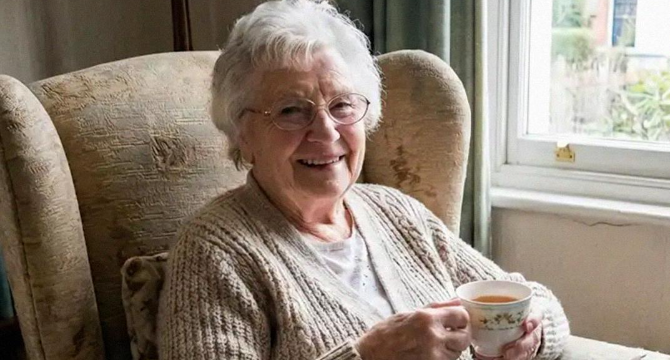
My grandma lived in the same small brick house for 42 years. The porch steps had started to dipped where she sat with iced tea, watching the block every day.
Two weeks after her funeral, I moved in. I told everyone it was purely practical, but really I couldn’t bear strangers buying her place and changing everything about the house that reminded me of my Gran.
“We like to things kept tidy around here.”
The neighborhood looked trimmed and polite, like a brochure. Still, curtains shifted when I carried things inside, and the air felt watched. Her wind chimes hung under the porch roof, perfectly still.
Mrs. Keller lived across the street in a beige house with flawless flower beds. Grandma used to call her “the mayor” when she thought nobody could hear. That morning Keller stood in her doorway with a stern look on her face.
“You must be the grandson,” she called, voice tight. “We like things kept tidy around here.”
I could already see conflict brewing. “I’m just moving in. I’m not here to start problems.”
“After I’m gone, deliver these.”
Her eyes swept my yard, over the bins and the hedges. “Your grandmother had… habits,” she said, and with that she marched off.
That night I ate a half-hearted lasagna for dinner, and every car headlight that slid across the walls made me jump. It was difficult to get used to the house without Grandma being there.
The next morning I searched Grandma’s dresser for towels and found five sealed envelopes instead. Each one had a neighbor’s name in her neat handwriting. On top sat a small note:
“After I’m gone, deliver these.”
I stared at the names in disbelief.
I promised myself I wouldn’t open them.
Mrs. Keller, Don down the street, Lydia around the corner, Jared, and Marnie. Grandma had complained about them, but I didn’t think she’d have words for them after her death.
“What did you do?” I whispered to the empty room.
I promised myself I wouldn’t open them. It felt like reading her diary, and she deserved privacy even in death. Still, she’d asked, and I couldn’t get myself to ignore her request.
Around midmorning, I walked across the street with Keller’s envelope. The sun was shining brightly, which made the foreboding in my chest even worse. Keller opened the door before I knocked.
Less than an hour later, sirens cut through the street.
“This is from my grandmother,” I said, holding it out. “She asked me to deliver it.” Keller’s gaze dropped to the handwriting, and something sharp crossed her face. “That’s… unexpected,” she said, and took it with two fingers.
The door shut without another word. I stood there, embarrassed by how much my hands shook. Back home, I decided I’d deliver the other four after lunch and be done.
Less than an hour later, sirens cut through the street. Two squad cars pulled up in front of Keller’s house. My stomach dropped as soon as I heard them soaring down the street.
“Did you deliver a letter to the woman across the street?”
I walked onto the sidewalk and approached an officer. “What happened?” I asked. He looked me over and said, “You live here?”
“My grandma did. She passed and left me her home.”
He looked incredibly stern after that. “Did you deliver a letter to the woman across the street?”
My mouth went dry. “Yes. It was sealed.”
“Well, she called 911. She says it had documents and a flash drive. She reported it as threatening.”
“A flash drive? I didn’t put anything in it, officer. It’s just one of the letters I was asked to deliver.”
Dates ran down the page
I could tell he was debating whether I was telling the truth. “Don’t deliver any more letters until a detective speaks with you,” he said. “Do you understand?”
I nodded too fast and went inside. The dresser drawer looked innocent, but my skin prickled near it. After a long breath, I opened Don’s envelope.
Inside was a clipped stack of papers and a USB drive in a plastic bag. The top page read, in Grandma’s handwriting, “Timeline of incidents.” Dates ran down the page, meticulously taken down.
The next envelope held what looked like a forged petition.
I flipped through and felt sick. Copies of complaint reports. Screenshots of neighborhood messages. Photos of our yard from angles that meant someone had been inside the fence.
I opened Lydia’s envelope next. “Missing items,” the first sheet said, followed by a list: jewelry box, silver spoon, medication organizer. Next to several entries Grandma had written, “Last seen after Lydia arranged contractor visit.”
I sat on the carpet. “Why didn’t you tell me?” I wondered out loud. The next envelope held what looked like a forged petition, Grandma’s signature copied and circled in red ink.
Detective Rios arrived and sat at Grandma’s kitchen table.
Jared’s envelope had a hand-drawn map of the side path between our fences. Arrows showed where someone could step without triggering the old porch light. In the margin she wrote, “They think I’m stupid. I’m not.”
Marnie’s envelope began with one sentence: “If anything happens to me, this is why.” My hands shook hard enough to rattle the paper. I called the number the officer gave me and said, “There are more letters, and they’re evidence.”
Detective Rios arrived and sat at Grandma’s kitchen table, eyes sharp and tired. “Start from the beginning,” she said. When I told her about delivering Keller’s envelope, she didn’t scold me, but her jaw set.
That night I heard a scrape near the side gate.
“Your grandmother documented a pattern,” Rios said, tapping the timeline. “Some dates match prior calls. Some were dismissed as neighbor disputes.”
“So she tried to report it, and nobody listened?”
Rios met my eyes. “Without proof, people minimize. We need proof to do anything.” She pointed at the remaining envelopes. “You don’t deliver anything else. You don’t confront anyone alone.”
That night I heard a scrape near the side gate. When I checked, it was open and swaying gently. The next morning my trash bin sat crooked, lid half raised, with a bag I didn’t recognize resting on top.
“Your grandmother was upset near the end.”
I called Rios. “I think they know,” I said.
“Stay inside. Don’t touch anything. I’m sending someone.”
That afternoon, Mrs. Keller appeared on my porch with Don and Lydia by her side. Don’s eyes slid past me into the house.
Lydia smiled. “We wanted to offer condolences.”
“We heard about letters,” Don said. “Your grandmother was upset near the end.”
Keller leaned in. “We don’t want misunderstandings spreading. Show us what she wrote, and we can move on.”
I kept my hand on the screen door. “No.”
Keller’s smile thinned. “That’s not very neighborly.”
“Neither was calling the city on her trash bin, or reporting her for ‘suspicious activity’ when she fixed her roof.”
“We were protecting the neighborhood.” Lydia had obviously prepared for these accusations.
“You could have dealt with things in much better ways.” I shut the door before they could retort.
Rios stepped out from behind the living room wall and said, “Good. They’re nervous. Do you have any cameras to watch the places where there had been activity?”
I spotted a tiny lens staring back at me from a knothole.
“No. I’ve never needed anything like that before.”
“Check the yard. Your grandmother might have.”
So I walked outside and stared at the birdhouse near the feeder.
After some investigation, I spotted a tiny lens staring back at me from a knothole. When Rios arrived, she nodded once. “That helps.”
I rubbed my arms. “I don’t want them inside,” I said. “I don’t want to be scared in the house she left me.”
Rios held my gaze. “Then we end it clean. If they come back, we’ll catch them.”
At 11:30, the backyard motion light clicked on.
Two nights later, I kept the living room lights off while I sat on the couch. Rios and an officer waited upstairs, listening through an earpiece.
At 11:30, the backyard motion light clicked on. Shadows moved along the side path, slow and practiced. The back door handle jiggled, and I heard more movement suggesting someone was up to no good.
Rios’s voice murmured in my ear. “Don’t move.”
On the camera feed, Mrs. Keller appeared in the harsh light, jaw clenched, and with a bag in her hand. Don Harris hovered behind her, eyes darting around nervously.
Sirens erupted so close they rattled the windows.
Lydia stood off to the side, hands twisting, whispering, “Hurry.”
Keller tried the handle again and hissed, “I know this gate doesn’t lock.”
Don tried the gate, bumping it with his shoulder in an attempt to force it open. “She can’t ruin us from the grave,” he snapped.
Then Lydia’s voice shook. “Just jump over and check the back door. We have to get the papers. If they exist, they need to disappear.”
That seemed to be all the evidence we needed. Rios piped up in my earpiece:
“Now.”
Sirens erupted so close they rattled the windows. Flashlights flooded the yard, and officers poured through the gate, shouting commands.
Lydia started crying, mascara streaking.
“Stop right there!!” an officer yelled.
Keller spun around, face pale, and snapped, “This is ridiculous! We were checking on him!”
Don pointed at her instantly. “It was her idea,” he blurted. “She said the letters were dangerous!”
Lydia started crying, mascara streaking. “I’m not even really in on this,” she said. “He was the one who always moved the gate to scare the old lady.”
From the fence line where he’d silently been hiding, Jared stepped into the light. “I told you not to do this. It was way too risky,” he said.
When the cars finally rolled away, the street went dark again.
Rios came down the stairs and stood beside me. “You’re on camera,” she called through the door. Keller’s eyes cut toward my window, hate flashing hard.
“She was a liar,” she spat. “That old woman made things up.”
My voice rose before I could stop it. “She was alone,” I shouted, “and you took advantage of that!”
Keller flinched, then lifted her chin. “We kept this neighborhood safe,” she said.
Rios stepped closer. “You kept it needlessly quiet,” she replied. “There’s a difference.”
Keller tried to pull away as they cuffed her, and Don kept talking like speed could save him. Lydia sobbed, repeating, “I didn’t mean it,” over and over.
“They thought she was easy to bully.”
When the cars finally rolled away, the street went dark again. I stood on the porch with Rios, watching taillights fade. “Was it really coordinated?” I asked, voice thin.
Rios nodded once. “They isolated her and made her look unstable,” she said. “They wanted any complaint from her to sound like a rant.” I swallowed. “Why her?” I asked.
“Because she noticed things,” Rios said. “And because they thought she was easy to bully.” I looked back at Grandma’s dark windows, feeling guilty that I’d never been aware of how difficult things were for her.
“We copied everything.”
A week later the block stayed quiet in a new way. No porch committees, no fake smiles, no sudden “concerned citizen” glares. A realtor sign appeared in Don’s yard like surrender.
Rios returned with a folder and the original envelopes. “We copied everything,” she said. “Keep these safe, and don’t engage with anyone who contacts you.” I nodded.
“Thank you,” was all I managed.
I pressed the paper to my forehead.
After she left, I found a sixth note tucked behind the stack. It wasn’t for a neighbor; it was for me. It began, “Sweetheart,” and my eyes stung instantly.
She wrote, “I was scared sometimes, but I was prouder than I was scared. I did not want my life edited into a story where I was the problem.” I pressed the paper to my forehead. Outside, I nudged her wind chimes, and they rang out, clear and stubborn. Just like my Gran.