Kindness is often mistaken for softness—until it changes the entire outcome. These 12 moments show how choosing empathy and compassion over ego disarmed conflict, shifted power, and proved that real strength doesn’t always look loud or aggressive.
1.
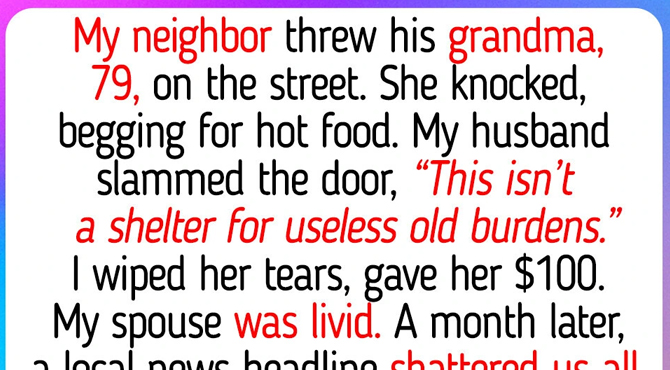
My neighbor threw his 79-year-old grandmother out of the house. That evening she knocked on our door, asking for something warm to eat. My husband didn’t hesitate: he opened the door just wide enough to say, “This isn’t a shelter for useless old burdens,” and slammed it in her face. She stood there crying, small and humiliated. I ran after her, wiped her tears, hugged her, and slipped her $100. She whispered something I couldn’t catch and walked away. My husband was furious. We fought. I told him, “Imagine if that was your mother. Would you want someone to shut the door on her?” He just shrugged. Cold. Detached. A month later, a local headline exploded through the neighborhood. The “useless old burden” had a name — Rosa. She had spent her entire life as a nurse at our hospital, staying late with patients no one visited: women after stillbirths, mothers abandoned with disabled newborns, people who had lost everything. To many of them, she became family.
Years ago, one of those women was the wife of a powerful businessman. After a stillbirth, he left her. Rosa held her together, day after day, until she found the strength to rebuild her life. That woman later built a thriving business and raised three children. And by pure coincidence, she was in a restaurant next to the bakery where Rosa used my $100 to buy food. She recognized her immediately. She took Rosa home. Made sure she would never be alone again. Then she told her story to the press — including how her own grandson had thrown her onto the street. The grandson became an outcast overnight. When my husband read the article, he went pale. Not because he felt guilty — but because he was terrified someone would remember what he said at our door. That’s when I truly saw him. Not as strong. Not as principled. Just scared of consequences. Rosa changed my life without ever knowing it.
2.
After a serious illness, I returned to work slower and visibly changed. People grew impatient. Tasks were reassigned without explanation. One colleague began quietly helping me keep up. He stayed late and took on extra responsibilities. It affected his performance reviews. He was criticized for burnout. He never explained why he was struggling. He just didn’t want me singled out. When I was finally stable again, he stopped helping without comment. Only later did I understand what he’d done. That support protected my dignity. It cost him professionally. He never asked for acknowledgment. I think about that often.
3.
My reputation was quietly destroyed after a personal conflict spilled into my professional life. People assumed the worst without asking. I was excluded and sidelined. One supervisor noticed and didn’t buy the story. She advocated for me privately. She pushed back in rooms I wasn’t in. It cost her a lot. She lost influence she’d spent years building. She was warned to stop. She didn’t. Eventually, she was moved to a less visible role. She never told me what she’d risked. She just told me to keep going. That support gave me space to recover. She paid for it with her standing. I still carry gratitude for that.
4.
A single mom in my neighborhood was barely managing after a sudden divorce. She looked exhausted all the time. One neighbor stepped in quietly and helped with school pickups and meals. She also helped her find better legal support. “You shouldn’t have to figure this out alone,” she said. That support changed everything. Stress reduced visibly. The kids became calmer. Stability returned gradually. No one posted about it. No praise followed. It was just consistent help. That’s the kind that lasts.
5.
I lost my job and didn’t tell anyone because I was embarrassed. Bills stacked fast. A former manager reached out unexpectedly and asked how I was doing. I finally told the truth. She offered freelance work immediately and paid upfront. “You’re not starting over from zero,” she said. That reassurance mattered. I stabilized before things spiraled. Confidence returned alongside income. Support didn’t feel pitying. It felt respectful. That distinction made it easier to accept. Timing saved me. I’m still thankful.
6.
When my husband cheated, it wasn’t just the affair that broke me, it was how quickly his family closed ranks around him and treated me like an outsider who had overstayed her welcome. I was excluded from holidays immediately, removed from group chats, and told gently that it would be “less awkward” if I stayed away. I had spent a decade building relationships with them, and suddenly I was nothing. The only person who didn’t fully participate in the erasure was my father-in-law. He never defended me out loud, and he never challenged his son publicly. Instead, he quietly transferred money to help cover my legal fees when the divorce became hostile. I later found out he’d pulled that money from savings he’d set aside for his own surgery.
He postponed the procedure for over a year. His health worsened during that time. His son found out and stopped speaking to him for months. He never told me about any of this. I discovered it accidentally through paperwork. When I confronted him, he shrugged and said he just didn’t think I should be crushed twice. His relationship with his son never fully recovered. He paid that price without hesitation. I don’t think he sees himself as generous, but I know what it cost him.
7.
When my older brother died unexpectedly, I became the legal guardian of his two kids even though I was barely stable myself. I had a small apartment, a demanding job, and absolutely no idea how to raise children overnight. The first few months felt like I was constantly making the wrong choice and hoping no one would notice. One afternoon their school principal asked to speak with me, and I walked into that office expecting criticism. Instead, she asked what I needed to keep the kids grounded. I didn’t even know how to answer at first. She helped arrange counseling at school, waived certain activity fees, and assigned a staff member to check in weekly. When I apologized for not being prepared, she said, “You showed up, and that’s what matters.”
That sentence stayed with me longer than any advice. The kids slowly began adjusting. I stopped feeling like an imposter pretending to be an adult. We found a rhythm that didn’t feel forced. It wasn’t perfect, but it was steady. That steady support gave us space to breathe. Without it, I think the pressure would have cracked me. Sometimes you don’t need saving, you just need backup.
8.
After my dad remarried, my stepmother made it clear I was an obligation, not family. She excluded me from vacations, decisions, even small celebrations. When my dad died, the distance became final. I was told gently that I wasn’t needed anymore. Years later, my stepmother’s health declined, and her biological children were largely absent. I could have stayed away and no one would have blamed me. Instead, I started visiting regularly. I managed her appointments and medications. I paid for home care when her insurance fell short. It drained my savings steadily. Her children accused me of trying to manipulate the inheritance. I never corrected them. She never apologized for how she treated me growing up. She rarely even thanked me. But she wasn’t alone in her final years. That felt more important than settling scores. The cost was financial and emotional, and I accepted it quietly.
9.
A guy in my office went through a brutal breakup that left him suddenly responsible for his elderly aunt, who had been depending on his ex for daily care. He never asked for help, but it was obvious he was overwhelmed trying to manage medical appointments and full-time work. One of our team leads noticed he was staying late every night just to keep up. Instead of reprimanding him for slipping performance, she called him in and asked what was really happening. After he explained, she rearranged project assignments and personally covered a major client presentation he was supposed to lead. She also connected him with a caregiving consultant she knew through a friend. “You can’t split yourself in half,” she told him, not unkindly.
Over the next month, he looked less exhausted and more focused. The aunt’s care became organized instead of chaotic. Work stabilized naturally once his home life stopped feeling like a constant emergency. No one in the office was told the details. There was no big speech about compassion. It was handled quietly and professionally. Watching that made me rethink what good management actually looks like. It’s not about squeezing output; it’s about preventing collapse.
10.
I was a first-generation college student trying to navigate systems my family had never even heard of. When my financial aid got delayed because of a documentation issue, I was too embarrassed to tell anyone I couldn’t afford books or rent that month. I started skipping meals and telling myself it was temporary. One professor noticed I stopped participating and asked me to stay after class. I tried to brush it off, but she kept gently asking until I admitted what was happening. She walked me to the financial aid office herself and didn’t leave until someone agreed to review my case that day.
She also quietly loaned me a copy of the textbook and told me to return it whenever I could. “You belong here,” she said when I apologized for being difficult. I didn’t realize how much I needed to hear that. The aid issue was fixed within a week. I caught up on assignments and stopped spiraling. The crisis passed, but the impact stayed. I graduated two years later. Sometimes the difference between dropping out and staying is one adult refusing to let you disappear.
11.
There was a teenage girl in my neighborhood whose parents were going through a very public and messy divorce, and she ended up taking care of her younger siblings most evenings. You could see how tired she was, even though she tried to act normal. One of the neighbors, a woman in her forties with grown kids, started inviting all three children over for dinner a few nights a week. It wasn’t a big community event, just a regular meal at her kitchen table. She also helped the older girl with homework and college applications while the younger ones played. When the girl said she felt guilty accepting help, the neighbor replied, “You’re still a kid too.”
That reminder seemed to land hard. Over time, the girl started talking about her own plans again instead of only her siblings’. The siblings seemed calmer, less chaotic. The neighbor never criticized the parents or inserted herself into legal matters. She just created a stable pocket of normalcy. That stability gave the girl room to think about her own future. Years later, she got into a university she’d almost stopped considering. All because someone decided dinner could be more than food.
12.
A frail old woman once begged on the street, holding a newborn. I gave her $100. A man nearby scoffed, “Don’t bother, she’s a scam.” I walked away feeling foolish, but still hoping the money would help, not harm. A month later, long after I’d forgotten about her, a huge black box arrived at my door. I wasn’t expecting anything. When I opened it, my hands started shaking.
Inside were stunning, hand-embroidered linens: tablecloths, towels, pillowcases, all brand new, all made with incredible care, the kind of work people treasure for a lifetime. On top lay a short note:
“You saved me and my grandson with your $100 and your generous heart. You didn’t let us disappear into human indifference. This is the only way I can thank you. I hope this brings beauty and warmth to your home.” I never found her again. She was gone from that street. But I know she’s safe — and that her life changed, at least a little. And I learned something simple: kindness and compassion don’t vanish. Empathy always finds its way back, multiplied.