I live in a pretty quiet and safe neighborhood. That’s exactly why I chose it — I always felt calm and secure there.
Nothing dramatic ever happened on my block.
People nodded, kept to themselves, and went home before dark. I liked that.
My name is Dexter. I live alone in a modest apartment above a dry cleaner, and most of my days look the same. I work, I come home, I make something simple for dinner, and I try not to make trouble for anybody.
I do not have much, but I get by. I have always believed that peace matters more than appearances.
That evening was bitterly cold.
I remember pulling my coat tighter as I walked up to my building, grocery bag in one hand, keys in the other. Then I saw a man lying near the entrance.
At first I thought he might be dead.
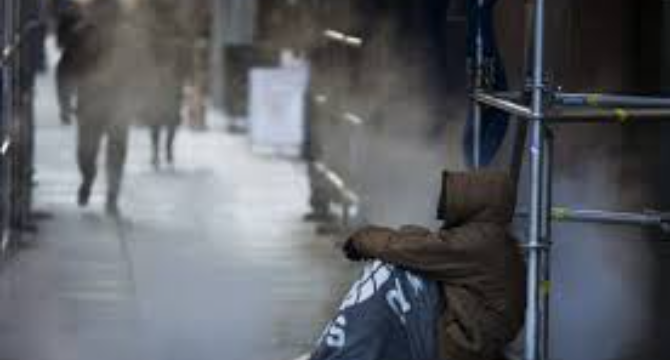
He was stretched out on the concrete, one arm twisted under him, his coat open to the freezing air.
He was drunk, that much was obvious, and he looked homeless… though more than homeless, he looked completely broken and hopeless. His face was red from the cold, and his breathing was rough.
I stood there longer than I should have, just staring.
In a neighborhood like mine, a sight like that feels almost unreal. My first thought was to call someone. My second was that he did not need a lecture or a siren. He needed warmth.
He was sleeping directly on the cold concrete.
I crouched beside him.
“Hey,” I said. “Can you hear me?”
He groaned, barely opened his eyes, then let them fall shut again.
He was too far gone to stand, maybe even to understand me.
I went upstairs, unlocked my apartment, and looked around at what I had. The only things I had were my single blanket, a pillow, and a little food with some water.
That was the truth of it. I was not one of those people with extra supplies tucked away for emergencies. I had one blanket on my bed, one decent pillow, two sandwiches left from the day before, and a bottle of water in the fridge.
Then I picked everything up and carried it back downstairs.
I draped the blanket over him first. He moved immediately, grabbing it with both hands, pulling it close like instinct had taken over. I slipped the pillow under his head and set the food and water beside him.
“There,” I murmured. “It’s not much, but it’ll help.”
For some reason I could not explain, I took out my wallet and left my business card next to him too, thinking maybe I could help him again someday, even in some small way. Maybe he would wake up embarrassed and need a number to call. Maybe he would throw it away. I did not expect anything from it.
To me, it was just a simple act of humanity.
That night I slept under a thin throw, because the blanket I gave him was the only one I had. I barely slept. Every time I woke up shivering, I pictured him outside on that concrete and told myself it was worth it.
By morning, I assumed he would be gone, and that would be the end of it.
I was wrong.
The next morning, my phone rang while I was still half asleep.
I fumbled for it, eyes barely open, and answered with a voice that sounded as tired as I felt. “Hello?”
A calm, polished voice said, “Good morning. Am I speaking with Dexter?”
“Yes,” I said. “Who is this?”
“My name is Alan. I am calling on behalf of Mr. Jack. I’m his personal assistant. The driver has already arrived to pick you up.”
“What?”
“The driver is outside, sir.”
For a second, I honestly thought it had to be some kind of prank. Then he added, “Mr. Mercer received your business card last night.”
That woke me up all the way. I immediately understood that this somehow had to do with the man from last night.
Ten minutes later, I stepped outside, still not convinced this was real. But there it was — a huge luxury car parked near my building, gleaming black in the morning light.
Two men were standing next to it, clearly waiting for me.
They were dressed in dark coats and looked like they belonged to a world I had only ever seen from a distance.
I slowed to a stop on the sidewalk.
One of the men opened the rear door.
And then the car door opened wider, and the same miserable man from the night before stepped out.
Except now… he looked completely different.
He was wearing a tailored coat and polished shoes and was clean shaven. He stood straight, composed, and unmistakably wealthy.
If I had passed him on the street, I would never have connected him to the man I had covered with my blanket.
I stared at him. “You’ve got to be kidding me.”
He gave me a tired smile. “I know.”
“You were sleeping on the concrete.”
“Yes.”
“You looked homeless.”
“I probably looked worse than that.”
I folded my arms. “So what is this? Some strange test?”
“No. I wanted to thank you. Would you have breakfast with me?”
Against my better judgment, I said yes.
He took me to a place where the coffee cups were too delicate, and the servers spoke in near whispers. I felt out of place immediately.
But Jack fit there without trying.
We sat down, ordered, and after a few minutes, Jack got a phone call and excused himself.
As soon as he stepped away, Alan, the assistant, leaned toward me.
“I think you deserve context,” he said quietly.
“I’d appreciate that.”
Alan glanced toward the window, then back at me. “Jack is a very successful businessman. But years ago, he lost his entire family in a tragic accident. His wife and children. All at once.”
I did not say anything. I just listened.
“After that,” Alan went on, “he changed. He drinks too much. He disappears sometimes. He avoids people unless he has to see them. And he trusts almost no one. Most kindness directed at him comes with motives attached. Business, money, influence.”
I thought about the man outside my building, too drunk to defend himself from the cold.
Alan lowered his voice. “Last night was one of his lowest points. He remembers what you did. The blanket, the pillow, the food, the water… and your card. You had very little, and you still gave. That mattered to him more than you know.”
I looked down at the table, suddenly embarrassed by how small my act had felt at the time.
When Jack returned, he sat quietly for a moment, then said, “Most people would have stepped over me.”
I met his eyes. “Maybe. But I couldn’t.”
He nodded once, as if that answer landed somewhere deep.
And for the first time that morning, he looked less like a wealthy stranger and more like a man hanging on by a thread.
Breakfast lasted nearly two hours. That surprised me most of all.
I had expected a formal thank-you, a handshake, maybe an envelope shoved across the table. Instead, we talked about grief, routine, loneliness, and the strange ways people survive when they do not want to be pitied.
There was no awkward performance in it.
At one point, Jack stirred his coffee and said, “Do you know what money can’t buy?”
I gave him a look. “I’m guessing you already know the answer.”
He let out a dry laugh. “It can buy access. Comfort. Silence. But not sincerity.”
That stayed with me.
He told me more about his family then. Not every detail, but enough for me to understand the damage.
He had loved them deeply.
Then, in one terrible accident, they were gone. He buried himself in work for a while, then in alcohol. The work made him richer. The alcohol made him emptier.
“I stopped believing people do kind things for free,” he said. “Then I woke up with your blanket on me.”
I looked down, not knowing what to say.
By the time breakfast ended, I felt something I had not expected to feel toward him: protectiveness. Not because he was helpless — he clearly was not — but because beneath all the money and polish, he seemed terribly alone.
When we walked outside, he handed me a paper-wrapped package.
“What’s this?” I asked.
“A thank-you,” he said.
I opened it back in the car.
Inside was a new blanket and a pillow, both far nicer than the ones I had given away.
I laughed despite myself. “You replaced them.”
He looked out the window. “You gave me your only ones.”
That should have been the end of it. A strange story, a nice gesture, and then life moving on.
But it was not.
Instead of trying to pull me into his world of wealth and luxury, Jack did something I never saw coming. He started showing up at my apartment. Sometimes with Alan dropping him off, sometimes alone.
He would sit at my tiny kitchen table, drink terrible coffee, and talk like the walls made him feel safe. Other nights we went to small local bars, and he surprisingly liked those places.
I guess it was because nobody there cared who he was. Nobody asked him for anything.
One night, over cheap beer and a bowl of stale peanuts, he said, “I forgot what normal feels like.”
I shrugged. “Normal’s overrated.”
He smiled. “Not this kind.”
Slowly, I saw changes in him. He drank less and listened more. He laughed once in a while, and when he did, it sounded rusty, like a part of him waking up after a long sleep.
He never turned into a different man overnight. Healing does not work that way. But he started to look forward instead of only backward.
And I learned something too.
Sometimes the smallest act of compassion can change a life… in ways you never see coming.
I thought I was just helping a man survive a freezing night. I gave him my only blanket, a pillow, some food, water, and a business card. I expected nothing. I did not even expect to see him again.
Instead, I found a friendship that had nothing to do with money, status, or obligation.
Jack once told me, “You treated me like I still mattered before I believed it myself.”
I have carried that sentence ever since.
Because maybe that is what kindness really is. It isn’t about saving someone or fixing them. It’s more about just reminding them that they are still worth seeing.
And honestly, how many lives would change if we did that more often?