I have a routine, and I stick to it.
At 6:15 a.m., my alarm goes off, and the first thing I have is coffee. Then, there are 30 minutes of silence before the day gets loud. I’ve lived alone for so long that silence doesn’t bother me anymore — it’s just the background noise of my life.
I’m 47 years old, and I’ve built everything I have with my own two hands, on my own time, without asking anyone for help.
That part I’m proud of. Mostly.
I don’t have siblings. I don’t have parents — my mother, Margaret, passed eight years ago, and my father, Robert, followed two years after that. We were never especially close, the three of us. My childhood was quiet in the way some childhoods are: everything looks fine from the outside, but there’s a hollowness underneath you learn not to talk about.
I grew up feeling like something was slightly off, like a painting hung just a fraction crooked that nobody else seemed to notice.
I never figured out what that feeling was.
Eventually, I stopped trying.
I made peace with my life. Good job, small apartment, a cat named Henry who has no interest in my emotional state, and that suits us both just fine. I had friends — the kind you grab dinner with twice a year and mean to call more often. I was okay. I told myself that regularly, and most of the time I believed it.
Then the symptoms started.
It was small at first. I blamed fatigue on long hours. A dull ache in my side that I told myself was stress. As I mentioned, I am very good at handling things on my own, which also means I am very good at talking myself out of taking things seriously.
I put off the doctor for three months. Then four. Then the pain stopped being dull and started being something I couldn’t ignore at two in the morning, curled up on the bathroom floor with Henry watching me from the doorway with those flat, unreadable eyes.
I finally went in.
The word they used was urgent. As in, we need to schedule this as soon as possible. As in, you should not have waited this long. My doctor was kind about it, but she didn’t soften the edges much.
There was a mass, and it needed to come out. The surgery was serious — the kind that requires a specialist, a full team, and several hours in an operating room.
“Is there someone who can be with you?” she asked, pen hovering over the intake form.
“I’ll be fine,” I said.
She looked at me for a moment, then wrote something down without pressing further.
I checked into the hospital on a Tuesday morning in February. The waiting room was cold and too bright, the way hospitals always are, and I sat in a plastic chair with my overnight bag between my feet and my insurance card in my hand. Around me, people had their people — spouses reading magazines, adult children on their phones, friends squeezing hands.
I had Henry at home and a neighbor who agreed to feed him.
When the intake nurse slid the paperwork across the desk and asked for my emergency contact, I paused for just a second.
“Leave it blank,” I said.
She didn’t comment. She’d probably seen it before.
I signed my name at the bottom of the form, folded my hands in my lap, and waited.
They took me back at seven in the morning.
The pre-op room was all pale curtains and quiet beeping, and a nurse named Daniel walked me through everything with a steady, unhurried calm that I was more grateful for than I let on.
“You doing okay?” he asked, adjusting something on my IV line.
“Define okay,” I said.
He smiled. “Fair enough. Just breathe. You’re in good hands.”
I nodded, stared at the ceiling, and tried to do exactly that.
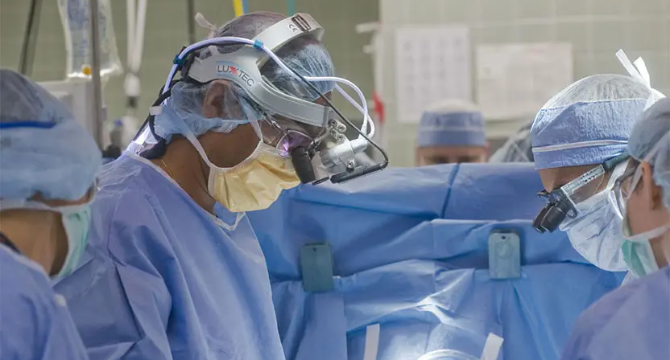
When they wheeled me into the operating room, the cold hit me first. Then the lights — enormous, white, aimed directly down.
The room was full of focused movement. People in masks and gloves, instruments arranged on trays, soft voices calling out numbers and confirmations. It felt like the inside of a machine, precise and indifferent, and I was the thing being fed into it.
I tried not to think about the empty line on the intake form.
The surgeon arrived and introduced herself — Dr. Katherine. She was composed in the way that very skilled people often are, calm without being cold, thorough without being mechanical. She talked me through the next few minutes in a low, even voice, and I focused on her words rather than the room around me.
Something about her nagged at me. I couldn’t place it.
“We’re going to take good care of you,” she said.
They tilted the table slightly, and the anesthesiologist leaned in, and I felt the medication beginning to pull at the edges of my thoughts. The voices in the room softened. The lights blurred at their edges.
And then Dr. Aldren leaned across me to check something on my left side, and her collar shifted.
I saw it.
A birthmark on the right side of her neck, just below the jaw. Small, irregular, slightly darker at one edge. I have had the exact same mark in the exact same place for 47 years. Not similar. Not close. Identical — same shape, same size, same placement, down to the slight asymmetry on the left edge.
Something clicked in my head, sharp and sudden, cutting straight through the fog of the medication.
I tried to focus. Tried to hold onto the thought, to follow it somewhere.
And then her hand moved — quickly, smoothly — and adjusted her collar back into place. Too quickly. Too precisely timed to be accidental.
She had felt me looking. She knew.
I tried to speak and couldn’t find the words. My thoughts were coming apart at the seams, softening at the edges, sliding away from me no matter how hard I reached for them.
The last thing I remember before the darkness came in completely was her eyes above her mask, looking down at me with an expression I couldn’t read.
Then nothing.
When I woke up, the lights were softer, and Daniel was there, smiling.
“Congratulations,” he said warmly. “The surgery was successful. Everything went beautifully.”
I blinked at the ceiling. My throat was dry, and my body felt distant and strange, but underneath all of it there was one thought, sitting solid and immovable right in the center of my chest.
“I want to see the doctor,” I said.
“She’ll be in to check on you a little later. Just rest for now —”
“I want to see the doctor,” I said again, louder this time. “Right now. Please.”
Daniel looked at me carefully. Then he nodded and slipped out of the room.
She came in about 20 minutes later.
Dr. Katherine closed the door behind her and pulled a chair to my bedside, which told me something immediately — surgeons doing routine post-op checks don’t sit down.
She folded her hands in her lap and looked at me, and this time there was no operating room composure to hide behind. She looked, for the first time, like a person rather than a professional.
“How are you feeling?” she asked.
“Like I need you to tell me something,” I said.
A long pause. She looked down at her hands, then back up at me.
“I think you already know what I’m going to say.”
“I want to hear you say it,” I told her.
She reached up slowly and moved her collar aside. The birthmark was right there, exactly as I’d seen it on the table. She held still and let me look at it, and neither of us spoke for a moment.
“My name is Katherine,” she said finally. “Kate. I’m 49 years old. I was born in Millhaven, in the summer of 1975.” She paused. “You were born there, too. Two years after me.”
I shook my head. “I don’t have a sister.”
“You do,” she said quietly. “You just didn’t know it.”
“That doesn’t make any sense,” I said. “My parents — I grew up with my parents. There was no one else. There was never anyone else.”
“I know.” She reached into the bag she’d brought and placed a folder on the bed beside me. “I know this is a lot. I’m not asking you to believe me right now. I’m just asking you to look.”
I didn’t want to look. I sat there with my arms crossed over the thin hospital blanket and told myself this was a mistake, a misunderstanding, some strange emotional confusion born from medication and fear. The birthmark was a coincidence. These things happened.
But my hands opened the folder anyway.
Inside were documents — a birth certificate, an original one, with my name and a set of parents that matched. Beside it was her own. Same parents. Same address. Two years apart.
There were photographs too, old ones printed on that thick matte paper from the early 80s. In one photo, a woman I recognized as a younger version of my mother, Margaret, was sitting in a garden chair. And beside her was a little girl, maybe four years old, with dark hair and serious eyes.
I looked at the little girl for a long time.
“That’s you,” I said.
“Yes.”
I looked back at the documents. I thought about that feeling I’d carried my whole life, that vague, sourceless sense of something missing. That painting hung just slightly crooked.
“What happened?” I asked.
Kate was quiet for a moment.
“Our parents were struggling,” she said. “Financially, emotionally — it was a difficult time. I was old enough to understand that something was wrong. You weren’t.” She paused. “There were decisions made that shouldn’t have been made. I’ve spent a long time being angry about that. But they’re gone now, and the anger doesn’t go anywhere useful anymore.”
“They never told me,” I said.
“No,” she said. “They didn’t.”
I stared at the photograph and felt something I hadn’t expected — not anger, not disbelief, but a sudden, flooding memory of warmth. Laughter somewhere close by. Small hands. A presence I had assumed was imagined, a comfort I’d written off as wishful thinking. I had spent my whole life believing I’d made it up.
“I remembered something,” I said slowly. “When I was little. I always thought it was a dream.”
Kate’s composure cracked.
“It wasn’t,” she said.
Then she told me the rest.
She had recognized my name on the surgical schedule three days before the operation. She had gone back and forth about what to do, had nearly transferred my case to another surgeon, but in the end, she couldn’t do it. She couldn’t hand me to someone else and walk away. Not again.
“I needed to know you were okay,” she said simply. “I needed to be the one in that room.”
I looked at her — this composed, careful woman who had spent decades looking for me and then spent three hours with her hands steady over my open chest — and I didn’t have a single word.
The weeks that followed were not easy.
The surgery bills arrived, and they were what they were: significant, cold, and indifferent to the timing. I sat at my kitchen table one evening, surrounded by envelopes, and felt the old familiar weight of handling everything alone.
Then my phone rang.
“I’m coming over,” Kate said when I picked up.
“You don’t have to —”
“I know I don’t have to,” she said. “That’s not the point.”
She came. She sat across from me at the kitchen table and went through every envelope, methodically and without fuss, the way she did everything. She didn’t make it a gift or a gesture. She made it practical, the way family does — quietly, without asking for gratitude in return.
Later, we sat on the couch with tea going cold on the coffee table. Henry climbed onto Kate’s lap and settled there as if he’d always known her, the traitor.
She looked down at him with something close to surprise, then laughed.
I reached over and took her hand.
We sat like that for a long time, not saying much, while the apartment held the kind of quiet I’d spent 47 years filling with routines and independence and the careful business of needing no one.
I thought about that operating table, about the cold lights and the fear I’d swallowed alone, about the thought that had crossed my mind in those final seconds before the anesthesia took me — if something goes wrong, no one will ever know how scared I was.
Someone knew. She had always known.
And sitting there, with my sister’s hand in mine and a borrowed cat between us, I let myself wonder — how many of us are living as though we’re alone in this world, when the person who’s been looking for us might already be closer than we ever imagined?