I work as a detective in a missing persons unit. Most days, my job is routine — names, faces, timelines, grief. You learn to separate yourself from it, to treat every case like a puzzle instead of a person.
Until one file made that impossible.
That morning started like any other. Coffee in hand, I flipped through case folders, scanning details, marking leads. By the time I reached my third file, I was already halfway on autopilot.
Then I opened it — and froze.
The woman in the photo looked exactly like me.
Not similar. Not close.
Identical.
Same bone structure. Same hair. Same build. Even the slight tilt of her head felt familiar.
Only her clothes were different — loud, mismatched, nothing I would ever wear.
For a second, I just stared.
Then I laughed.
“Nice try,” I muttered, grabbing the file and walking out into the bullpen. “Alright, who did it?”
My colleagues looked up.
“Did what?” one of them asked.
I dropped the file onto a desk. “You edited my face onto some random woman. I’ll admit — it’s convincing.”
No one laughed.
“Maddie,” my partner said slowly, “that’s a real case.”
The room felt suddenly smaller.
I opened the file again, this time more carefully. Everyone gathered around.
“Wow,” someone whispered. “She really does look like you.”
I swallowed. “I don’t have siblings.”
No one said anything.
But no one argued either.
I took the file back to my office and shut the door.
For the first time in years, I wasn’t looking at a case.
I was looking at myself.
Or someone who could be me.
The file said her name was Millie Carter. Mid-twenties. No stable address. History in the foster system. Cognitive challenges noted in prior records.
Reported missing after wandering away from a supervised housing program.
Witnesses claimed they’d seen her walking alone, sometimes confused, sometimes asking strangers for directions she couldn’t follow.
Every description sounded like a version of me… if my life had gone differently.
I tried to shake it off.
But I couldn’t.
Weeks passed, and the case consumed me.
I pulled every record I could find — hospital logs, adoption files, social services reports. I ran facial recognition comparisons. I checked birth records under sealed archives.
Something wasn’t adding up.
So I brought it home.
My dining table turned into a mess of photos, timelines, and notes. Red lines connected documents. Dates overlapped in ways that made my chest tighten.
There was only one explanation that made sense.
And I didn’t want it to be true.
My parents came over that Friday.
I wasn’t ready to confront them — not without something undeniable. So I covered most of the documents with a tablecloth, stacking the rest neatly.
Still, my dad noticed.
“You’ve never brought work home,” he said, glancing at the table.
“Just an interesting case,” I replied.
We sat down to eat, but something felt off. My dad kept looking toward the table. My mom barely touched her food.
When I stepped into the kitchen, I saw my dad lifting the edge of the tablecloth.
Reading.
When I came back, both of them looked like they’d seen a ghost.
“We should go,” my mom said quickly.
“What? Why?”
“Something came up.”
They didn’t wait for a response.
They just left.
The next morning, I knew something was wrong before I even opened my eyes.
The apartment felt… empty.
I walked into the living room.
The table was clear.
Every document was gone.
My stomach dropped.
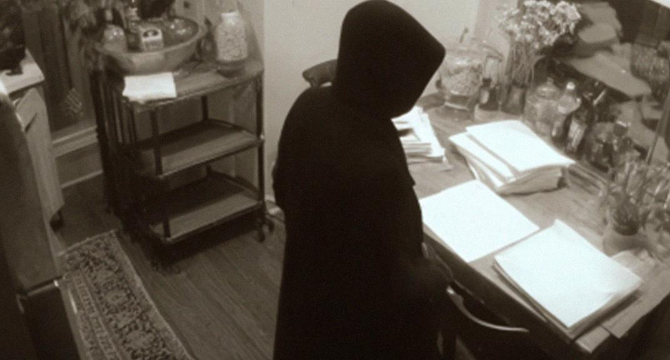
I pulled up my security footage.
At 2:13 a.m., the door opened.
My mother walked in.
She moved with purpose — no hesitation, no confusion. She went straight to the table, gathered everything, and left.
Like she already knew what she’d find.
I stared at the screen, my hands shaking.
This wasn’t fear.
This was confirmation.
I went straight to their apartment.
When my mom opened the door, she didn’t even try to act surprised.
“Why did you take my files?” I asked.
She closed her eyes.
“Maddie…”
“No. Not this time. I want the truth.”
My dad stepped behind her, tense.
“We were trying to protect you,” he said.
“From what?” I snapped. “From finding out I have a double walking around the city?”
Silence.
“Say it,” I demanded.
My mom turned and walked inside. I followed.
She opened a drawer and pulled out a photo.
Two babies.
Identical.
Twins.
“You have a sister,” she said.
The words hit harder than I expected.
“Where is she?”
My dad exhaled shakily. “She was sick. Very sick. We couldn’t afford the care she needed.”
“So you gave her up?”
“We placed her in a care facility,” my mom said quickly. “It was supposed to help her.”
“But you didn’t go back for her.”
Tears streamed down her face.
“She was transferred into the system. And… we didn’t fight hard enough to get her back.”
I felt something inside me crack.
“You didn’t fight at all.”
“We followed her,” my dad said. “From a distance. We made sure she was okay.”
“You watched her,” I said slowly, “but you never told her she had a family.”
Neither of them answered.
“And when I got close to finding her,” I added, my voice shaking, “you broke into my apartment and stole evidence.”
My dad looked down.
“You interfered with an active investigation,” I said. “Do you understand what that means?”
That landed.
For the first time, they looked afraid.
Not of losing me.
Of what they had done.
“I’m going to find her,” I said.
“And this time, you don’t get to decide what happens next.”
Back at work, the case didn’t stay private for long.
My partner pulled me aside. “Internal flagged your file.”
“Why?”
“Because someone accessed and removed evidence tied to your case.”
I held his gaze. “It was my parents.”
He blinked. “Maddie…”
“I know.”
Now it wasn’t just personal.
It was official.
And there was no turning back.
My parents returned everything to me — every photo, every note. I logged it, accounted for what was missing, and filed the report. It didn’t turn into a full investigation, but I still had to answer for it.
My supervisor reviewed everything himself. The files had been recovered, nothing was altered, and there was no sign I had been involved in taking them. He let it go — but not without a warning. Personal or not, I should have reported it the moment it happened.
After that, I pushed everything personal aside and went back to the work. The case still needed to be handled properly, and this time, I followed every step by the book.
It didn’t take long to find her.
She hadn’t been abducted.
She hadn’t disappeared.
She had been failed.
Records showed gaps — missed check-ins, inconsistent supervision, paperwork that had been filed but never followed up.
The system had let her slip through.
I found her eight blocks from her last known location.
At a women’s shelter.
She was sitting at a table, laughing softly with two other women.
For a moment, I couldn’t breathe.
Then she looked up.
And everything stopped.
“You…” she said, standing slowly. “You look exactly like me.”
I stepped closer.
“My name is Maddie.”
She stared at me, then reached out.
“I’m Millie.”
When our hands touched, something settled in my chest.
Like a missing piece clicking into place.
I brought her home.
We talked for hours.
About everything.
Her life in foster care. The confusion she sometimes felt. The way people treated her when she didn’t understand things fast enough.
Then she asked the question I wasn’t ready for.
“Why didn’t they keep me?”
I froze.
She looked down. “Was I… too much?”
“No,” I said immediately. “You were never too much.”
“Then why me?” she asked softly.
I didn’t have a good answer.
And that silence said more than anything else.
The next day, my parents came over.
They stood at the door like strangers.
My mom broke the moment she saw Millie.
“I’m so sorry,” she cried, reaching for her.
Millie stepped back.
Just slightly.
Not rejection.
But not full acceptance either.
“You knew where I was,” she said gently. “All this time.”
My mom nodded, sobbing.
“And you didn’t come get me.”
That was the moment everything became real.
Not just for them.
For all of us.
“We were wrong,” my dad said. “We were scared. And we made the worst decision of our lives.”
Millie looked at them quietly.
Then she said, “If you want to be in my life… you have to show up now.”
Not forgiveness.
Not yet.
A condition.
A boundary.
And for the first time, the power was hers.
Rebuilding didn’t happen overnight.
My parents had to prove themselves — appointments, financial support, showing up consistently. No more distance, no more hiding.
At work, the case closed with a formal note: system negligence contributing to disappearance risk.
It wasn’t just about finding Millie.
It was about acknowledging what had failed her.
We got her proper treatment.
Therapy. Support. Stability.
And slowly, she began to change.
Not into someone new.
Into who she had always been underneath everything.
Stronger. Clearer. More confident.
One evening, she looked at me and smiled.
“I think I want to help people like me,” she said.
“You should,” I told her.
And she did.
Years later, she stood in her own classroom as a Special Education teacher — patient, kind, steady in a way that inspired trust.
She wasn’t the girl who got lost anymore.
She was the one helping others find their way.
As for our parents…
They never stopped trying.
They didn’t erase what they had done.
But they faced it.
Every day.
And that was the only reason we could begin again.
One night, Millie sat beside me and said, “I always felt like something was missing. I just didn’t know it was you.”
I looked at her, my chest tightening.
“I think I knew,” I said quietly. “From the moment we met.”
She smiled, squeezing my hand.
“We found each other anyway.”
I nodded.
“Yeah,” I said. “And this time, we don’t let go.”