The kitchen was still dark when I poured my coffee. It was the kind of dark that pressed against the window and made the small lamp above the sink feel like the only warm thing in the world.
I had learned to move quietly in those pre-dawn hours, the way widows learn to move, careful not to wake the grief sleeping in the next room.
Six months without Daniel, and the house still felt like it was holding its breath.
I counted the coins on the counter into a small pile, then slid them into the empty coffee tin where I kept the grocery money.
I had 43 dollars until Friday.
The stack of unopened bills near the toaster had grown again.
I turned it so the return addresses faced the wall.
On the cutting board, I laid out the last of the bread.
Two slices for Noah’s sandwich.
A wrinkled apple from the bottom of the fruit bowl.
A small handful of crackers in a folded napkin because the snack-sized bags had run out two weeks ago.
It was not much, but it was something.
I tucked it all into his blue lunchbox and zipped it shut.
“Mom?”
Noah stood in the doorway in his pajamas, his hair sticking up on one side, his small frame swallowed by the hallway behind him.
“You’re up early, love,” I said. “Come sit. I’ll make your toast.”
He padded over and climbed onto the chair, watching me the way he had lately.
Quiet.
Careful.
Like he was studying something he could not quite name.
“Did you eat yet?” he asked.
I smiled at him without turning around.
“I will, baby. After you leave.”
“You said that yesterday.”
“And I did eat yesterday.”
He did not answer.
I felt his eyes on my back as I buttered the bread.
I set the toast in front of him and brushed his hair down with my fingers.
He leaned into my palm for a second, then picked up the slice and began nibbling at the crust like he was rationing it.
“Eat the whole thing, okay?” I said. “You’re growing.”
“You always say that.”
“Because it’s always true.”
He smiled then, just a small one, but it was enough to loosen something in my chest.
I kissed the top of his head and breathed him in.
He smelled like sleep and the cheap shampoo I had switched to last month.
“Go get dressed, mister. The bus comes in 20 minutes.”
He slid off the chair and disappeared down the hall.
I leaned against the counter and pressed both hands to my face, just for a moment, just long enough to remind myself that I could do this.
I could.
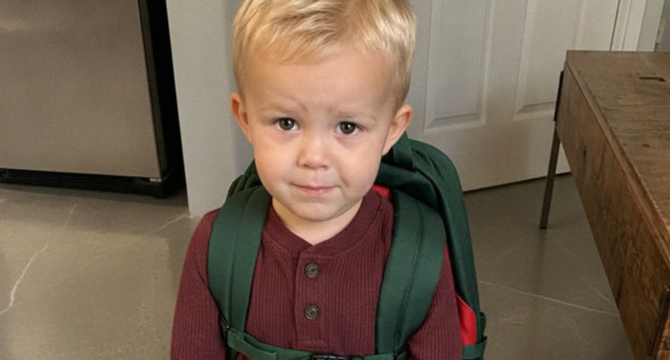
When he came back, he was dressed, and his backpack was already on his shoulders, the straps too long and the bottom bouncing near the backs of his knees.
He grabbed his lunchbox from the table and held it against his chest like it was something precious.
“Got everything?” I asked.
“Sandwich, apple, crackers,” he recited.
“Good boy. Now what do we say?”
“Eat everything, okay? You’re growing.”
He said it in a sing-song voice, trying to be funny, but his eyes were serious.
I laughed anyway.
We walked to the bus stop at the end of our street, his small hand swinging in mine.
The air was sharp, and I made a mental note to dig his winter coat out of the closet that night.
He had grown 2 inches since last winter.
“Mom,” he said as the bus rounded the corner, “you’ll have lunch today, right? A real one?”
I stopped walking.
“Sweetheart, why do you keep asking me that?”
He shrugged, suddenly very interested in his sneakers.
“I just want you to.”
“I promise,” I said, crouching down so I was eye-level with him.
“I promise, baby. You worry about being seven. I’ll worry about the rest. Deal?”
“Deal.”
He hugged me tightly, tighter than usual, and then he was running toward the bus, his backpack bouncing and his lunchbox swinging at his side.
I waved until the bus turned the corner.
Walking back to the house, I felt the weight in my shoulders lift just a little.
Forty-three dollars.
A son who still hugged me tight.
We were going to be okay.
I sat down on a public bench near the house, sitting with my grief and my worry.
I was lost in thought, when my phone began to ring in my pocket.
I checked the time: It was 7:30 in the morning.
I had been sitting with my thoughts for 20 minutes, and I didn’t even realize it.
I shifted Noah’s empty travel mug to my other hand and pressed the screen to my ear, expecting a reminder about an overdue bill or a robocall I would have to delete.
Instead, a woman’s voice came through, soft and careful.
“Via? This is Teacher Mariella, Noah’s teacher. Do you have a moment?”
I stopped walking.
Something in the way she said my name made the cold morning feel colder.
“Of course,” I said. “Is everything okay? Is Noah hurt?”
“No, no, he’s fine. He just arrived.”
There was a pause that stretched a beat too long.
“Via, can you come in today? I need to talk to you about Noah.”
I leaned against the side of the car.
My breath fogged the window.
“Is he in trouble?”
“Not exactly. It’s about his lunch.”
The word landed strangely.
I had packed his lunch that morning.
A butter sandwich, a wrinkled apple, and a folded napkin of crackers because the snack bags had run out.
He had watched me over the rim of his cereal bowl.
At the bus stop, he had tugged my sleeve and asked, “You’ll have lunch today, right? A real one?” I had promised him yes.
I had lied.
“His lunch?” I asked.
“Could you come by during my planning period? Around 11? I think it would be better if we spoke in person.”
“Teacher Mariella, please. You’re scaring me.”
She exhaled.
I heard the small sound of a classroom door clicking shut on her end.
“Via, do you know why Noah keeps bringing empty lunchboxes to school?”
For a second, the parking lot, the sky, and the cars all blurred into a single soft hum.
“That’s impossible,” I said.
“I pack his lunch every morning. I packed it today. I watched him put it in his backpack.”
“I know you did. I believe you. That’s why I needed to call.”
“How long?” I whispered.
“At least two and a half weeks. Maybe three.”
I closed my eyes.
Three weeks.
Almost a month of mornings when I had kissed the top of his head and told him to eat everything, almost a month of afternoons when I had asked him how his sandwich was, and almost a month of him nodding and saying it was good.
“I’ll be there in 20 minutes,” I said.
“Drive carefully.”
I do not remember the drive.
I remember gripping the wheel so tightly that my fingers ached, and I remember running through every possibility like a deck of cards being shuffled too fast.
A bully on the bus.
A bigger boy at the lunch table.
A group of mean kids who had figured out which child was easiest to pick on, the quiet one with the dead father, the tired mother, and the secondhand sneakers.
I parked crookedly and walked into the school office.
Teacher Mariella met me in the hallway near the kindergarten bulletin board, her cardigan pulled tight around her shoulders.
“Thank you for coming so quickly,” she said.
“Just tell me what you’ve seen.”
She guided me into an empty conference room and closed the door behind us.
“For almost three weeks now, Noah has come back from lunch with an empty box. Sometimes there are crumbs. Sometimes it’s spotless, like nothing was ever in it. I started watching more closely last week.”
“Has someone been taking it from him?” I asked. “On the bus? In the cafeteria line?”
“That was my first thought, too. I offered him a tray from the cafeteria three days in a row. I told him it was free, that I had a coupon, that it was leftover. He said no every time. Politely, but firmly.”
“He said no to food?”
“He said he wasn’t hungry.”
I sat down hard in one of the small plastic chairs.
The room smelled like crayons and old coffee.
“He has to be hungry,” I said quietly.
“He’s seven. He runs everywhere. He plays baseball after school. He eats two helpings of whatever I put on his plate at dinner.”
“I know,” his teacher said.
She sat down across from me and folded her hands.
“I did ask him directly yesterday what happened to his food. He just smiled and said he wasn’t hungry. That’s when I knew I needed to call you. Via, I have been a teacher for 22 years. I am not telling you this to alarm you. I am telling you because something is happening with that lunchbox, and I do not think Noah is the one eating from it.”
I stared at the floor. The tile had a small chip near my shoe.
“Is he giving it away?” I asked.
The words felt strange in my mouth, too gentle for the panic behind them.
“That is my guess. But he won’t tell me. He just smiles and changes the subject. He is a very polite little boy.”
“He gets that from his father.”
She nodded slowly.
She had taught Noah’s older cousins.
She had been at the funeral, in the back row, holding a casserole dish.
“Whatever is happening,” she said, “I wanted you to know first, before I made any official notes. I thought you would want the chance to talk to him yourself.”
I pressed my hand against my mouth.
“Thank you,” I managed. “Thank you for calling me, and not, I don’t know, social services, or something.”
“Via, you are a good mother. Anyone who has watched you walk that boy to the bus knows that.”
I did not trust myself to answer.
I just nodded and stood up.
“He has baseball practice after school today,” I said. “I’ll pick him up early. I’ll find out.”
“Will you call me tomorrow, either way?”
“I promise.”
I walked out of the building and into the cold sunlight of the parking lot.
I sat in the driver’s seat without turning the key.
My hands were shaking against the wheel.
“There has to be an explanation,” I whispered to the empty car. “There has to be.”
Then I pulled out of the lot and drove toward the baseball field, with no idea what truth I was about to uncover.
I pulled into the parking lot of the community baseball field and turned off the engine, but I did not get out right away.
From the driver’s seat, I watched Noah through the chain-link fence.
He stood near the dugout in his slightly oversized uniform, the sleeves bunched at his elbows.
His wrists looked thinner than I remembered.
One of the other mothers walked along the bench, handing out small bags of pretzels and juice boxes.
When she reached Noah, he took the bag with both hands and gave her a polite little nod.
Then, he sat down and picked at the pretzels, eating slowly, like he was rationing each one.
My throat tightened.
I waited until practice ended, then waved him over.
He jogged to the car with his glove tucked under his arm, his cheeks pink from running.
He looked like the same Noah I had kissed goodbye that morning, and like a boy who had been keeping a secret.
“Hi, Mom,” he said, sliding into the passenger seat.
“Hi, baby. How was practice?”
“Good. Coach said I am getting better at catching.”
“That is wonderful.”
I reached over and buckled his seatbelt myself, the way I used to when he was smaller.
He let me.
He did not roll his eyes or pull away.
That alone almost made me cry.
I waited until we were on the quiet road before I spoke again.
“Noah, I need to ask you something, and I need you to tell me the truth. Okay?”
He nodded slowly.
“Love, has somebody been taking your lunch from you?”
His face went pale. He shook his head quickly.
“No,” he whispered.
I tightened my hands around the steering wheel, trying to keep my voice gentle.
“Then what happened to it, sweetheart? Teacher Mariella said your lunchbox has been empty for almost three weeks.”
He stared down at his sneakers.
His little fingers twisted the strap of his backpack so hard that his knuckles turned white.
I pulled over to the side of the road, put the car in park, and turned to face him fully.
“Noah. Whatever it is, you are not in trouble. I just need to understand.”
His chin started to tremble.
“Am I going to get Eli in trouble?” he asked.
“Eli?”
“He is in my class.”
I softened my voice as much as I could.
“No, sweetheart. Nobody is going to be in trouble. I promise.”
He took a shaky breath.
Then, he looked at me with the same brown eyes Daniel had, and the words came out all at once.
“Eli does not have a lunch. His mom lost her job, and he comes to school with nothing. Last month, I found him crying in the bathroom because his stomach hurt from being hungry. He said, ‘Please do not tell anybody.'”
“Oh, Noah.”
“So I have been giving him my lunch. Every day. He eats it in the bathroom so the other kids do not see. He told the teacher he eats in the cafeteria, and he told the cafeteria he brings lunch from home. He said thank you, and that I am his best friend.”
I felt the air leave my chest.
Teacher Mariella had mentioned Eli to me, too, almost in passing, saying she had noticed he never brought a lunchbox and had assumed his family had signed up for the cafeteria program.
She was worried about him, she said, and meant to check.
Two boys had slipped through the same small crack, and a clever seven-year-old had widened it just enough to hide in.
“Baby,” I whispered. “Why didn’t you tell me? I could have packed extra. I would have packed extra.”
Later, after Noah told me everything, I called Teacher Mariella from the parking lot.
For a moment, she said nothing.
“He’s been giving away his own lunch every day?” she finally asked.
“Yes.”
I heard her exhale softly.
“Via, I have been teaching for 22 years, and I do not think I have ever seen a child carry that kind of responsibility for someone else.”
My eyes filled again.
“That says something remarkable about the boy you’re raising,” she said, before putting down the phone.
Noah looked away from me, out the passenger window, and his voice got very small.
“It’s because I heard you on the phone that one time, mom.”
My heart slowed.
“What phone call, sweetheart?”
“With the bank. A long time ago. You were in the kitchen, and you were crying, and you said you did not know how we were going to make it through the month.”
I closed my eyes.
“I knew if you packed extra, it would mean more groceries. So I just gave him mine instead. That way, nobody had to buy anything more. Not his mom, and not you.”
“Noah.”
“I am not hungry, Mom. Not really. The other moms give us snacks at practice sometimes. And there is water at school. I am okay.”
I could not speak for a long moment.
I just stared at my seven-year-old son, who had been carrying our budget around in his backpack alongside his spelling words.
“How long have you been doing this?” I finally asked.
“Since Eli started crying. A long time.”
“Almost three weeks?”
He nodded.
I pressed my hand over my mouth.
There it was.
The thing I had not been able to name all afternoon.
It was not a bully. It was not a thief on the bus.
It was the weight of a house with one parent missing and too many bills on the counter, and a little boy who had decided to lift one corner of it for me.
The antagonist had been in our kitchen the whole time.
It was the silence I kept around hard things.
The pride that told me a good mother does not let her child see her cry on the phone with the bank.
“Sweetheart,” I said, and my voice cracked. “Come here.”
He unbuckled his seatbelt and climbed across the console into my lap.
He was almost too big for that now, all knees and elbows, but he folded himself against me like he was four again.
I held him so tightly that I could feel his heart against my collarbone.
“I am so proud of you,” I whispered into his hair. “For loving your friend like that. Do you hear me? I am so, so proud of you.”
He nodded against my shoulder.
“But it is not your job to worry about money, Noah. That is my job. Yours is to be a kid. To eat your lunch. To grow.”
“But Eli.”
“We are going to take care of Eli. I promise you. You and me, we will figure it out together. Okay?”
He pulled back just enough to look at me. His cheeks were wet, and so were mine.
“Together?” he asked.
“Together,” I said.
And I knew, sitting on the shoulder of that quiet road, that whatever came next, I could not do it the same way I had been doing it.
Something in me had to change before Monday morning.
I drove home with Noah’s small hand resting on mine over the gearshift.
By Monday morning, I had a plan, and I was not letting pride stop me.
I sat across from Teacher Mariella in her quiet classroom, my hands folded tightly in my lap.
“I want to pack two lunches every morning,” I said. “One for Noah, one for Eli. Label Eli’s as a school snack so he is never embarrassed.”
Her eyes softened.
“Via, the school has a small fund for families like Eli’s. And there is a community program for widowed parents that I would love to connect you with.”
I felt my throat close.
For months, I had said no to every offered hand.
“Okay,” I whispered. “Yes. Please.”
A week later, Teacher Mariella called again.
The school had approved meal assistance for Eli’s family, and a local outreach program had connected his mother with employment resources.
Teacher Mariella also told me that several parents had quietly contributed to the school’s student support fund after learning that some children were struggling with food insecurity.
Nobody made a spectacle of it.
Nobody pointed fingers.
People simply stepped in where help was needed.
For the first time in a long while, I felt like we were part of something larger than our own worries.
That night, I sat Noah down at the kitchen table and held both of his small hands.
“Sweetheart, I owe you the truth. Worrying about money is my job, not yours.”
“But Mom, I just wanted to help.”
“I know, love. And you did. But your job is to be seven. To eat your lunch. To grow.”
His eyes filled, and he nodded.
“I promise I will tell you when things are hard,” I said. “But I will never, ever let you go hungry to protect me.”
Weeks later, I stopped by the school during lunch and peeked through the cafeteria window.
Noah and Eli sat side by side, swapping crackers and laughing at something only seven-year-old boys understand.
I had picked up three new bookkeeping clients through the community program.
The bills were still tight, but I was no longer carrying them alone, and neither was my son.
Standing there, I finally understood.
The proudest moment of my motherhood was not packing the perfect lunch.
It was raising a boy whose first instinct was kindness and learning, at last, to let kindness back in.