At 68, I had learned that grief did not leave when the casseroles stopped coming or when people lowered their voices around you.
It simply changed shape and moved into the corners of your life.
Mine sat in Leo’s room, in the tiny pill organizer on the kitchen counter, in the hospital bracelets tucked into my purse, and in the silence that followed every phone call from the cardiology unit.
I had been raising my grandson, Leo, ever since my daughter passed away. He was eight years old now, all big brown eyes and thin wrists and a smile that still managed to light up a room, even when his body was too tired to keep up with his spirit.
For the last six months, Leo had been fighting a rare congenital heart defect. That was the phrase the doctors used, careful and clinical, as if clean language could soften cruel truths. The only thing that could save him was a highly specialized surgery that cost over $250,000.
Insurance would not cover it.
Some numbers stop feeling real after a while. Two hundred and fifty thousand dollars was one of them. One hundred and fifty thousand, the amount I was still short, had become another. I had repeated both sums so many times that they no longer sounded like money. They sounded like a verdict.
I sold my car first. It was old and rattled when it turned, but it had been mine, paid off, and dependable. Then I remortgaged my small house, the one my late husband and I had nearly finished paying off before cancer took him too.
After that, I started cleaning office buildings at night.
I scrubbed glass conference doors while men in pressed shirts left half-empty coffee cups on polished desks. I emptied trash cans full of takeout cartons and printer paper while my knees ached and my back burned.
Some nights, I would get home just in time to shower before taking Leo to an appointment.
I never told him how bad things were. Children know more than we think, of course. They can hear fear in the pauses between words. Still, I tried.
One evening, as I tucked his blanket around him, Leo looked up at me with his mother’s eyes.
“Grandma, are we still going to do the surgery?”
My throat tightened. “We’re doing everything we can, sweetheart.”
He frowned in that serious way he had when he was trying to be brave. “I heard the nurse say it was expensive.”
I brushed his hair off his forehead. “That’s grown-up talk. Your job is to rest and let me worry.”
He gave me a weak little smile. “You always worry.”
“That’s because I’m very talented,” I told him, and to my relief, he laughed.
That laugh carried me through more than he would ever know.
Karen, my neighbor, had been checking in more often these past few months. She was in her early 50s, brisk and practical, the sort of woman who noticed if your curtains stayed closed too long.
She would stand at my back door, holding a container of soup or a bag of groceries, and pretend she was just passing by.
“You look exhausted, Eleanor,” she said one afternoon, setting a loaf of bread on my counter. “When did you last sleep?”
I forced a smile. “I close my eyes now and then.”
Karen crossed her arms. “That is not sleep.”
“I’ll sleep when Leo is better.”
Her expression softened. “You can’t carry all of this alone.”
I wanted to tell her that I had no choice. That carrying impossible things was the one skill life had made sure I mastered. Instead, I nodded and thanked her for the bread.
Yesterday, the hospital administrator called me with the worst news imaginable. Her voice was polished, sympathetic, and practiced in the way people become when they deliver devastating information for a living.
“Ms. Eleanor, if we don’t have the money by next Friday, we will have to remove Leo from the surgery schedule.”
I gripped the phone so tightly my hand cramped.
“No,” I whispered. “Please, no.”
“I’m so sorry,” she replied. “I know how hard you’ve been trying.”
Trying. Such a small word for what it had cost.
After the call, I sat down at my kitchen table and stared at the peeling wallpaper. Next Friday. Not next month. Not someday. Next Friday. His little heart would not last much longer than that. I knew it.
The doctors knew it.
And still the world kept moving, as if there were not a child in danger because his grandmother could not produce a sum of money larger than anything she had ever held in her life.
I spent the entire night sitting at my kitchen table, crying into my hands. I felt like a complete failure. I prayed, begged, even screamed at the empty room.
I asked God what kind of plan required an eight-year-old boy to suffer. I asked my daughter to forgive me for not being enough.
I asked the dark kitchen walls questions that they could not answer.
By 9 a.m. this morning, I had not slept at all. My head throbbed, my eyes burned, and my body felt hollowed out from the inside. I was making instant coffee with tap water because my electricity had just been shut off.
The kitchen was cold in a mean, creeping way, and the silence in the house seemed louder without the hum of the refrigerator.
I stood there in my old housecoat, stirring bitter granules into lukewarm water, when there was a knock on the door.
I almost did not answer it.
My first thought was that it was the landlord or a debt collector. My second was that I simply did not have one more ounce of strength left for bad news.
But the knocking did not stop.
It came again, firm and steady, not rude exactly, but insistent enough to make my pulse jump.
I set the mug down on the counter and wiped my hands on my robe. For a moment, I just stood there, listening. Leo was still asleep in the back bedroom, and I was absurdly grateful for that. Let him have one more hour without hearing fear in my voice.
The knock came a third time.
“All right,” I muttered to no one, then made my way to the door.
When I finally opened it, I froze.
Standing on my porch was a man in a perfectly tailored suit. Behind him was a sleek black car with a driver waiting.
He looked at me, his eyes filling with tears.
“Are you Eleanor?”
I nodded, my heart pounding.
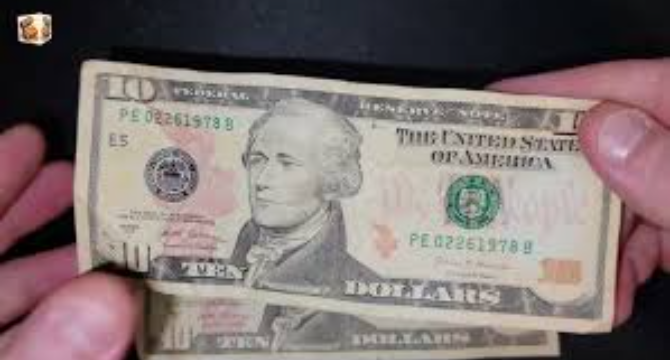
He reached into his pocket and pulled out a laminated, worn $10 bill.
“You don’t remember me,” he said, his voice shaking, “but in the winter of 1998, you gave me your last $10 at a Greyhound station. You told me to go change the world.”
Then he handed me a thick medical folder with my grandson’s name on it.
“What is it?” I asked.
He looked down at the folder for a moment, as if steadying himself, then lifted his eyes to mine again.
“It is Leo’s full medical review. I had my team obtain every record the hospital would release. I have already spoken to the specialists handling his case.”
I stared at him, my fingers trembling around the file.
“Why would you do that?”
His throat moved as he swallowed. “Because you saved me that day, Eleanor.”
I could only blink at him.
He took a slow breath. “I was 26 years old at the time — broke, hungry, and sleeping in bus stations because I had nowhere else to go. I had one chance left, a job interview in another city, and I was $10 short of a ticket. I was shivering so badly I could barely speak.”
His voice softened.
“You sat beside me on that hard Greyhound bench, took the last bill out of your wallet, and pressed it into my hand. I told you I could not take it. But you weren’t ready to take no for an answer.”
My hand flew to my mouth.
The memory came back in a rush. The dirty station windows. The smell of coffee and wet coats. A thin young man with hollow cheeks and pride hanging on by a thread.
I had been heading home from visiting my sister, and I remembered that something in his face had broken my heart.
“You made it to the interview,” I whispered.
He nodded. “I did. That bus ride changed everything. I got the job. One opportunity led to another. I went back to school, finished medical training, and eventually specialized in pediatric cardiac surgery.”
His eyes shone now. “My name is Nick. And I am here because your kindness never left me.”
The porch tilted beneath me. I had to grip the doorframe to stay upright.
He stepped forward, alarmed. “Eleanor?”
“My grandson,” I choked out. “Can you save my grandson?”
His expression grew firm, almost tender.
“Yes, I believe I can.”
A sob broke free from my chest before I could stop it. Not a quiet, dignified tear. It was a full, shaking cry that seemed to tear through months of fear and exhaustion. I bent over the folder, weeping into my hands, and Nick gently took my elbow to steady me.
“Oh, Lord,” I whispered. “Oh, thank you.”
He waited until I could breathe again, then said, “The surgery will cost you nothing. My foundation will cover every expense the hospital refused to cover. The operation, the post-operative care, the medication, the follow-up treatment, all of it.”
I stared at him through tears.
“Nothing?”
“Nothing,” he repeated. “You gave me your last $10 when you had no reason to believe you would ever see me again. Let me give your grandson his future.”
At that moment, I heard the soft creak of the hallway floorboards behind me.
“Grandma?”
Leo stood there in his pajamas, one small hand rubbing his eyes. He looked so tiny in the doorway that my heart nearly split in two.
I opened my arms at once.
“Come here, sweetheart.”
He padded over, leaning against my side, then looked up at the stranger. “Who is that?”
I smoothed his hair with a shaking hand. “His name is Dr. Nick.”
Nick crouched so they were eye level. His voice was warm when he spoke. “Hi, Leo. Your grandma and I met a very long time ago.”
Leo studied him with the serious expression that always made him seem older than eight. “Are you a real doctor?”
That brought a laugh through my tears.
Nick smiled. “I am. And I know a lot about hearts.”
Leo glanced up at me. “My heart?”
“Yes, baby,” I whispered. “Your heart.”
Nick opened the folder and pointed to the top page. “I came to tell you that I am going to help fix it.”
Leo’s eyes widened. “Really?”
“Really,” he said.
My grandson turned to me, uncertain, hopeful, almost afraid to believe it.
“Grandma?”
I dropped to my knees and held his face in both hands. “Yes, sweetheart. You are getting your surgery.”
Leo threw his arms around my neck. I held him so tightly I could feel the fragile beat of his little heart against my chest, and for the first time in months, I did not hear a clock ticking inside my head.
Karen must have seen the car outside, because a few minutes later, she hurried across the yard and stopped short on the porch. “Eleanor, is everything all right?”
I looked up at her, still kneeling with Leo in my arms, and laughed through my tears.
“It is now.”
She pressed a hand to her mouth as I explained in broken pieces, and by the end, she was crying too.
Some people say life comes full circle.
I never understood that until that morning. Twenty-eight years earlier, I had handed a desperate stranger the last $10 in my wallet and thought nothing more of it.
I did not know that kindness could travel through time. I did not know it could come back wearing a tailored suit, carrying a medical folder, and offering my grandson a second chance at life.
A week later, Leo was back on the surgery schedule.
And when I kissed his forehead before they wheeled him into the operating room, I whispered the same words I had once said to a young man in a bus station.
“Go change the world.”