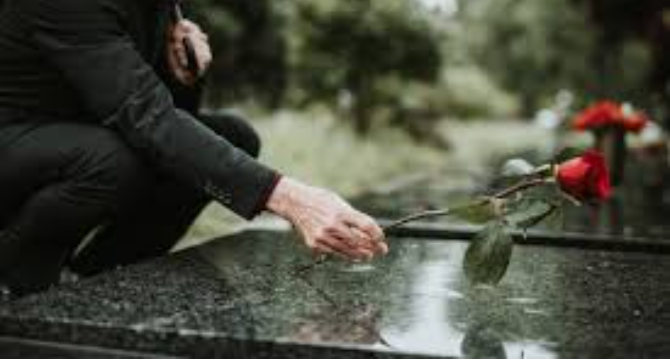
My father died on a Tuesday, which felt wrong somehow.
Robert had always been a Sunday kind of man. He loved his slow mornings, his black coffee, and the newspaper spread across the kitchen table.
That’s exactly why Tuesday felt too abrupt for someone who had taken up so much space in my life. I kept thinking about that on the drive to the church.
The wrongness of the day.
The service was held at St. Michael’s, the same church where my father had attended Mass every week for 30 years. It was full, which didn’t surprise me. Robert was someone whom people loved dearly.
I sat in the front pew and stared at the flowers beside his casket and tried to hold myself together with both hands.
I wasn’t doing particularly well at it.
The priest spoke, someone read a passage, and I heard the words the way you hear things when grief is sitting directly on top of you.
I kept my eyes forward, took a deep breath, and told myself I just had to get through the next hour.
That was when I saw the woman who’d soon turn my world upside down.
She was standing toward the back of the church, slightly apart from the group nearest to her. At first, my brain simply didn’t process what I was seeing. It filed it away as a trick of the light or a coincidence that startles you for a second and then resolves itself into something ordinary.
Except it didn’t resolve.
I looked again, longer this time, and I couldn’t take my eyes off her.
She had the same face, the same dark eyes, and the same jawline as me. She was wearing a dark coat and she was watching the casket with an expression of grief so quiet and so genuine that it stopped me completely.
Nobody around her seemed to find anything unusual. The people nearest to her were looking at the altar, or at their programs, or at the floor. Not one of them glanced at her twice.
I turned to look at my own reflection in the dark window panel beside the pew, then back at her.
It was like looking at a mirror that had developed its own opinions.
When the service ended, and people began to move, I lost her for a moment in the shuffle of dark coats and murmured condolences. I shook hands and accepted embraces and said the things you say, all while scanning the room over people’s shoulders.
Then I caught a glimpse of her near the side door, moving quickly, head down, clearly intending to leave before anyone could speak to her.
I excused myself from a conversation I couldn’t have told you anything about and followed her out.
“Wait!” I called out, but she didn’t respond.
She was already on the path outside, walking fast, when I caught up. I reached out and put my hand on her arm.
She stopped and turned slowly.
Up close, the resemblance was so complete that my voice didn’t work properly for a moment. I stood there on the church path with the cold air around us and the sound of voices drifting out from inside, and just stared at her.
“Who are you?” I finally managed. “How did you know my father?”
She looked at me for a moment, clearly thinking about what to say next.
“My name is Clara,” she said.
And then she stopped, like that was both everything and not nearly enough.
Around us, other mourners were drifting out of the church in small clusters, buttoning coats and speaking in low voices. Nobody looked at us. Nobody seemed to register two women with the same face standing three feet apart in the cold.
“Clara,” I repeated. “And how did you know Robert?”
Her gaze lowered and paused for a few seconds before she looked back into my eyes.
“He was my father too,” she said.
I looked at her with wide eyes, unable to process what she’d just said. Her father? Was Robert her father, too?
“Th-that’s not possible…” I stammered. “I’m his only child. I’ve always been his only child. How can you—”
“I know that’s what you were told,” she cut me off. “We were separated when we were infants. Our parents split up. It was complicated, and very fast, and the decision was made to raise us separately.”
“You stayed with your father,” she continued. “And I went with our mother.”
I stared at her. “Our mother.”
“She passed eight years ago.”
I had so many questions that none of them could get through the door. I stood there and said nothing for a moment, trying to find a place to begin.
“He knew,” I said finally. “My father knew about you this whole time.”
“Yes,” Clara nodded. “He stayed in contact with me. Not constantly or openly, but consistently. Letters, mostly. Phone calls sometimes. He came to see me a handful of times over the years.” She held my gaze steadily. “He never stopped being my father. He just did it quietly.”
The thing that hit me hardest wasn’t the existence of a sister I’d never known about. It was the image of my father — my Sunday-morning, newspaper-and-coffee father — carrying this parallel life for 52 years without a single word.
“Why are you here?” I asked. “Why now?”
Clara reached into the bag on her shoulder and drew out a manila folder.
“Because he asked me to come,” she said. “Before he passed, he called me. He said it was time. He said he wanted us to meet.” She held the folder but didn’t open it yet. “He told me you’d be here, and that I should find you after the service.”
“He planned this,” I said.
“Yes.”
I looked at the folder in her hands. “What’s in there?”
“Everything he couldn’t say while he was alive.”
We found a bench at the edge of the churchyard, away from the thinning crowd. I sat down and opened the folder.
The first thing inside was a document I recognized immediately as a birth record, except it wasn’t mine. It was Clara’s, and it had the same date, the same year, and the same father’s name printed in the box at the top.
Beneath it was my own, which I had seen multiple times before.
Behind the birth records were financial documents detailing transfers, records of support payments, and receipts from decades ago.
My father had been quietly, consistently supporting Clara her entire life.
I turned the pages slowly, not saying anything.
At the very back of the folder was an envelope. My name was written on the front in my father’s handwriting, which was enough to make my throat tighten immediately.
Below my name, in the same hand, was Clara’s.
He had addressed it to both of us.
I looked at Clara. She nodded.
I opened it.
The letter was three pages, handwritten on the pale blue stationery my father had used for as long as I could remember.
His handwriting was slightly looser than usual, the way it got in his later years, but the voice was completely his.
He wrote that he had made decisions early in his life that he had spent the rest of it trying to manage as honorably as he could.
He wrote that separating his daughters had been the greatest failure of his life.
He had also confessed that he had told himself for years that he was protecting both of them by keeping the arrangement stable rather than disrupting it. He wrote that he understood, reading it back, how thin that reasoning sounded. That stability and silence were not the same thing, and that he had confused them for too long.
He wrote that he had been afraid that if he told me about Clara, I would feel that my place in his life was smaller than I’d believed. He was also afraid that if he brought us together too soon, before we were old enough to handle it, it would damage something irreparable.
And so he waited, and kept waiting, and the years moved faster than he expected them to.
By the time I understood that there was no right moment, he wrote, I had already used most of them up. So I am using this one instead. The last one I have.
He asked us to be patient with each other.
He asked us to be patient with him, if we could manage it. He said he loved us both in ways he had never found adequate words for, and that the one thing he wanted was for us to know each other.
I folded the letter slowly and held it in my lap.
Clara was quiet beside me. When I finally looked up, her eyes were wet, though she was holding herself very still in that composed, careful way she had.
“He told me about you,” she said softly. “Over the years. He talked about you a lot.”
“He never mentioned you,” I said. “Not once.”
“I know,” she said. “I think that was harder for him than he let on.”
I looked down at the folder in my hands. It was evidence of 52 years of a life I hadn’t known was running parallel to mine, close enough to touch and never quite visible.
I didn’t know yet what came next. I didn’t know what you did with a sister who was also a stranger, or how you began to build something with someone when the foundation under you was still settling.
But I knew that he had put us on this bench together on purpose, with a folder full of evidence and a letter full of honesty, and that felt like something worth taking seriously.
I turned to Clara.
“Do you want to get coffee?” I asked.
She hesitated for only a second before nodding.
We ended up in a small café a couple of blocks away, sitting across from each other like strangers who somehow shared the same face. At first, the conversation came slowly and carefully as if we were both afraid of saying the wrong thing.
But we didn’t leave.
We kept talking, filling in pieces of a life that had been split in two for so long.
It’s been a few months now, and we’re still working on our relationship, learning about each other one conversation at a time. It isn’t perfect, and it probably never will be, but it’s real, and for now, that’s enough.
How many of us are living our whole lives just one conversation away from the truth, never knowing how much we’ve been kept from, or how much we’ve been loved in silence?