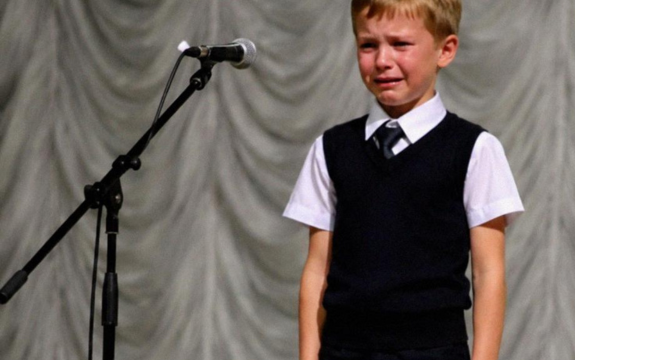
My son, Ethan, stood in front of the cracked hallway mirror, tugging at the sleeves of his faded blue shirt like he could stretch confidence out of cotton.
“Dad,” he whispered, not looking at me, “does this look… bad?”
I froze with my hand on my tie.
It was the same shirt he wore to church last Easter. The collar had softened from too many washes, and one button didn’t quite match the others because I’d sewn it myself after it fell off. His sneakers were clean, but worn at the edges, the white rubber scuffed gray no matter how hard he scrubbed them.
Still, to me, he looked perfect.
I walked over and placed both hands on his shoulders. His small frame stiffened under my palms.
“Ethan,” I said, meeting his eyes in the mirror, “you look like my son. That means you look better than anyone in that room.”
He tried to smile. It barely made it halfway.
“But everyone else will be dressed up,” he murmured. “Jason said his dad bought him new shoes just for today.”
I swallowed the ache rising in my throat. Money had been tight since my wife, Laura, passed. Tight was the polite word. Some nights, after Ethan went to sleep, I sat at the kitchen table counting bills with one hand and holding my head with the other, wondering which problem could wait another month.
But Ethan never complained. Not once.
“We’re not going there to impress people,” I told him. “We’re going because it’s Father’s Day at your school, and I wouldn’t miss it for the world.”
His eyes flickered toward mine. “You promise you’re not embarrassed?”
That question nearly broke me.
I crouched in front of him and fixed his collar. “Embarrassed? Buddy, walking beside you is the proudest thing I do.”
A few minutes later, we stepped into the school gym. Balloons hung from the basketball hoops, fathers laughed beside decorated tables, and kids posed for photos under a paper banner that read: Celebrating Our Heroes.
Then I saw him.
A man in a dark designer suit, gold watch shining under the gym lights, stared straight at Ethan’s shoes.
His lips curled.
Ethan felt it too. His hand slipped into mine. And before I could steer him away, the man laughed loudly enough for half the gym to hear.
“Well,” he said, smirking, “did you two stop at a thrift store on the way here?”
The gym went so quiet I could hear the faint squeak of sneakers from the basketball court next door.
Ethan’s fingers tightened around mine.
The man’s son — Jason — laughed nervously beside him, though it sounded forced, like he knew something about the moment felt wrong.
I stepped forward slowly. “That’s enough.”
The man tilted his head, amused instead of ashamed.
“Oh, relax,” he said. “It’s just a joke.”
“No,” I replied, my voice hardening, “you’re humiliating a child.”
A few parents nearby shifted uncomfortably. One mother lowered her phone, and another whispered something to her husband while glancing at Ethan.
But the man only shrugged.
“Kids should learn early that presentation matters,” he said loudly. “The world judges you whether people like it or not.”
Ethan stared at the floor as every instinct in me screamed to take him home. I could already imagine the car ride — the silence, the pretending he wasn’t hurt, the quiet way he’d peel off those shoes the second we got back to our apartment.
The thought made my chest burn.
“My son doesn’t need expensive clothes to deserve respect,” I snapped.
The man chuckled under his breath.”That’s easy to say when you can’t afford them.”
A few gasps rippled through the crowd. I clenched my fists so tightly my knuckles ached.
“Dad…” Ethan whispered softly, tugging my sleeve.
That one word stopped me.
I looked down at him. His face was red with embarrassment, his eyes glossy like he was fighting tears with every ounce of strength he had left. And suddenly I realized something worse than the insult itself:
He thought this was his fault.
I knelt beside him immediately.
“Hey,” I said quietly, ignoring everyone else in the room. “Look at me.”
He hesitated before lifting his eyes.
“You have nothing to be ashamed of. Do you hear me?”
“But everybody’s staring…”
“Then let them stare,” I said firmly. “Because I’d choose you over every person in this gym.”
His lip trembled.
Behind us, the rich father exhaled dramatically, clearly irritated that the attention wasn’t staying on him.
“Some people are too sensitive these days,” he muttered.
That was when the microphone screeched at the front of the gym. The principal, Mr. Bennett, stepped onto the stage holding a stack of papers.
“Alright everyone,” he announced warmly, unaware — or pretending to be unaware — of the tension hanging in the room. “Before we begin the Father’s Day activities, we have something special this year.”
The crowd slowly redirected their attention forward.
I stood back up, placing a protective hand on Ethan’s shoulder.
Mr. Bennett smiled at the audience. “Every year, we recognize parents who contribute to making this school a better place for our students.”
The rich father beside us straightened immediately.
I noticed the subtle adjustment of his cufflinks. The smug confidence returned to his face.
Of course, he thought this was about him. His family’s name was on half the sponsorship banners hanging around the gym. Jason looked up at his father with expectation as the man gave him a proud wink.
Mr. Bennett continued speaking. “Usually, donations and fundraising efforts get the spotlight. And while financial support matters greatly…” His expression shifted slightly. “Character matters more.”
Something in his tone made the room still.
The rich father’s smile weakened.
Mr. Bennett glanced down at the papers in his hand before speaking carefully. “This year, there was one parent who repeatedly offered support only if his company received public advertising in return.”
Whispers immediately broke out, and I saw the rich man’s jaw tighten.
The principal continued. “When asked to contribute anonymously toward classroom repairs and student activity funds, he declined multiple times unless additional promotion was guaranteed.”
Now people were turning and looking at him. The color drained from his face.
“Dad…” Jason murmured uneasily.
The man forced a laugh. “This is ridiculous.”
But Mr. Bennett wasn’t finished.
“Meanwhile,” he said, his voice growing softer, “another parent volunteered quietly for months without asking for recognition at all.”
My stomach dropped.
No.
Please no.
Mr. Bennett looked directly at me.
“Many of you don’t know this, but several broken desks in the fifth-grade classrooms were repaired by one father who came here after working full shifts at his job.”
Ethan blinked up at me in confusion as the principal smiled gently.
“He fixed cafeteria tables, repainted damaged walls backstage before the winter play, repaired shelves in the library, and even cleaned the gym storage room on weekends.”
The entire room was silent now.
I felt heat crawl up my neck. I never wanted attention for any of it. I just knew the school couldn’t afford repairs, and I had experience doing maintenance work.
That was all.
Mr. Bennett’s eyes softened further.
“And despite struggling financially himself, he refused every offer of compensation because he said,”—he checked the paper—'”the kids deserve a place they can feel proud of.'”
A woman near the front covered her mouth.
One of the teachers started clapping. Then another. And another.
The sound spread across the gym like rolling thunder, and suddenly, everyone was applauding.
Parents. Teachers. Students.
All standing.For us.
Ethan stared around in disbelief. His eyes widened as people smiled at him — not with pity, but admiration.
Beside us, the rich father stood frozen, humiliation carved across his face. And then came the moment that hit harder than anything else. Jason slowly stepped away from his father.
Not dramatically, not angrily, just… quietly.
Ashamed.
The rich man noticed immediately. “Jason,” he hissed under his breath.
But the boy avoided his eyes.
Meanwhile, Ethan looked up at me like he was seeing me for the first time.
“Dad…” he whispered.
He threw his arms around my waist before I could say anything. The gym blurred for a second because my vision suddenly wasn’t steady anymore.
“You fixed all that stuff?” he asked against my shirt.
I laughed weakly. “Some of it.”
“You never told me.”
“I didn’t think it mattered.”
He pulled back just enough to look at me, and there were tears in his eyes now — but not the same tears from earlier. These were different.
Proud tears.
“It matters to me.”
The applause continued around us.
The applause slowly faded, but the feeling in that gym stayed heavy, almost sacred. Ethan stood beside me with his shoulders back, no longer hiding behind me or staring at the floor. He looked confident.
Mr. Bennett stepped down from the stage and shook my hand firmly. “People notice more than you think, Oliver,” he said quietly.
I nodded, still overwhelmed.
Across the gym, the wealthy father grabbed his coat and muttered something under his breath before heading toward the exit. But Jason didn’t follow immediately. The boy lingered near us awkwardly, his face burning with embarrassment.
Then he looked at Ethan.
“Your dad’s really cool,” he admitted softly.
Ethan glanced at me, and I saw the smallest smile pull at his lips.
“Yeah,” he replied. “He is.”
Jason lowered his head before hurrying after his father.
As families gathered for photos and games, several parents approached to thank me for helping the school. One teacher even told Ethan, “You should be proud of your father.”
My son wrapped his arms around me again after she walked away.
“I am proud,” he whispered.
I closed my eyes for a moment, holding him tightly. We had arrived at that school feeling small, judged, and unwanted. But we left with something far more valuable than money or status. We left knowing kindness always outlives cruelty.
And as Ethan walked beside me toward the parking lot, he no longer tried hiding his worn sneakers from anybody there again.