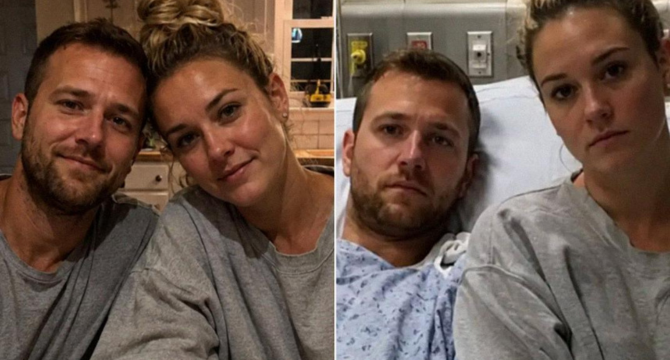
When the call came, I was standing in the kitchen with a dish towel in my hand, staring at the clock and wondering why Ryan was late again.
My husband had always been the kind of man who texted if traffic slowed him down for five minutes.
At least, he used to be.
Lately, he had become harder to read. He was quieter and more guarded. He smiled less when he walked through the door, and sometimes I caught him staring at me like he was trying to decide whether I was a problem he could solve.
Still, when the hospital called and told me Ryan had been in a car accident, none of that mattered.
I dropped the towel on the floor and ran.
By the time I reached the hospital, my chest hurt from crying. A nurse led me down a bright hallway that smelled like disinfectant and coffee, and every step felt like a punishment.
I kept picturing Ryan’s face, his hands, and his voice. I kept thinking of the last stupid thing I had said to him that morning.
“Don’t forget to pick up almond milk.”
That was all. Not “I love you.” Not “drive safe.”
Just almond milk.
When I walked into my husband’s hospital room after his car accident, I ran straight to him in tears.
“Thank God you’re okay…”
Ryan was sitting up in bed with a bandage near his temple. His dark hair was messy, and his face looked pale under the hospital lights. For one second, I thought he would reach for me. I thought he would pull me in, whisper my name, and make the terrible weight in my lungs disappear.
But instead of hugging me back, he looked confused.
His eyes moved over my face as if he were searching for something and finding nothing.
“Who are you?” he asked.
I stopped so fast I almost tripped over my own feet.
At first, I thought he was joking. It was a cruel thought, but Ryan had never been cruel to me. Not like that. Then I saw his expression. Blank. Careful. Empty.
I turned to the nurse, my voice breaking.
“What is he talking about?”
That was the moment doctors told me he had amnesia. They said trauma could do strange things to memory. They said the brain sometimes protected itself in ways medicine could not always explain. They spoke gently, the way people do when they are trying to keep you from falling apart.
But the strange part was that his scans looked almost completely normal.
One doctor, a tired-looking man with kind eyes, pulled me aside near the doorway after checking Ryan’s chart again.
He lowered his voice so my husband could not hear.
“Something doesn’t add up,” he admitted quietly.
I clung to those words for days.
The following weeks were painful. I brought him photos from our wedding, our vacations, and our life together, but he looked at me like I was a stranger.
I showed him the picture of us cutting cake, his hand over mine, both of us laughing because I had nearly dropped the knife.
He stared at it, then handed it back.
“I’m sorry,” he said flatly. “I don’t remember.”
I showed him a photo from our trip to Oregon, where he had insisted we hike in the rain and then complained the whole way down. Nothing.
I played him old videos. His own voice filled the room, teasing me while I tried to build a bookshelf.
Still nothing.
Every time, I felt a small piece of myself fold inward.
I was 30 years old, and I had spent six years loving Ryan. I knew the way he took his coffee, the song he hummed when he was nervous, and the scar on his thumb from slicing an avocado the first month we lived together.
But he looked at me like I was a woman who had wandered into the wrong room.
Then one morning, he finally said, “I can’t force feelings I don’t have. You’re nobody to me. I want a divorce.”
The words landed harder than the accident ever could have.
A few days later, I learned he had already hired a lawyer. Conveniently, his “condition” could help him avoid splitting most of our assets.
That’s when I started suspecting he was faking everything.
So I made a plan.
I secretly installed a tiny camera in our basement facing the safe where we kept emergency cash. Later that day, I made sure he saw me go downstairs before coming back up carrying a trash bag that looked full.
“What were you doing down there?” he asked immediately.
I pretended to panic.
“Nothing… just cleaning.”
Then I walked away.
But seconds later, I saw him quietly heading toward the basement.
And right then, I knew my trap had worked.
I watched Ryan from the hallway mirror as he slipped down the basement stairs, moving with the kind of purpose a man did not have when he could not remember where anything was.
My hands shook, but I forced myself to stay still.
For weeks, he had forgotten our wedding song, our first apartment, and the nickname he gave me when we were dating. Yet somehow, the moment he thought I had touched the emergency cash, he remembered the basement. He remembered the safe. He remembered exactly where to go.
I opened the camera feed on my phone.
The screen showed Ryan stepping into the basement. He glanced toward the stairs, then hurried to the old metal shelf where we kept paint cans and holiday decorations. Behind them was the safe.
He moved the cans aside without hesitation.
My throat tightened.
“Come on, Ryan,” I whispered, though I did not know if I wanted him to stop or keep going.
He knelt, punched in the code, and opened the safe on his first try.
The code was my birthday.
For a moment, he froze.
Then he reached inside and started counting the cash. Not slowly. Not like a confused man trying to understand what he had found. He counted like someone checking whether his plan had been disturbed.
I saved the recording with trembling fingers.
Then I called his lawyer.
The next morning, Ryan sat across from me in our living room with his attorney beside him. His face had the same empty look he had been wearing since the hospital. It used to break me.
Now it just made me sad.
His attorney cleared his throat. “Maya, given Ryan’s medical condition, it would be best for everyone to settle this cleanly.”
Ryan stared at the coffee table. “I don’t want to hurt you. I just don’t know you.”
I almost laughed, but it would have come out as a sob.
“You don’t know me?” I asked softly.
He looked up. “No.”
“You don’t remember our wedding?”
“No.”
“Our trip to Oregon?”
“No.”
“And what about the safe in the basement?”
His jaw tightened so slightly that anyone else might have missed it.
I placed my phone on the table and pressed play.
The room filled with the quiet sound of basement steps, paint cans scraping metal shelves, and Ryan entering my birthday into the safe. His attorney leaned forward. Ryan’s face drained of color.
I watched him watch himself.
“You opened it on the first try,” I said. “You moved the paint cans without looking. You knew exactly where the safe was.”
Ryan swallowed. “That doesn’t prove anything.”
“No?” I asked, my voice shaking now. “Then tell me the code.”
He said nothing.
His attorney turned to him slowly. “Ryan?”
Ryan’s mask cracked. For the first time in weeks, I saw the man I had married. Not the sweet man I missed, but the real man hiding underneath all that silence.
“I was trapped,” he muttered.
The words hit me harder than his lie.
I leaned back. “In our marriage?”
He rubbed both hands over his face.
“In everything. The house. The bills. The expectations. You were always talking about the future, and I couldn’t breathe.”
“You could have told me,” I said.
He snapped his head up. “And what? Watch you cry? Watch you beg? I knew you’d never let go.”
I stood then because sitting across from him felt impossible.
“I would have cried,” I admitted. “I might have begged for an explanation. But I would have survived the truth. What you did was cruel.”
His attorney closed his folder and spoke in a low voice.
“I need to advise my client privately.”
But there was no saving it. The recording went to my lawyer. The doctor who had once whispered that something did not add up agreed to document his concerns. Ryan’s attempt to use his supposed amnesia to walk away with most of our assets collapsed almost immediately.
Two months later, the divorce was finalized fairly.
On the day I signed the last papers, Ryan caught me outside the courthouse.
He looked smaller than I remembered.
“Maya, I’m really sorry.”
I studied the man I had loved for six years and felt something inside me finally loosen.
“I know,” I replied. “But I’m done being the only one who means it.”
Then I walked away.
I cried in my car for almost 20 minutes, not because I wanted him back, but because I was grieving the person I thought he was.
After that, I drove home, changed the locks, and opened every window in the house.