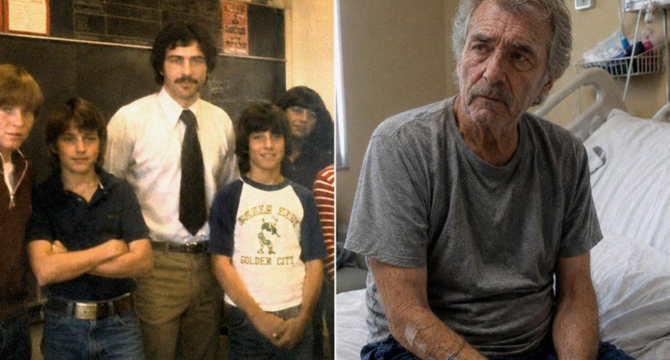
I first saw Mr. Bennett in Room 317 on a Thursday evening, though at first, I only knew him as the old man who could not afford to live. He sat near the window with his hands folded over a thin hospital blanket, staring at the orange sky as if it had already decided his fate. His suitcase — brown, cracked, and older than some of the nurses — rested beside his bed.
Dr. Harris stood at the foot of the mattress, shifting uncomfortably.
“I’m sorry, Mr. Bennett,” he said. “But the surgery is extremely expensive.”
The old man nodded slowly. “How much?”
When the doctor told him, Mr. Bennett’s lips parted, but no words came out. His shoulders seemed to sink into himself.
“I don’t have that kind of money,” he whispered.
“I understand,” Dr. Harris said, though his eyes said he didn’t. “Tomorrow is the last day we can keep you here without payment.”
I froze outside the door, my fingers tight around the medicine tray.
Tomorrow?
Mr. Bennett looked down at his hands. “And if I leave?”
The doctor hesitated. “Then your condition will worsen. Quickly.”
Silence filled the room like cold water.
After Dr. Harris left, I stepped inside to check the IV. “Good evening,” I said softly.
The old man turned toward me. His face was pale, but his eyes were gentle.
Then I saw him clearly.
The silver hair. The tired smile. The small scar above his eyebrow.
My heart stopped.
“Mr. Bennett?” I breathed.
He blinked at me, then smiled faintly. “Well, I’ll be,” he said. “Clara.”
My knees almost gave way.
“You remember me?”
“Of course I do.” His smile trembled. “You stuck chewing gum under every desk in my classroom.”
I laughed once, but it broke into a sob.
He frowned with concern. “Now, now. No crying over old desks.”
But I was no longer seeing a patient. I was seeing the teacher who had once put extra sandwiches in my schoolbag when my mother could not afford lunch.
That night, I watched him pack his suitcase with shaking hands.
“Mr. Bennett,” I whispered, “please don’t leave yet.”
He gave me a tired smile.
“My dear,” he said, “sometimes leaving is all a poor man can afford.”
And by sunrise, everything changed.
At first, Mr. Bennett thought there had been an accident outside the hospital. From his bed near the window, he watched people gathering near the entrance below. Cars lined the street. Men and women stepped onto the sidewalk carrying flowers and envelopes, their faces tense with emotion.
“Clara,” he asked as I checked his IV, “what’s happening out there?”
I smiled faintly. “I think they’re here for you.”
His brows knitted together. “For me?”
A knock sounded at the door before I could explain. A tall man in a navy coat stepped inside. The moment he saw Mr. Bennett, his eyes filled with tears.
“Mr. Bennett,” he whispered.
The old teacher stared at him for a long moment. “Daniel?”
Daniel laughed shakily. “You still remember me.”
“You used to draw rockets on your math homework.”
“And you said they were more impressive than my grades.”
Mr. Bennett smiled weakly, but the smile vanished when more people appeared behind Daniel.
A woman with curly red hair burst into tears the second she entered. “Oh my gosh,” she cried. “Mr. Bennett!”
He squinted. “Emily?”
“You made me stay after school for talking too much.”
“You talked through an entire geography lesson.”
The room filled with soft laughter.
Then, more voices followed from former students. Dozens of them.
Some were now lawyers, nurses, or business owners. Others looked like exhausted parents who had rushed there without even changing clothes. Yet every face carried the same expression: love.
Mr. Bennett looked overwhelmed. “Why are you all here?”
The room fell silent.
Daniel stepped forward first. “Because Clara called me last night.”
Mr. Bennett turned toward me in confusion.
“I remembered you mentioning Daniel,” I explained softly. “So I found him online. He contacted everyone else.”
“And now,” Emily said through tears, “your entire old classroom practically lives in the hallway downstairs.”
Mr. Bennett shook his head slowly. “I don’t understand.”
Daniel reached into his coat and handed him an envelope. “You’re not leaving this hospital.”
Mr. Bennett frowned. “Daniel—”
“Your surgery is fully paid for.”
The old man froze.
“No,” he whispered. “That’s impossible.”
“It’s done,” Daniel replied. “Every dollar.”
Mr. Bennett’s hands trembled violently. “You shouldn’t have done that.”
A man near the doorway spoke up. “You paid for my graduation exam when my parents couldn’t.”
“You brought food to our house for months,” another woman added.
“You stayed after school, teaching me to read.”
“You bought me my first winter coat.”
The memories came one after another, filling the room like waves.
Mr. Bennett stared at them helplessly. “I was only doing my job.”
“No,” Daniel said quietly. “You were changing lives.”
Tears rolled down the old teacher’s face as he lowered his head into his hands.
Then Daniel looked toward me. “Tell him, Clara.”
My chest tightened instantly. “When I was 12,” I began softly, “my mother lost her job. We were about to leave school because we couldn’t afford tuition.”
Mr. Bennett looked up slowly.
“Years later, after my mother passed away, I found an old receipt hidden inside her Bible.” My voice broke. “You secretly paid my school fees for two years.”
The room went silent.
Mr. Bennett looked more embarrassed than proud. “It wasn’t important.”
“It changed my life,” I whispered. “I became a nurse because someone once showed me kindness when I needed it most.”
Emily covered her mouth, crying openly now.
Dr. Harris suddenly entered the crowded room, looking completely confused. “What is happening here?”
Daniel turned calmly. “Accounting should’ve received payment for Mr. Bennett’s surgery.”
The doctor blinked. “The full amount?”
“Every penny.”
Dr. Harris smiled at Mr. Bennett warmly. “Well,” he said, “that changes everything.”
Mr. Bennett looked around the room in disbelief. “I don’t know how to thank all of you.”
“You already did,” Emily whispered.
But Daniel reached into his pocket once more. “There’s something else.”
He placed a small silver key into Mr. Bennett’s trembling hand.
“We bought you a house.”
The room erupted with soft gasps.
“A small furnished place,” Daniel explained. “Near Greenlake Park.”
Mr. Bennet’s eyes widened instantly. The park where he used to take students on field trips every spring.
“You remembered that?” he whispered.
Daniel nodded. “You made us feel safe there.”
The old teacher broke down completely then, tears streaming freely down his face.
“I can’t accept this.”
“Yes, you can,” Marcus said firmly from the back of the room. “Because we’re not letting you grow old alone.”
“And this time,” I whispered through tears, “you don’t have to take care of everyone by yourself anymore.”
Two weeks later, I stood beside Mr. Bennett’s hospital bed as Dr. Harris removed the final set of monitors.
“You’re officially free to go,” the doctor said with a smile.
Mr. Bennett blinked at him. “Still feels strange hearing that.”
“You gave us quite a scare,” I teased gently.
He chuckled softly, though his eyes were already drifting toward the hallway outside the room. The moment the door opened, applause exploded through the corridor.
Mr. Bennett stopped walking. Nearly everyone had returned.
Daniel stood near the elevators holding balloons. Emily waved so hard she nearly dropped the flowers in her arms. Marcus leaned against the wall, grinning proudly.
And behind them were even more faces.
Former students.
People who had driven for hours just to see their old teacher walk again. Mr. Bennett covered his mouth with trembling fingers.
“You all came back?”
“You didn’t really think we were done with you, did you?” Daniel laughed.
The old teacher shook his head in disbelief. “This is too much.”
“No,” Emily said softly. “This is what family does.”
I watched his eyes water again. For years, this man had believed he was alone. But now the hallway overflowed with people whose lives carried pieces of him everywhere they went.
Outside the hospital, sunlight spilled across the parking lot as Daniel helped Mr. Bennett into a car.
“Ready to see your new place?” he asked.
Mr. Bennett looked nervous. “I still can’t believe this is real.”
The drive to Greenlake Park was quiet at first. Mr. Bennett spent most of it staring out the window, watching familiar streets pass by. Then Daniel pulled into a peaceful neighborhood lined with maple trees.
“There,” he said softly.
The little house sat beside the corner of the park, warm sunlight glowing against its white walls. Fresh flowers lined the walkway. Wind chimes swayed gently on the porch.
Then Mr. Bennett stepped out of the car slowly. For a long moment, nobody spoke.
Then he whispered, “It’s beautiful.”
Inside, the house was fully furnished. Bookshelves stood near the living room fireplace. A soft blue blanket rested over the couch. Framed photographs of old school field trips decorated one wall.
Mr. Bennett touched one of the frames carefully. A photo of dozens of smiling children standing beside him at Greenlake Park, 20 years earlier.
“You kept these?” he asked.
“We all did,” Emily replied quietly.
He then lowered himself into a chair, suddenly overcome with emotion.
“I don’t deserve this.”
Daniel knelt beside him immediately. “Yes, you do.”
Mr. Bennett looked around the room at the people surrounding him.
His students. His children in every way that mattered. And for the first time in a very long while, the loneliness in his eyes disappeared.
That evening, as the sun set beyond the park, laughter filled the little house. Not because a sick old man had been saved. But because kindness, after traveling through countless lives for decades, had finally found its way home.