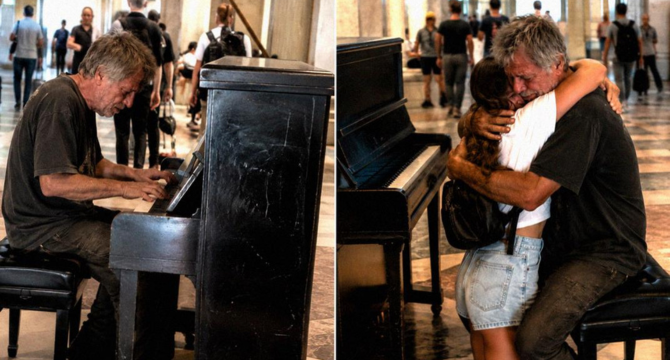
The piano at Millfield Station had been there longer than most of the staff could remember. It was an upright, slightly out of tune on the higher keys, with a small handwritten sign taped to the side that said, “Play Me.”
Most people ignored it.
Commuters walked past it the way they walked past everything in a train station — head down, bag on shoulder, somewhere else already in their mind.
Arthur arrived every evening at 6:50 p.m., set his worn leather satchel on the bench beside him, and began to play at seven on the dot.
He was 73 years old, with white hair and large, careful hands that moved across the keys with a gentleness that suggested the piano was something he was trying not to wake. People who noticed him at all assumed he was a retired musician, or perhaps just a lonely old man with nowhere better to be. Some dropped coins into the open case at his feet.
He never asked for them and never turned them away.
He didn’t play for money, though. He had a pension, a small apartment 12 minutes from the station, and no particular financial need. He played because it was the only thing that still made him feel close to her.
Her name was Evelyn. She had been five years old the last time he saw her.
Arthur had married young, to a woman named Catherine who was quick-witted and restless in equal measure.
For a few years they were happy, or something close enough to it.
Then Evelyn arrived, and Arthur fell in love in a way he hadn’t known was possible — the specific, disorienting love of a parent for a very small child.
He wrote a song for her the week she was born and refined it over the following years, adding words as she grew old enough to understand them.
Every night before bed, he would sit on the edge of her mattress and sing it softly until her breathing slowed and her eyes closed.
He and Catherine grew apart the way some couples do.
There was no drama involved in the way they drifted apart. It was very quiet.
And then one morning when Evelyn was five, Arthur came home from work to find the apartment half-emptied and a note on the kitchen table.
It read, “We need a fresh start. Don’t look for us.”
He looked anyway.
For years he looked — police reports, private investigators, phone calls to Catherine’s relatives who claimed not to know anything and may have been telling the truth. The trail went cold so completely that eventually even the investigator he’d hired sat across from him and said, with genuine regret, that there was simply nothing left to follow.
“You need to move on, Arthur,” his sister told him once, not unkindly.
“You have to find a way to live your life.”
He nodded and said he understood, because it was easier than explaining that he didn’t know how to do that.
He went to work, came home, ate dinner, and slept. He did all the things that constitute a life. But every evening at seven he came to the station and played Evelyn’s song, because it was the only thing that felt like keeping a promise.
On the evening it happened, it was raining.
Arthur sat down at the piano and began to play.
The station was busy for a Tuesday. A school group was gathered near the far platform, a man in a business suit was arguing quietly into his phone, and a woman in her early 40s stood near the edge of the concourse with a rolling suitcase, staring at the departures board with the distracted expression of someone trying to decide something.
Arthur played through the first verse of the melody the way he always did, unhurried, the notes familiar as breathing.
He closed his eyes the way he often did in the middle of it, the way that made the station, the fluorescent lights, and the noise recede until it was just the music and the memory of a small girl going still in his arms.
Then he heard it.
A voice, behind him and slightly to the left, soft at first as if the woman wasn’t entirely sure she was doing it. Singing the words. Every single word, in the right places, with the right pauses between the lines.
Arthur’s hands stopped moving.
The silence that followed was only a second long. He turned around very slowly.
The woman with the suitcase was standing about ten feet away, facing him now instead of the departures board.
Tears were running down her face, and she wasn’t trying to stop them.
She looked back at him with an expression he couldn’t fully read.
He stood up from the bench. His legs felt unsteady, and he was aware of his own heartbeat in a way he usually wasn’t.
“That song,” he said. His voice came out strange.
“How do you know that song?”
She shook her head slowly, like the answer was something she was still working out herself.
“I’ve always known it,” she said. “For as long as I can remember. My mother used to say she made it up, but I never quite believed her.” She paused, pressing her lips together. “I don’t know why I started singing just now. I heard the first few notes and it just… it just came out of me.”
Arthur took a step toward her.
His hands were trembling. “What’s your name?”
She hesitated for just a moment.
“Eve,” she said. “Most people call me Eve. My full name is Evelyn.”
The word landed somewhere in the center of his chest.
He looked at her face the way you look at something when you’re desperately trying to locate something familiar inside it — the angle of her jaw, the way she stood, the shape of her eyes.
She had Catherine’s coloring but something else, something in the expression, something he recognized from a photograph he had kept in his wallet for 40 years until the edges went soft.
“Evelyn,” he said. “Is that you?”
She stared at him. The tears were falling faster now, and she reached up and pressed the back of her hand against her mouth.
“Who are you?” she whispered. “Why are you looking at me like that?”
“My name is Arthur,” he said.
The color left her face so completely that he stepped forward instinctively, afraid she was going to fall. She didn’t fall.
“Arthur,” she repeated, barely audible.
“Your mother’s name was Catherine,” he said. “You had a stuffed rabbit called George that you carried everywhere. I wrote that song the week you were born, and I sang it to you every single night until you were five years old.”
She made a sound that wasn’t quite a word, and then she sat down heavily on the nearest bench and pressed both hands over her face.
Arthur sat beside her and waited.
The station moved around them — announcements overhead, footsteps, the distant sound of a train arriving on platform three — and neither of them paid any attention to any of it.
After a while she lowered her hands and looked at him with red eyes.
“She told me you didn’t want us,” she said. Her voice was steady, but it was costing her something to keep it that way. “She said you asked us to leave.”
Arthur closed his eyes briefly.
“No,” he said. “No. I came home, and you were gone.”
She looked at him for a long time.
“I always thought the song was hers,” she said finally, almost to herself. “She sang it to me too. I think it was the only thing she kept.” She shook her head. “She died four years ago. Toward the end she said there were things she should have done differently. I didn’t understand what she meant.”
“I’m sorry,” Arthur apologized, and he meant it without complication, the way you can sometimes mean something about a person who hurt you badly.
Evelyn looked at the piano and then back at him.
“How long have you been coming here?” she asked.
“Twelve years at this station,” he said. “Before that, other places. Wherever there was a piano and people passing through.” He paused. “I thought if I kept playing it in enough public places, maybe someday the right person would hear it.”
“That’s either the saddest thing I’ve ever heard or the most hopeful,” she cried. “I can’t decide which.”
“Both, maybe,” Arthur said.
She laughed at that, a short, wet sound, and wiped her face with her sleeve. They sat together for a while longer without speaking, which felt surprisingly easy for two people who had just found each other after forty years.
Eventually she reached into her coat pocket and pulled out her phone.
“I live in Portland now,” she said. “I was just passing through for work.” She looked at him with something careful and new in her expression.
“I’d like to come back. If that’s alright.”
“I’ll be here,” Arthur said. “Every evening at seven.”
She smiled at that, just slightly, and then she looked at the piano again.
“Will you play the rest of it?” she asked. “I’d like to hear it properly. The whole thing.”
Arthur stood up, walked back to the bench, and sat down. He placed his hands on the keys, and he played the song he had written for his daughter the week she was born — all the way through, without stopping, while she sat on the bench behind him and sang every single word.