There is a particular kind of loneliness that comes not from being alone but from knowing exactly whose absence you are feeling.
I had lived with that loneliness for 15 years, and I had gotten very good at arranging my life around it the way you arrange furniture around a hole in the floor — carefully, methodically, and always aware of where it is.
My name is Eleanor, and I am 58 years old.
I live in the same house I raised my daughter in, on a quiet street in a town that has changed considerably less than I have over the past decade and a half.
The neighbors know me as the woman with the garden, the one who brings food to the church sale, waves from the porch, and seems, from the outside, to have a life that holds together reasonably well.
What they don’t know, what I have never told anyone in full, is that I have not spoken to my daughter Clara since she was 18 years old.
Her absence has been the central fact of my life ever since.
The argument that ended things between us was not, in retrospect, worthy of what it cost.
I have had 15 years to examine it from every angle, and I can tell you with complete certainty that it was the product of two stubborn people who were too similar to back down and too proud to be the first one to say so.
Clara had made a decision about her future that I disagreed with — strongly, vocally, in terms I should not have used.
She had responded with the particular fury of an 18-year-old who has been underestimated by the person whose opinion matters most.
Words were said that were meant to wound and succeeded.
She packed a bag and walked out the door, and I stood in the hallway and told myself she would be back in a week.
But she did not come back.
I wrote letters in the first year. Long ones, then shorter ones, then a series of brief notes that said little beyond the fact that I was still here and still sorry and still waiting.
I don’t know whether she received them.
All I know is that I received nothing in return.
A mutual friend told me, two years after the argument, that Clara had moved to another city and was doing well, and I held that information like something precious because it was all I had.
After that, I lost even the indirect news.
She had moved beyond the reach of anyone who might pass word back to me, and the silence became complete.
I kept the candle in the window anyway.
It sounds like a sentimental gesture, and it was, but it was also simply something I needed to do — the physical expression of a thing I refused to stop believing, which was that Clara might come home.
Every morning, I replaced the candle if it had burned down.
Every evening, I lit it. Fifteen years of evenings. The neighbors probably thought it was a decoration.
I also kept her room. I am aware of how that sounds, and I want to be clear that I am not a woman who stopped time the way you read about in stories.
The room was clean, and I occasionally used it for guests.
But her things were still there. The books she had left on the shelf, a photograph on the dresser, and a jacket she had forgotten in the back of the closet.
I told myself I was keeping them in case she came back and wanted them. I knew, in the part of myself that was honest at three in the morning, that I was keeping them because getting rid of them would have felt like giving up.
I never gave up.
It was the one thing I managed consistently across all 15 years.
Life, meanwhile, continued in the quiet way life always does. Seasons changed. Neighbors moved away, and new ones arrived. Children on the street grew up and left for college. Birthdays came and went.
And through all of it, I kept lighting the candle.
Some mornings, I woke convinced that Clara might call.
Most mornings, if I am being honest, I expected nothing at all. Hope had become less a feeling than a habit — something I practiced daily without asking whether it would ever be rewarded.
Then, on an ordinary Tuesday morning in October, everything changed.
The envelope arrived.
I was returning from my walk when I checked the mailbox, which I do every morning out of habit more than expectation.
There was the usual collection — a bill, a circular, a card from my dentist reminding me of an upcoming appointment. And beneath all of that, a small padded envelope that I almost didn’t see.
I saw the handwriting first.
I want to try to describe what it felt like to recognize your child’s handwriting after 15 years of nothing, and I find I don’t quite have the words for it.
It was clearly Clara’s handwriting. I knew that particular way she made her capital letters and the slight leftward slant she had always had.
I couldn’t believe I was reading my name and address in her handwriting, written on an envelope in my mailbox on an ordinary Tuesday in October.
My hands began shaking before I had fully processed what I was looking at.
I stood at the end of my driveway for a moment, unable to move, just holding it. A car went past on the street.
The driver waved, and I am sure I did not wave back.
I went inside and sat at the kitchen table.
I held the envelope for a long time before I opened it, because some part of me understood that whatever was inside would change things, and change — even the change you have been waiting 15 years for — requires a moment of preparation.
I said something out loud, quietly, that was directed at Clara in some general way. I don’t remember exactly what. Something about being here. Something about being sorry.
Then I opened it.
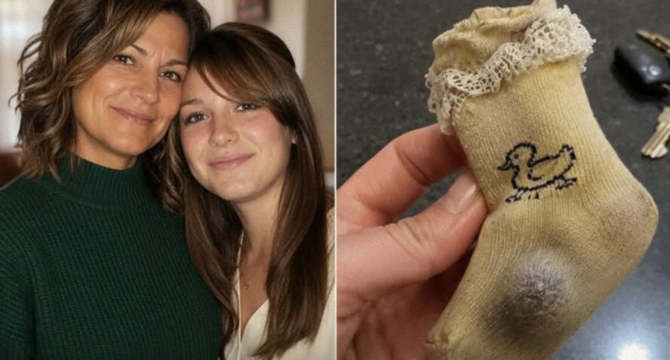
A single faded yellow baby sock fell out onto the table.
I picked it up and held it. The confusion I felt was profound. It was the sock — I knew it immediately, the yellow one with the small white stripe around the cuff, the sock she had worn home from the hospital the day I brought her home 33 years ago.
I had kept it in a memory box for years. Somehow, Clara had it.
I had not known she had taken it when she left.
I held it to my nose instinctively, the way you reach for sense memory when you’re overwhelmed, but there was nothing left of her in it.
Just the faint smell of old fabric, cardboard, and time.
I turned the envelope over, looking for a letter, a note, or anything written. There was nothing else.
Just the sock.
I sat with it in my hands, feeling a confusion that was edging toward grief, and then something sharper underneath the grief that I am not proud of. A flash of anger, quick and hot.
Was this a message? Was she telling me something about how little she thought remained between us?
A single worn sock after fifteen years of silence felt, for one terrible moment, like a cruelty.
I squeezed the fabric in my hand, and that’s when I felt it.
Something hard and small, lodged deep in the toe.
I worked at it with my fingers, trying to dislodge it without tearing the fabric, but the seam was old and tight, and eventually I pulled it apart along the toe seam, the delicate threads giving way, and a tiny tarnished silver locket slipped out and clattered onto the kitchen table with a sound that seemed very loud in the quiet room.
I sat very still for a moment.
Then I picked it up and pried it open with my thumbnail.
Inside was a photograph of a little girl, perhaps five years old, with curly dark hair and hazel eyes that I recognized with a shock that went through my entire body.
That was not because I knew the child, but because those were my eyes. My eyes, and my hair as it had been when I was small, and a face that was simultaneously a stranger’s and deeply familiar in the way that family resemblance is familiar, unmistakable, and visceral.
It was not me. It was not Clara.
But I knew, the way you know certain things before you have any rational basis for knowing them, exactly who this child was.
A tiny folded piece of paper was tucked beneath the photograph. I unfolded it with fingers that had stopped shaking and gone very still in the way that hands go when the rest of you is holding its breath.
It was Clara’s handwriting again.
The first sentence read: Mom, by the time you read this, I will be gone.
My knees buckled. I went down onto the kitchen floor, and I did not try to stop myself. I sobbed in a way I had not sobbed since the day Clara left, the kind that empties you, takes everything, and leaves you on the floor with nothing but the small scrap of paper in your hand and the sound of your own breathing.
I don’t know how long I was on the floor. I guess long enough for the light in the kitchen to change.
Then the doorbell rang.
I pulled myself up by the table edge and went to the door with Clara’s letter still in my hand, my face undoubtedly wrecked, completely unprepared for whoever was on the other side.
A woman stood on my porch with a clipboard tucked against her chest. She looked professional at first, composed in the way people are when they have practiced delivering difficult news.
Then she saw my face, and her expression softened.
“Mrs. Eleanor?” she asked gently.
I nodded, though I couldn’t seem to find my voice.
“My name is Angela,” she said. “I’m a social worker with Family Services. I know this is an incredibly difficult morning.”
My fingers tightened around Clara’s letter.
“You knew?” I asked.
Angela’s eyes moved briefly to the paper in my hand.
“Clara asked us to wait until you received the envelope,” she said. “She wanted you to hear it from her first.”
At the sound of Clara’s name, something inside me gave way again.
I pressed one hand to the doorframe to steady myself.
“She really sent you here?” I whispered.
“She did. She was very clear about what she wanted.”
Only then did I notice the small shape half-hidden behind Angela’s coat.
A little girl stood there, gripping the woman’s sleeve with both hands. She had a dark halo of curls and hazel eyes that looked up at me with careful seriousness.
Not fear, exactly. More like she was trying to decide whether this new place was safe.
Angela turned slightly.
“Lily,” she said softly, “this is your grandmother.”
The little girl didn’t move at first.
I covered my mouth with my hand.
For a moment, none of us spoke.
Then Lily peered around Angela’s coat and looked past me, into the house.
“Is the candle still there?” she asked.
I stared at her.
“The candle?” I repeated.
Lily nodded. “Mom said you keep one in the window every night.”
My throat tightened.
For a moment, I couldn’t speak.
Angela looked between us and gave me a small, encouraging smile.
“Clara talked about you often,” she said quietly.
I swallowed hard. “She did?”
“Every chance she got.”
I closed my eyes briefly.
Fifteen years of silence. Fifteen years of wondering whether my daughter hated me, whether she ever thought of me at all.
And here was this child standing on my porch, speaking about Clara as though she had never stopped carrying me with her.
Lily shifted her weight from one foot to the other.
“Mom said you grow tomatoes.”
A surprised laugh escaped me. “I do.”
“The big ones?”
“The very big ones.”
She seemed to consider this important information.
Then she reached into the pocket of her coat. “I have something.”
Very carefully, she pulled out a small yellow sock with a white stripe around the cuff.
My breath caught. The matching sock.
She held it out toward me with both hands.
“Mom said this belongs with the other one.”
I took it from her. My hands were shaking so badly that I nearly dropped it.
For a moment, I couldn’t look at anything except that tiny piece of fabric.
The social worker gave us both a moment before speaking.
“Mrs. Eleanor,” she said gently, “would it be alright if we came inside?”
I nodded immediately and stepped aside.
“Of course.”
Lily walked in first.
She paused in the hallway and looked around with open curiosity. Her gaze moved across the photographs on the wall, the staircase, and the living room doorway.
Then she pointed toward the front window. “That’s it.”
I followed her gaze.
It was still there.
Still burning.
The sight of it nearly undid me all over again.
Behind us, the social worker quietly closed the door.
“Clara never stopped hoping for this,” she said.
I looked down at the letter still crumpled in my hand.
The letter had told me everything.
Clara had been diagnosed with a terminal illness two years earlier. She had spent that time putting her affairs in order and, more importantly, preparing herself for the decision she would eventually have to make about Lily.
What she decided was that she wanted her daughter to come to me.
And that was because she believed this was where Lily belonged.
“I told her about you every single day,” Clara had written. “She knows your garden. She knows the candle in the window. She knows you have been waiting. Please don’t make her wait the way I made you wait. She deserves better than the pride that kept us apart. So do you.”
I had read those words through tears on my kitchen floor only minutes earlier.
Now the child Clara had written about stood in my living room. She was looking at the photographs on the wall as though she were searching for pieces of her mother.
I crouched down to her level.
Lily turned toward me immediately.
Her eyes were Clara’s eyes.
Not exactly the same, but close enough to make my chest ache.
“You’re the grandmother with the candle,” she said.
“Yes,” I said softly. “I am.”
After a moment, she held out the yellow sock.
I took it carefully.
Then I reached for her hand.
She looked down at our hands and then back up at me.
At that point, neither of us seemed quite so uncertain about what would happen next.
Together, we walked farther into the house.