I turned 47 last week, and for thirty years, I’ve kept myself busy on my birthday.
Mowing the lawn at six in the morning. Cleaning the gutters. Organizing the garage into a system that nobody but me would understand.
Anything with a motor, or a task list, or enough noise to fill a head that would otherwise go somewhere I don’t want it to go.
For thirty years, I hated my birthday.
Her name was Lily.
We were seventeen, the kind of close that adults watch with slightly worried expressions and describe as a “phase.”
We let them think that.
We had plans that felt more real than anything the adults around us were doing. A college acceptance I was giddy about. An apartment we’d picked out from a classified ad: third-floor, big windows, a fire escape that faced west.
A life that existed so completely in my head that even now I can describe the furniture we never bought.
Her name was Lily.
Whenever I worried about the future, Lily would laugh and say:
“You’ll always know where to find me.”
She went to the river on the morning of my birthday. Fishing with her older brother, the way they did every few weeks.
I was supposed to go.
I woke up with a fever instead, shaking and useless.
I was supposed to go.
Lily stood in my doorway in her rain jacket with her tackle box.
She kissed my forehead and said, “Don’t die on me. I’ll bring you back the biggest fish you’ve ever seen.”
She never came back.
They said she slipped on the bank, hit her head on a rock, and went into the current. Her brother said he had tried to reach her. By the time anyone else arrived, there was nothing to find.
She never came back.
The casket at her funeral was closed.
I sat in the front pew and stared at it for an hour, absolutely certain, in the way that grief sometimes produces its own logic, that if I just waited long enough, she’d walk in the back door and apologize for the joke.
She didn’t.
I stayed in this town. I worked. I had relationships that mattered and then didn’t, each one eventually running aground on the same quiet fact that part of me was never fully present.
I had relationships.
A woman named Carol, whom I genuinely loved for four years, told me gently and correctly that she felt like she was competing with someone who wasn’t in the room.
She wasn’t wrong.
I kept one photograph of Lily in the top drawer of my nightstand. The way she was half-turned toward the camera, laughing at something out of frame. The small scar on her collarbone. The way her hair sat differently on the left side than on the right.
Thirty years is a long time to know a photograph by heart.
I kept one photograph of Lily.
This year’s birthday started the same way all the others do.
I was out in the yard before seven, the mower running, the noise doing its job.
That’s when I heard the side gate.
I killed the mower engine and turned around, already irritated.
And then I stopped.
I heard the side gate.
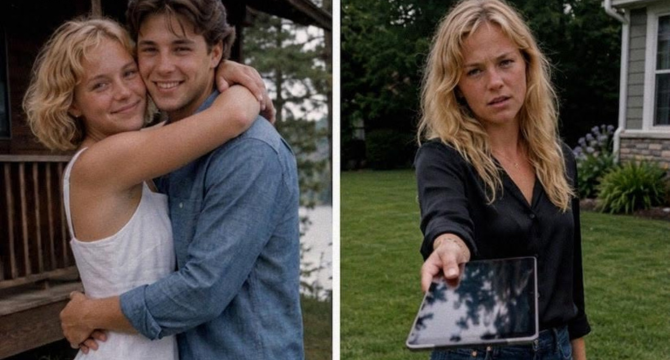
A young woman was standing at the edge of my yard.
My brain did something it has never done before and hasn’t done since. It stopped mid-process. Stopped reasoning and comparing and cataloguing and simply presented me with one raw, impossible perception.
She looked exactly like Lily.
The same dark eyes. The same slight tilt of the head when uncertain. The same way of standing with her weight shifted slightly forward, ready to move but not yet moving.
She looked exactly like Lily.
She was too young, clearly, twenty or twenty-five at most, which made no sense and also made the whole moment worse somehow.
“Who are you?”
“My name is Ashley,” she said. “I think you knew my mother.”
She held out a tablet.
“What happened at the river thirty years ago,” she revealed softly, “was a lie. Please. You need to see this.”
“I think you knew my mother.”
I pressed play.
I was on the grass before the video was thirty seconds old.
The woman on the screen had gray at her temples and lines around her eyes, and I knew her immediately. I knew her the way I know the photograph in my drawer, except this was worse; this was her moving, her hands gesturing the way they always had, her voice in my ears after thirty years of complete silence.
Lily.
She was alive.
She had been alive.
She was alive.
She looked directly into the camera.
“Shawn,” she said. “I’m sorry. I’ve been trying to say this for thirty years and I’ve written it so many times and I never found a way to make it not devastating, so I’m just going to say it.” She stopped. “I didn’t fall into the river. I walked away.”
I paused the video.
“No.”
The word came out harsher than I intended.
“I didn’t fall into the river.”
Thirty years.
Thirty birthdays.
Thirty years of believing she was dead.
“She just left?”
Ashley sat down in the grass beside me without asking. We were both watching the screen.
“I found this three months after Mom died,” Ashley said.
Thirty years of believing she was dead.
I hit play again. “If you’re seeing it, then Ashley found you. And if Ashley found you, then she’s the brave one, because I never was.” Lily smiled at the camera, and it broke something open in me. “I need to tell you the truth. I should have told you thirty years ago. I should have told you every year since. I kept running out of courage.”
The video ended.
For a long time, neither of us spoke.
“I kept running out of courage.”
“She passed away in March,” Ashley said finally. “Ovarian cancer. It was fast at the end.” She looked down at her hands. “The last thing she asked me was whether I’d found you yet. I spent three months going through her things, and I found boxes. Letters, photographs, journals. And the video.” She paused. “And this.”
She reached into her bag and set a small wooden box on the grass between us.
It was tied with a piece of twine, the old-fashioned kind. I touched the lid without opening it.
“Letters,” Ashley said. “All addressed to you. None of them mailed.”
“She passed away in March.”
I read them through the night.
Dozens of letters spanning thirty years, in a handwriting I recognized before I registered the words. The earliest was dated six weeks after Lily disappeared, the pen pressed hard like someone writing fast before they could stop.
She’d watched me from a distance more times than I could count. Seen my truck outside the hardware store and sat in her car for forty minutes before driving away. Attended my mother’s funeral from the back row and left before it ended because she was afraid I’d see her.
Another letter described the night she almost called.
She’d watched me from a distance.
She’d dialed my number, listened to the first ring, then hung up.
She wrote:”I don’t know how to explain what I did in a way that doesn’t make you hate me, so I’ve been waiting until I figure that out. Years keep passing faster than I expected.”
The last letter in the box was dated eight months before she died.
The handwriting was shakier. Like it cost more.
“I spent thirty years wondering if you’d forgive me. I never found the courage to ask.”
The handwriting was shakier.
Ashley came back the next morning with a photograph.
A woman and an older man, standing outside a diner somewhere I didn’t recognize. The woman was Lily, older, maybe fifteen years ago.
The man beside her had aged into someone I almost didn’t recognize.
Almost.
“That’s her brother,” I said. “That’s Thomas.”
“That’s her brother.”
Thomas, who had stood at Lily’s funeral with his face so closed down I couldn’t read it. Thomas, who told me the story of the river accident so many times in the weeks after that it had the quality of something rehearsed. Thomas, whom I’d quietly resented for thirty years for not saving her.
“He’s still alive,” Ashley said. “He lives about two hours from here. Mom visited him every year.”
We drove out on a Thursday morning.
Thomas was sixty-something now, white-haired, moving carefully through a small house with a garden that had seen better years. When he saw Ashley, something in his face went soft and sad at once.
“He’s still alive.”
When he saw me, he went still.
“She’s gone,” Ashley said.
He nodded. He’d known.
“Tell him, Uncle Tom,” Ashley said. “Mom would’ve wanted you to.”
“I’ve been waiting thirty years to,” Thomas said, looking at me.
When he saw me, he went still.
He sat at his kitchen table and looked at his hands for a long time before speaking.
“Your scholarship wasn’t the only thing our father threatened,” he finally admitted. “He owned the bank that held your parents’ mortgage. He told Lily he’d ruin your future and make sure your family lost everything. He even threatened to marry her off to someone wealthier. Lily was terrified, and I helped her escape because she thought it was the only way out.”
I stared at him.
“Lily believed him.”
Thomas looked down. “Honestly, Shawn… she probably should have.”
“I helped her escape.”
Silence settled between us.
“She was seventeen,” he finally said. “She thought she was protecting you.”
“And the river?”
Thomas closed his eyes when I asked that.
“The river gave her a way out.”
“She thought she was protecting you.”
I sat in Thomas’s kitchen with my hands flat on the table.
I didn’t feel relieved. I didn’t feel grateful. I felt something I didn’t have a word for at first, and then I found it.
Wrecked.
Lily had loved me enough to let me grieve her. For thirty years she had carried that choice alone, and I had spent those same thirty years believing I’d been abandoned, carrying my half of a grief she’d meant as a gift.
Thomas reached into a drawer and set another envelope on the table.
I didn’t feel relieved.
The paper was old. My name was on the front in handwriting I knew.
“She wrote this twenty years ago,” he said. “She told me to keep it hidden unless Ashley ever brought someone to my door.”
I read it in the car. Ashley sat in the passenger seat and didn’t say anything.
It was three pages long. Lily wrote about the specific plans she had to come back. After her father died. After she married a quiet man named Paul, who was good to her. After Ashley was born. After Ashley left for college.
It was three pages long.
Every year she planned to come back.
Every year she convinced herself that she had already caused enough damage.
And every year became another year.
Near the end, she wrote: “What I know now, that I didn’t understand at seventeen, is that time doesn’t make hard things easier. It just makes them more expensive.”
Then: “I spent thirty years wondering if you’d forgive me. I never found the courage to ask.”
She planned to come back.
Below that, a line I had to read three times.
“You’ll always know where to find me.”
I put the letter down.
Ashley was watching me.
“There’s one more thing,” she said. “She left a location.”
“You’ll always know where to find me.”
The hill overlooked the river.
It wasn’t far, maybe twenty minutes outside town, up a path through a stand of old pines that opened onto a cleared rise with a view that stretched all the way to the bend in the water where everything had started and ended.
At the top was a small stone plaque set into the ground. No name. Just a date. The date of my birthday. Our birthday, she’d always called it, because Lily said she was claiming partial credit for the day.
“She placed this herself,” Ashley said. “She came up here every year on that date.”
“She placed this herself.”
I stood there for a long time.
She hadn’t marked the place where she died.
She’d marked the place where she lost me.
Ashley was crying. I was crying.
We stood on a hill above a river on a clear afternoon and mourned the same woman from our different angles, and after a while that felt like enough.
She’d marked the place where she lost me.
I went back three days later.
I brought flowers. Wild ones I picked from the field at the base of the path, because Lily always said florists made flowers look anxious.
I sat beside the plaque for a long time. I’d brought the final letter with me, and I read through it again slowly.
Near the end, I found the line I’d missed the first time. Or maybe I hadn’t been ready for it the first time.
“You’ll always know where to find me.”
I brought flowers.
I sat with that for a while.
At seventeen, I thought it sounded romantic. I didn’t know it was going to become the kind of sentence that takes thirty years to finish.
I set the flowers against the stone.
Looked out across the river, the same water I’d hated for three decades, which was the wrong river to hate, I understood now.
At seventeen, I thought it sounded romantic.
It wasn’t the river’s fault. It wasn’t even Thomas’s fault. It was a seventeen-year-old girl’s impossible choice, made with the best math she had available, and it had cost both of us everything it could cost.
“It just took me thirty years,” I whispered to the view.
The river kept moving the way rivers do, indifferent and endless, and the afternoon light came down through the pines and sat on the water like something left there on purpose.
I stayed until the sun got low.
Then I walked back down the hill.