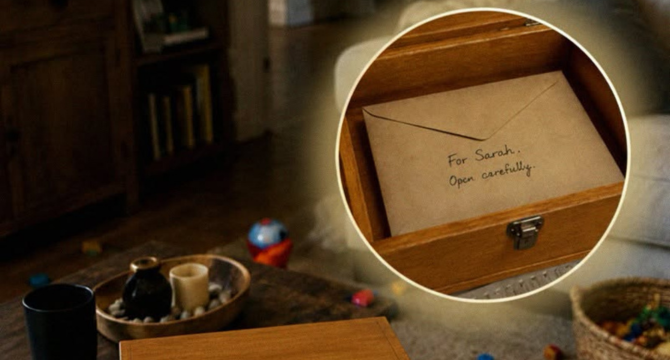
Mark died in a car accident when I was seven months pregnant with our third child.
One moment, we were arguing about baby names.
Next, a police officer was standing at my front door.
That was how fast a life could split in two.
Before and after.
Before, I was Sarah, a wife of nearly 20 years, a mother of two, and a woman who still believed the people she loved would make it home if she waited long enough.
After, I became the woman who stood in the doorway with one hand on her stomach while a police officer removed his cap and said my husband’s name in a voice that made the floor disappear beneath me.
“Ma’am, are you Mark’s wife?”
I remember nodding.
I remember seeing rain on his shoulders.
I remember thinking Mark hated driving in the rain.
Then he said, “There has been an accident.”
Everything after that felt like survival.
I had two grieving children, a newborn on the way, and a future I never wanted.
Our oldest, Nick, was 14 then. He tried to act brave because he thought someone had to. He stopped crying in front of me after the funeral, but I found him in the garage once, sitting beside Mark’s old toolbox with his face buried in one of his father’s work shirts.
Our daughter, Avery, was ten.
She cried loudly, wildly, and without shame. She refused to sleep unless I sat on the edge of her bed and promised I would still be there in the morning.
And then there was the baby.
The baby Mark never got to meet.
The baby whose name we had been arguing about the evening he died.
“I’m telling you, if it’s a boy, Jonah is perfect,” he had said, leaning against the kitchen counter with that stubborn smile of his.
“And I’m telling you,” I replied, folding a towel over my stomach, “I am not naming our child after your childhood goldfish.”
Mark laughed so hard he nearly spilled his coffee.
“That fish lived a noble life.”
“That fish lived three weeks.”
“Still noble.”
I had rolled my eyes, but I was smiling when he kissed my cheek and grabbed his keys.
“I’ll be back in 20 minutes,” he said.
He wasn’t.
People told me time would heal things.
They were wrong.
Time simply taught me how to carry the pain.
For ten years, I raised our children alone. For ten years, I celebrated birthdays without him. For ten years, I wondered what our lives would have looked like if he’d made it home that day.
I learned how to fix a leaking sink because the plumber charged too much. I learned how to sit through parent-teacher conferences alone. I learned how to clap at graduations with one empty seat beside me.
And so, when our youngest was born, I named him Jonah.
Not because Mark had won the argument.
Because he would have laughed, kissed my forehead, and spent the rest of his life reminding me that his “noble” goldfish had finally gotten the tribute it deserved.
It was the last inside joke I could still give him.
By the time my 49th birthday arrived, grief no longer screamed in my house the way it used to. It had become quieter. It lived in smaller places.
In Mark’s old coffee mug at the back of the cabinet.
In the smell of rain on pavement.
In the way Jonah tilted his head when he was thinking, exactly like his father used to do.
That morning started normally.
Coffee.
Work messages.
A cake my kids had secretly bought.
I found it when I opened the refrigerator before breakfast. It was sitting behind a carton of orange juice, badly hidden under foil. Pink frosting showed through the edges.
Avery, now 20, walked in just as I spotted it.
“Don’t look in there,” she said quickly.
I closed the refrigerator door.
“I didn’t see anything.”
“You’re smiling.”
“I smile sometimes.”
“Not that suspiciously.”
Nick, who was 24 and far too pleased with himself, appeared behind her with two mugs of coffee.
“Happy birthday, Mom.”
Jonah, ten years old and still in pajama pants, shuffled in after him and wrapped both arms around my waist.
“You’re not allowed to work too much today,” he mumbled against my sweater.
“I have deadlines.”
“You have children,” Avery corrected. “Three of them. Very demanding ones.”
For a moment, I looked at all of them gathered in my kitchen, and my chest tightened.
Mark should have been there.
He should have been making some awful joke about candles. He should have been pretending not to know about the cake. He should have been kissing the side of my head and asking me how it felt to be 29 again.
Instead, his absence sat at the table with us, familiar and silent.
Still, I smiled.
Because that was what mothers did.
They swallowed the ache so their children could have a good morning.
By noon, Nick had left for work, Avery had gone to campus for an afternoon class, and Jonah was upstairs building something complicated out of blocks he claimed were not toys because “engineering is serious.”
I was at the dining room table answering work emails when the doorbell rang.
Once.
Sharp and clear.
I frowned.
We were not expecting anyone.
I opened the front door and found a delivery driver standing on the porch, holding a large wooden box.
It was not cardboard.
Not a package from some online store.
It was a real wooden box, dark brown, heavy-looking, with brass hinges and my name written across the top on a cream-colored label.
Sarah.
“No return address?” I asked.
The driver glanced at his tablet.
“No, ma’am. Just says scheduled delivery.”
“Scheduled by who?”
He shook his head. “I only drop them off.”
My hands started shaking before I even touched it. Something about it felt wrong.
Or maybe it was familiar.
I signed with a finger that barely obeyed me, then dragged the box inside and set it on the dining room table.
For several minutes, I did not open it.
I only stared.
No return address.
No company logo.
Just my name.
The wood smelled faintly of dust and cedar, like something that had waited too long in a closed room.
“Mom?” Jonah called from upstairs. “Who was it?”
“Delivery,” I answered, though my voice sounded strange even to me.
“For me?”
“No, sweetheart. For me.”
I ran my fingers along the lid.
There was no lock.
Only a small latch.
I opened it.
Inside the box was a smaller envelope.
On the front, written in unmistakable handwriting, were four words, “For Sarah. Open carefully.”
I nearly dropped it.
I knew that handwriting.
I had seen it on birthday cards.
Anniversary notes.
Love letters.
Shopping lists stuck to the refrigerator with magnets.
It was Mark’s.
My knees weakened, and I gripped the back of a chair to steady myself.
“No,” I whispered.
But the envelope remained there.
Real.
Waiting.
I opened it with trembling fingers. Inside was a letter. The date at the top made my heart stop.
It had been written 11 years ago.
A year before his death.
The first lines were enough to make me sit down.
Tears blurred the page. I kept reading.
Mark explained that he had arranged for the box to be delivered on my 49th birthday, no matter what happened to him. He wrote about the kids. About Nick’s serious face and Avery’s dramatic sighs. About the baby he might never meet. About how much he loved us.
By then, I was sobbing.
I pressed the letter to my chest and tried to breathe through the impossible feeling of hearing from a dead man.
Then I reached the last paragraph.
And everything changed.
“There’s something I never told you.”
My stomach tightened.
The next sentence was worse.
“Inside this box is the key to finding her.”
Her.
Not them.
Not the kids.
Her.
I stared at the word, confused and terrified.
Then I looked deeper into the box.
Beneath the letter was an old brass key. A faded photograph. And a birth certificate for a little girl I had never seen before.
Under the photo, Mark had written:
“She deserves to know the truth.”
At that exact moment, someone knocked on my front door.
Not loud.
Not impatient.
Just careful enough to make my skin prickle.
I folded Mark’s letter with fingers that no longer felt like mine, then crossed the hallway and opened the door.
A girl stood on my porch.
She looked about 16, with damp brown hair tucked behind her ears and a backpack hanging from one shoulder. Her face was pale from nerves, but her eyes were steady in a way that made me uneasy.
In her hands, she held a torn piece of a faded photograph.
My breath caught.
It was the other half.
The torn edge matched the photo inside Mark’s box perfectly.
“Are you Sarah?” she asked.
I gripped the doorframe. “Yes.”
Her lips trembled before she spoke again.
“My name is Emily. I’ve been searching for you.”
The name meant nothing to me.
Then she lifted the photograph slightly.
“Was Mark your husband?”
The world seemed to tilt under my feet.
Mark died ten years ago.
Emily was 16.
Which meant she had already been alive while Mark and I were married.
My mind went somewhere ugly before I could stop it.
A secret affair.
A hidden child.
A double life.
All those years I had spent mourning him, loving him, defending his memory, and suddenly I felt as though the ground beneath that memory had cracked open.
“Why are you asking about my husband?” I managed.
Emily swallowed hard. “My mom died three weeks ago. Cancer.”
Something in me softened, but only for a second.
“I’m sorry.”
“Before she died, she gave me this.” Emily looked down at the torn photo. “She told me, ‘If anything happens to me, find Mark.'”
The words struck me like a slap.
Find Mark.
As though he had belonged to someone else, too.
As though there had been an entire part of him I had never touched.
I stepped back from the door.
Emily looked past me and saw the wooden box on the dining table.
“You got it too,” she whispered.
I turned toward the box slowly, as if it might answer for him.
There was a birth certificate inside.
My hands moved before my thoughts could catch up. I returned to the table, snatched it up, and scanned every line again.
Emily followed me inside but stayed near the doorway, as though afraid I might send her away.
I found her name.
Emily.
Mother: Rebecca.
Father: blank.
Then I saw Mark’s name.
Not under father.
Under legal guardian.
I read it three times before the room settled around me.
Legal guardian.
Not father.
Emily watched my face change.
“He wasn’t my dad,” she said softly. “Not by blood.”
“Then what was he?”
Her eyes filled. “I was hoping you could tell me.”
I lowered myself into a chair because my legs were no longer dependable.
For a few minutes, neither of us spoke. The house felt too quiet around us. From upstairs, Jonah’s footsteps moved across his room, innocent and unaware that the world downstairs had just changed shape.
“Come in,” I said finally.
Emily stepped inside and closed the door behind her.
She sat across from me at the dining table, placing her half of the photograph beside mine. Together, they showed a younger Mark standing beside a woman I did not recognize.
The woman held a baby wrapped in a yellow blanket. Mark had one hand on the baby’s tiny foot, smiling in that gentle, open way I remembered too well.
My throat tightened.
“Was that your mother?” I asked.
Emily nodded. “Rebecca.”
Over the next hour, pieces of a life I had never known slid into place.
Years before Mark met me, he had dated Rebecca. She had become pregnant, but the baby’s biological father abandoned her before Emily was born.
Mark was not her father, but he helped anyway. He bought groceries. Paid bills when Rebecca fell behind. Took her to appointments when no one else would.
He stayed long after most people would have walked away.
Eventually, Mark and Rebecca broke up. Rebecca moved away. Later, she married a man who helped raise Emily, and Mark never spoke of her again.
At least not to me.
Then, shortly before Mark died, Rebecca contacted him. She had been diagnosed with cancer. Her husband had already died, and she was terrified Emily would end up alone.
So Mark promised to help.
Quietly.
He began preparing documents, savings accounts, trust funds, and guardianship papers.
“He told my mom he had a family,” Emily said, twisting the strap of her backpack. “She said he loved you. She said he was afraid you’d misunderstand.”
I laughed once, but there was no humor in it.
“He was right.”
Emily flinched.
I regretted it immediately.
“That wasn’t fair,” I said, rubbing my forehead. “I’m sorry.”
“No,” she whispered. “It is fair. I showed up at your house with a dead man’s photograph and a story that sounds insane.”
“It’s not your fault.”
“It still feels like I broke something.”
I looked at her then. Really looked at her.
She was 16.
Her mother had just died.
She had come to a stranger’s house carrying half a photograph because the last person she had left had told her to.
Whatever Mark had hidden from me, Emily had not created the secret.
She had inherited it.
The brass key opened a safe-deposit box at a bank across town.
I went the next morning with Emily sitting beside me in the car, both of us silent. Her hands stayed folded in her lap. Mine gripped the steering wheel so tightly my fingers ached.
Inside the box were folders arranged in Mark’s precise handwriting.
Legal papers.
Account information.
Instructions.
And another letter.
This one was addressed to me.
“Sarah,
I never told you because I was afraid you’d misunderstand. But if you’re reading this, then Emily is alone. And you’re the only person I trust to help her.
She is not my daughter, but she is a child I once promised to protect.
I know this is unfair. I know I should have told you. I was trying to find the right moment, and then I convinced myself there would be time.
Please don’t punish her for my silence.”
I sat in that little bank office and cried until Emily quietly pushed a tissue box toward me.
My children did not take it well.
Nick stood in my kitchen that night with the letter in his hand, his jaw tight.
“So Dad lied to us.”
“He kept something from us,” I said.
“That is lying, Mom.”
Avery crossed her arms. “And now what? We just welcome some stranger because Dad left instructions?”
“She’s 16,” I replied. “Her mother is dead.”
“She’s not our responsibility,” Nick said.
His words were sharp, but I heard the hurt beneath them.
Avery’s eyes shone with tears. “We spent ten years thinking we knew who Dad was.”
“We did know him,” I insisted.
“Did we?” she asked.
Jonah sat at the table, small and quiet, looking from one of us to the other.
“Was Dad a bad person?” he asked.
That broke me more than anything.
I went to him and pulled him close.
“No, sweetheart,” I said into his hair. “No. He was complicated. Like all people are.”
For weeks, tension sat in our house like smoke.
Emily never asked for money.
She never asked for an inheritance.
She never asked for a room, a place at our table, or a piece of my husband’s memory.
Still, my children resisted her.
Sometimes I did too.
Not because I wanted to be cruel, but because every time I saw her, I remembered that Mark had chosen silence. I remembered all those nights we had lain beside each other, talking about the kids, the bills, the baby, the future. I wondered how many times he had almost told me.
And I wondered why he had not trusted me enough to believe I would understand.
Then I found one more item in the safe-deposit box.
A small flash drive tucked inside a paper envelope.
On the front, Mark had written:
“For all of you.”
My hands trembled as I plugged it into the computer.
The video opened to Mark sitting in his old office chair, looking younger than I remembered and more tired than I had ever noticed.
“If you’re watching this,” he began,”“then I failed to say something important while I was alive.
His voice filled the living room.
Nick stood by the wall with his arms folded. Avery sat on the couch, tense and pale. Jonah leaned against me, barely breathing.
Mark explained how he had known Rebecca long before our life together began.
He explained Emily’s birth, the promise he made when Rebecca became sick, and the fear that kept him from telling me the truth while he still had the chance.
Then he looked straight into the camera.
“Nick, Avery, and my little one, whoever-you-are, I need you to know something. Helping Emily does not mean I loved you less. It means your mother taught me that love is not something we protect by making it smaller.”
Avery started crying first.
Nick looked away, but his shoulders shook.
Jonah whispered, “He talked to me.”
On the screen, Mark’s smile wavered.
“Sarah, I should have told you. That is my regret. Not helping Emily. Not keeping my promise. I regret that I made you carry the truth after I was gone instead of trusting you with it while I was alive.”
I covered my mouth.
“I love you,” he continued. “All of you. And I hope someday, when the anger softens, you can see that this was never a second family. This was one scared girl I could not abandon.”
The video ended.
No one spoke for a long time.
Then Nick walked out to the porch, and I followed him.
He stood with his hands in his pockets, staring at the street.
“I’m still mad,” he admitted.
“I know.”
“At him.”
“I know.”
“At you too, a little.”
That hurt, but I nodded. “I know.”
He wiped his face quickly. “But mostly I’m mad that he’s not here to explain it himself.”
I placed a hand on his shoulder.
“So am I.”
After that, things changed slowly.
Not perfectly.
Not magically.
But honestly.
A few days later, Emily came over with a notebook pressed to her chest. She stood in my kitchen, nervous and small.
“I don’t want anything from you,” she said.
“I know.”
She looked down. “I just have one question.”
“What is it?”
Her eyes lifted to mine.
“Can you tell me what he was like?”
For a long moment, I could not answer.
Then I looked at my children, all three of them waiting.
So I told her.
I told her Mark laughed too loudly at his own jokes. I told her he hated folding laundry but loved ironing shirts. I told her he believed every baby name deserved a dramatic speech. I told her he once drove 40 minutes in a storm because Avery wanted peach ice cream.
Nick added, “He used to burn pancakes and call them rustic.”
Avery wiped her cheeks. “He cried during dog food commercials.”
Jonah looked embarrassed before saying, “Mom says I tilt my head like him.”
Emily smiled through tears.
“He sounds kind,” she whispered.
I looked at the photo on the table, the two torn halves finally placed together.
“He was,” I said. “Not perfect. But kind.”
For the first time in ten years, I spoke about Mark not only as the man I lost.
I spoke about him as the man who quietly kept a promise no one knew he had made.
By the time I finished, Emily was crying.
So was I.
Then Jonah slid the last piece of birthday cake across the table toward her.
“He would’ve wanted you to have some.”
Emily stared at it like it was more than cake.
Like it was permission.
Like it was a door opening just enough to let light in.
She picked up the fork and took a small bite.
And somehow, in that aching little kitchen, surrounded by grief, anger, and a truth none of us had asked for, the past did not feel fixed.
But it finally felt honest.