For the 12 years we’d been married, there was one thing my wife never explained.
The tattoo on her left shoulder.
It wasn’t large. Just a tiny black symbol, no bigger than a thumbnail. A simple black mark that looked almost like a crooked little star if you stared too hard at it.
Most people never noticed it, but I did.
Of course I did.
When you love someone long enough, you notice the things they try not to show.
Whenever I asked about it, Emily would smile in that soft way she had when she wanted to shut a door without making it feel rude.
“It’s from a long time ago,” she’d say.
Then she’d kiss my cheek or ask me something unrelated or point out something burning on the stove. And that was that.
Emily was honest about almost everything. She told me when she was angry, when she was scared, when she missed her mother, when work was getting to her, when she thought I was being annoying, and when she thought I was being sweet.
But not about that tattoo.
And over the years, I noticed something else.
She always covered it.
Tank tops with cardigans. Swimsuits with wraps. Dresses with straps placed just right.
Even at the beach. Even during heat waves. Even when we were alone with friends.
I asked less as time went on, partly because I respected her and partly because I figured everyone is allowed one locked drawer in life.
Then one Saturday afternoon, that drawer burst open in the cereal aisle of a grocery store.
Emily and I had gone shopping after lunch. We were having one of those ridiculous married-people arguments that aren’t really arguments.
I was holding a box of plain cereal.
She was holding something coated in enough sugar to classify as a dessert.
“This is not breakfast,” I told her.
“It absolutely is breakfast.”
“It’s candy with vitamins.”
“It says whole grain on the box.”
“If I were to take that in the morning, I’d definitely feel a sugar rush.”
She laughed. “You’re just mad because you have no joy. That sugar rush is joy.”
Then an elderly man pushing a shopping cart froze halfway down the aisle.
At first, I thought he’d recognized someone else.
Then I realized he was staring straight at Emily’s shoulder.
Her sleeve had slipped just enough for the tattoo to show.
The man’s face went pale. The kind of pale that comes from shock so deep it empties the blood out of a person.
He lifted one trembling hand and pointed.
“I never thought I’d see that mark again,” he whispered.
Every bit of color left Emily’s face.
She yanked her sleeve back into place faster than I could blink in confusion.
Then she grabbed my wrist very hard.
“We have to leave. Right now.”
I stared at her. “Emily, what—”
“Now, Daniel.”
I’ve been married long enough to know when a tone is not up for debate.
So I put the cereal box down and followed her.
She moved fast, almost dragging me.
Her breathing had gone shallow and strange.
By the time we shoved through the automatic doors and stepped into the parking lot, I was no longer confused.
I was scared.
Not of the old man, but of whatever memory had just walked up behind my wife and laid a hand on her shoulder.
Then I heard footsteps.
Fast, deliberate, and steady.
“Please,” the old man called. “Please wait.”
Emily stopped.
She didn’t turn around. Neither did I.
The old man came closer, pushing his cart no more, just holding something in one hand inside the pocket of his coat.
Then he said, very softly, “Your mother asked me to tell you something… if I ever found you.”
Emily jerked back like she had been slapped on the face and was bearing the pain.
I turned then.
The man looked to be in his late 70s, maybe older. He was tall but slightly bent and had thin gray hair. Deep lines ran around his mouth. His eyes were kind eyes, but exhausted.
He looked like someone who had spent a long life carrying heavy things that did not belong to him.
And then he reached into his coat pocket.
I stepped in front of Emily without thinking.
He stopped immediately and raised his free hand.
“It’s all right,” he said. “It’s only a photograph.”
He pulled out an old Polaroid.
It was a photo with yellowed edges.
Emily stared at it before he even fully held it out.
Her hand flew to her mouth.
The photograph showed a little girl, maybe six years old, standing beside a woman I recognized from the framed picture Emily kept on her desk at home.
It was her mother, and standing on the other side of them was the old man.
Meanwhile, on the little girl’s shoulder, visible because she was wearing a sleeveless shirt, was the exact same tattoo.
Emily whispered, “I thought this photo got lost.”
The old man’s eyes softened. “Your mother thought so too, for a while. But I had kept a copy.”
I looked at Emily. “Do you know him?”
She nodded once, barely.
The old man spoke gently. “My name is Walter.”
Emily shut her eyes. “You worked at the shelter.”
That was when I realized this was a story that had not started with a tattoo.
It had started a very long time ago.
We ended up sitting in a coffee shop across the street because Emily was shaking too hard to stand in the parking lot much longer.
Walter bought tea he barely touched.
Emily wrapped both hands around her cup like she needed the heat to stay in one piece.
I just sat there and waited.
After a few minutes, Emily looked at me.
“I should have told you,” she said.
I reached for her hand. “Tell me now.”
She nodded.
“When I was six,” she said quietly, “there was a chemical plant explosion near my hometown.”
I stayed still.
“It was bad. There were fires, smoke, evacuations, and people running everywhere. My mom and I got separated during the evacuation.
There were buses, shelters, emergency centers… it was chaos.
I remember screaming for her. I remember strangers picking kids up and moving us from place to place.”
Walter lowered his eyes. He had heard this before, maybe many times.
Emily kept going. “I ended up in one of the temporary shelters. He was there.”
She glanced at Walter. “He helped reunite families.”
Walter nodded. “There were hundreds of children. Some only had first names. Some were too young to say anything. We did what we could.”
Emily stared into her tea. “My mother found me after a few weeks. But during the time we were apart, she became convinced we might never find each other again if something like that ever happened another time.”
Her fingers moved unconsciously to her shoulder.
“So she had the tattoo done,” I said.
Emily gave a tiny nod. “A matching symbol on both of us. Something small. Something permanent. Something only we would understand and use to identify each other.”
Walter said, “Your mother said if the world ever took everything else, that mark would still say who belonged to whom.”
I felt a tight pain and sadness catch in my chest.
Emily let out a shaky breath. “I hated it when I was little because it hurt. Then I loved it because it was ours. Then later…” She swallowed. “Later it just became too painful to look at.”
I knew what “later” meant before she said it.
Her mother. Emily had told me years ago that her mother died in an earthquake back in her hometown while she was away at college.
Their house collapsed. There was confusion, missing-person chaos, and bodies that were never properly identified.
Emily had searched, called, begged, traveled back, waited, and eventually been forced into the kind of acceptance that is really just exhausted grief.
“She died,” Emily said, voice cracking. “After always having her in my life, she was gone.”
Walter looked at her for a long moment. “That is what I want to talk to you about. She survived the earthquake.”
Emily’s face crumpled.
For a second, she looked not like my wife of 12 years, but like the little girl in the photograph.
“What?”
Walter took a careful breath. “She was injured, but she survived. She managed to get out of the house before it collapsed.”
“Oh no,” Emily cried out, “but I looked and never found her. I searched in all shelters, hospitals, and morgues I could think of, and I never found her.”
Emily was crying openly now, silent tears just spilling down.
“It’s not your fault,” Walter answered. “After such a big disaster, finding each other is hard. I know. I did that job all my life, and reunifying families was always so hard.”
I rubbed Emily’s back, but I felt almost numb myself.
“Your mom gathered things from the house before it collapsed further. Photos, papers, and keepsakes. She was brought to a church clinic first, where I was volunteering. We recognized each other, and I was there for her during that period.”
Emily whispered, “After I didn’t find her, I moved states. It was too hard living near our home, knowing she was no more.”
Walter’s face folded inward with regret. “She tried. We both tried to find you.”
Emily started sobbing again.
“I moved, dropped out of college, changed my old numbers as people kept asking if I had found her. After following every lead I could get and not finding my mom, I just wanted to start afresh,” she said.
“We looked for you everywhere. At college, I reached out to friends who knew you. It’s like you disappeared off the face of the earth.”
Emily shook her head slowly, like her body rejected the words.
“I thought she was dead,” she said. “I left everything behind me because I thought I lost my mother.”
Walter nodded sadly. “Yes.”
No one spoke for a moment.
Then Emily asked the question I had been thinking, “What happened to my mom then”
Walter reached into his coat again.
This time Emily didn’t flinch.
He pulled out a sealed envelope, worn soft at the edges from age. Emily’s name was written across the front in faded handwriting.
Walter placed it on the table like it was something fragile enough to bruise.
“She gave me this a few years after the earthquake,” he said.
“I’m sorry, Emily. She did not live long after that. She had a heart attack and died.”
Emily was sobbing harder now. She was mourning for the second time.
Mourning her mother and the time they missed having together, if only they could have found each other.
Walter continued, “Before she died, she told me, ‘If you ever meet my daughter again, give this to her.’ So I kept it with me. All this time.”
Emily stared at the envelope but didn’t touch it.
“I carried it for years,” Walter said.
“I moved to this state after marrying my wife. I needed a fresh start from my work as a volunteer. The job of reunifying families has its ups, but it takes from you so much when you don’t.”
I gave Emily tissues, and she began to calm down, listening to Walter.
“Even after moving, I kept my promise to your mother. I have carried this for decades. I brought it with me more often than I should have. My wife used to say I was waiting for a miracle to happen.”
Emily picked up the envelope with shaking hands.
Inside were several folded letters and a small silver key taped to the back of the last page.
Emily unfolded the first letter so carefully it looked like she was afraid the paper might disintegrate.
She read the opening line and let out a sob.
I didn’t read over her shoulder. I just held her hand while she read.
After a while, she handed me the first page.
“My sweet girl, if this ever reaches you, then it means I failed to find you while I was alive. I need you to know I did not stop looking.”
I had to stop reading for a second.
The letters were dated over several years. Some were short, some were longer. Her mother wrote about missing her.
About remembering the smell of her hair after a bath.
About hearing her laugh in dreams.
About the guilt of surviving the earthquake when it stole the chance to bring her daughter home again. About the tattoo.
About how she covered her own too, because looking at it hurt, but she would never have removed it because it was still a promise.
In one letter she wrote: “I might never see you again, but this tattoo, it has always remained a symbol of your presence with me. Deep in my heart.”
Walter waited quietly, giving grief the dignity of time.
Then he explained that the key was for a safe-deposit box at a local bank in Emily’s hometown.
The next weekend, we drove there.
The whole trip, Emily was quiet in the way people are when they are bracing for both hope and pain. I did most of the driving.
Sometimes she reread the letters. Sometimes she just stared out the window with one hand over her shoulder.
The bank manager had already been contacted by Walter, who had apparently kept records more organized than anyone I know.
We were led into a small private room, and the box was brought out.
Emily held the key for a long second before putting it into the lock.
Inside were pieces of a life rescued from disaster and saved against time.
Photographs, home videos, childhood drawings, birthday cards, a little fabric rabbit with one ear bent, report cards, a pressed flower inside a book, and journals, several of them.
Emily touched everything like she couldn’t believe all these pieces of her childhood and her life with her mother were still here.
At one point, she picked up a drawing done in thick red crayon and laughed through tears.
“I made this,” she said.
It was a picture of two stick figures holding hands under a giant crooked sun.
Written at the top in large, uneven letters: ME AND MOM.
I thought that might break me more than any letter had.
There was also a note in the box, written later than the others.
“If you are opening this, then someone finally found you for me. These are the pieces I saved when the house fell. I could not save enough. But I saved what we loved, and I saved it for us.”
By the time we got back to the hotel that night, Emily was emotionally wrung out. She sat on the edge of the bed with one of the journals in her lap and said, “I spent years grieving her.”
I sat beside her.
Then she said, “Now it’s like I am starting all over again, but with the closure I very much needed.”
I didn’t know what I could say to that.
So I just put my arm around her and let silence do its work.
Over the next few weeks, our house became a place filled with the past.
We watched the home videos one by one.
One of Emily at four in rain boots. Another of Emily at seven, missing her front teeth. One of her mother laughing behind the camera.
A Christmas morning, a school play, and a birthday cake with too many candles pushed into one side.
Sometimes Emily smiled so wide I saw the woman I married at twenty-six.
Sometimes she cried so hard I had to pause the video.
A few days after we came back from her hometown, Emily stood in front of our bedroom mirror wearing a tank top.
That alone caught my attention because she almost never wore them, not even at home unless she had a sweater nearby.
She looked at her reflection for a long time.
Then she said, “I want to showcase the tattoo now, as a memory of who my mother and I were.”
I walked up behind her and met her eyes in the mirror.
I said. “That’s wonderful. I think it’s one of the most beautiful things I’ve ever seen.”
She nodded, and tears filled her eyes again, but this time they looked different.
Less shattered, and more bittersweet.
“I used to cover it because it reminded me of losing her,” she said.
“And now?”
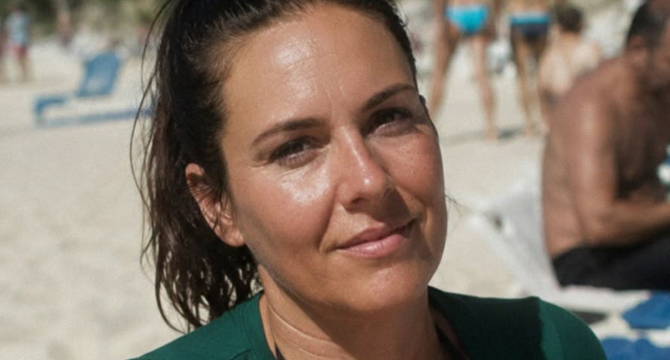
That weekend we went to the beach.
It was hot, the kind of bright summer heat that makes everything look too alive and beautiful.
Emily wore a swimsuit I had never seen before because it didn’t hide her shoulders at all.
For a while, I kept waiting for her to tug at a cover-up or angle herself away or cross her arm over it.
She didn’t.
She walked straight into the sun with that little black mark visible to anyone who happened to look.
Nobody did, of course.
That was the strange thing.
This symbol that had held so much grief, so much memory, so much fear was still tiny to the rest of the world.
But not to her.
And not to me.
That night, after we got home, Emily put one of her mother’s photographs on the mantel.
It was the one from the Polaroid, only there was a better copy in the safe-deposit box.
The three of them were in it: little Emily, her mother, and Walter, all looking half tired and half relieved after the disaster.
“I want to call him tomorrow,” she said.
“Walter?”
She nodded. “I don’t think anyone’s thanked him enough.”
I smiled. “Probably not.”
She looked at me then, really looked at me, and said, “I’m sorry I never told you.”
I shook my head. “You didn’t owe me the story before you were ready.”
“Maybe not. But I wish I had been open about it.”
Marriage teaches you a lot of things. Patience and timing are among the lessons.
For 12 years, I thought the tattoo on my wife’s shoulder was a secret.
It wasn’t.
It was a promise made between a frightened mother and a frightened little girl on the worst day of their lives.
A promise that survived disaster, distance, grief, and death.
A promise that found its way back in a grocery store beside the cereal.
And now, for the first time since I’ve known her, Emily doesn’t hide it anymore.