The day I started working the night shift at the hotel, the manager gave me one rule that made absolutely no sense.
I was 29 then, old enough to have worked bad jobs and young enough to still believe a new one could change my life. The hotel stood on the edge of downtown, where the office towers thinned into old brick buildings and closed storefronts.
From the outside, it looked elegant in a tired way.
Brass doors. Tall windows. A faded green awning that snapped in the wind like it was trying to warn people away.
My manager, Victor, was 54 and built like a man who had learned to take up less space over time. His suit fit well, but his shoulders stayed tense, as though he was always bracing for bad news.
He walked me through the lobby during my first hour, showing me the guest ledger, the card machine, the phone console, and the little drawer where we kept spare batteries, stamps, and lost jewelry no one ever claimed.
“Night shift is mostly quiet,” he told me.
“That sounds good to me,” I replied. “Quiet pays the same as chaos.”
He did not laugh.
Instead, he stopped beside the front desk and looked me straight in the eye.
“Whatever happens… NEVER answer calls from Room 312.”
I laughed, expecting him to smile.
He didn’t.
The lobby felt too still after that. Even the chandelier seemed to dim.
“If the phone rings from 312… don’t answer it.”
I waited for him to explain, but he only leaned closer, lowering his voice.
“If someone asks for the key… tell them it doesn’t exist.”
My smile faded. “What do you mean, it doesn’t exist?”
“And if you hear knocking from inside…”
He paused.
“IGNORE IT.”
That was the end of the conversation.
Victor stepped away as if he had said something normal, like where the coffee filters were kept. I stood behind the desk, staring at the phone console, waiting for him to turn around and admit it was some hazing ritual for new hires.
He never did.
By midnight, I had met two of my coworkers. Mara from housekeeping was 41, with sharp eyes and silver hoops that brushed her jaw. Silas, the security guard, was 36, tall and quiet, the kind of man who looked like he had swallowed every secret he had ever heard.
When I mentioned Room 312, Mara’s hands froze around a stack of fresh towels.
“Victor told you?” she asked.
“Told me not to answer calls from it.”
She pressed her lips together. “Then don’t.”
Silas appeared in the doorway behind her. “Aaron, leave that alone.”
The way he said my name made my stomach tighten. It was not a warning meant to scare me. It sounded more like he was tired of watching people make the same mistake.
The strange part?
Room 312 wasn’t listed anywhere. Not in the booking system. Not on the emergency evacuation map. Not even in the building’s original floor plans. Officially, the room didn’t exist.
I checked because I could not help myself.
On my second night, I pulled up the booking system and searched every room on the third floor. It skipped from 311 to 314. I found an old evacuation map framed near the service elevator. Third floor, same thing. Rooms 301 through 311 on one side, then 314 through 326 around the corner.
No 312.
I told myself old hotels were strange. Maybe there had been renovations. Maybe a linen closet used to be a guest room. Maybe Victor liked frightening new employees so we would not fall asleep at the desk.
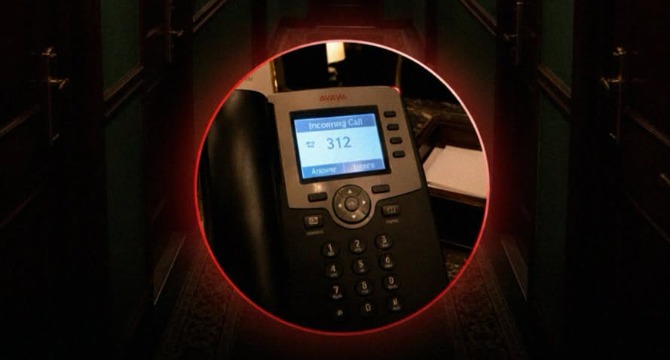
Then the phone rang.
It was just after 2:00 a.m.
The sound cut through the lobby so sharply that my whole body flinched. The console lit up.
Caller ID: 312.
I stared at it until my eyes burned.
The ringing stopped after the fourth ring.
I did not sleep when I got home that morning. Every time I closed my eyes, I saw those three numbers glowing red on the console.
The next night, it happened again.
Just after 2:00 a.m., the phone at the front desk RANG.
Caller ID: 312.
My hand hovered over the receiver. I could still hear Victor’s voice.
“Whatever happens… NEVER answer calls from Room 312.”
So I didn’t.
On the fourth night, the call came, and this time it did not stop after four rings. It rang and rang until the lobby seemed to pulse with it.
I finally picked up the receiver, then set it back down without bringing it to my ear.
My heart hammered like I had broken some law.
Sometimes there was only slow, steady breathing.
I learned that from Silas, though he would not say how he knew. He only muttered it after finding me staring at the phone one night.
“Sometimes it breathes,” he said. “Sometimes it begs.”
“Begs?”
He looked toward the ceiling.
Other nights, a QUIET VOICE whispered:
“Can someone PLEASE open the door?”
I never answered.
At least, not at first.
A week later, curiosity got the better of me.
It was a rainy Tuesday, and the hotel had only 18 guests.
The lobby smelled like wet wool and old carpet. Around 3:00 a.m., after the call from 312 had come and gone, I went into the security room while Silas was checking the parking garage.
I reviewed the security footage.
That’s when I noticed something IMPOSSIBLE.
Almost every night…
Someone walked down the third-floor hallway.
Stopped outside Room 312.
Looked around.
Then disappeared inside.
No key. No staff escort. No record of anyone entering the hotel.
The next morning, there was never anyone leaving.
I watched the footage three times, my mouth dry each time.
The person was different from night to night.
Once, a man in a dark coat. Once, a woman with long hair and bare feet. Once, someone small enough to be a teenager, moving stiffly as if pulled by a string.
Each time, they stopped at the same blank stretch of wall between 311 and the service stairwell.
Each time, they vanished.
When I asked my coworkers about it, they all gave me the same answer.
“Don’t ask.”
Mara would not meet my eyes. Silas told me to delete whatever I thought I had seen. Victor looked older every time I brought it up, like the question itself took years off him.
On my 12th night, the phone rang AGAIN.
This time, I picked up.
“Sable desk,” I said, though my voice barely sounded like mine.
SILENCE.
Then the same calm voice whispered, “You’re LATE.”
The line went dead.
I don’t know what came over me.
Maybe it was pride. Maybe it was fear wearing the mask of courage. Maybe I was tired of being treated like a child by people who clearly knew something and refused to say it out loud.
I grabbed the master key ring, even though everyone insisted no key fit Room 312.
I climbed the stairs.
The third floor was colder than the lobby. The carpet swallowed my footsteps. Every door I passed looked ordinary, with its brass number plate and tiny peephole.
The hallway was empty.
The brass numbers on every door ended with 311…
Then, at the very end of the corridor, I noticed a narrow door I’d somehow never seen before.
My breath left me.
The door was narrower than the others, painted the same cream color as the walls. Its brass numbers were clean and bright, as if someone polished them every day.
I slid the master KEY into the LOCK.
It clicked.
The door slowly creaked open.
Inside, something caught my eye immediately.
I instinctively took a step back.
Then, without taking my eyes off what was in the room, I reached for my radio with trembling hands and said, “I need the manager on the THIRD FLOOR…”
There was a long silence.
Then his voice crackled back.
PANICKED.
“Get out of Room 312. NOW!”
I couldn’t.
Because what I had JUST SEEN… shouldn’t have been possible.
For a few seconds, I forgot how to breathe.
Room 312 was not dusty. It was not abandoned. It did not smell like rot, old wallpaper, or anything else I had imagined during the long hours behind the front desk.
A warm lamp glowed beside a narrow bed. There was a half-empty bottle of water on the nightstand, a pair of sneakers near the chair, and a gray sweatshirt folded neatly over the armrest.
Someone had been living there.
Then I saw the wall.
It was covered with photographs.
Not old portraits or strange hotel pictures. Real photos. Recent ones. Men and women entering courthouses. A black SUV parked outside a diner. A blurry shot of a man in a baseball cap crossing a street. Newspaper clippings were pinned between them with red string connecting names I did not recognize.
At the center was one photo that made my throat tighten.
It was of Victor.
Younger, maybe by 20 years, standing beside a woman with dark hair and a little boy holding a stuffed bear. Someone had written one word across the bottom in black marker.
“SURVIVED.”
“Aaron!”
Victor’s voice exploded through the hallway behind me.
I turned so fast I nearly dropped the radio. He stood outside the door, breathing hard, his face drained of color. Silas was behind him, one hand hovering near his belt as if he expected something to come running out of the room.
“I told you to get out,” Victor said, but his voice cracked on the last word.
“What is this?” I asked. “Who lives here?”
Victor looked past me into the room, and the anger on his face collapsed into something worse. Grief. It softened his mouth and aged his eyes all at once.
“Close the door,” he whispered.
“No,” I said, surprising myself with how firm my voice sounded. “You don’t get to do that. Not now.”
Silas stepped closer. “Aaron, listen to him.”
“I have been listening to all of you for 12 nights,” I snapped. “Don’t answer the phone. Don’t ask questions. Pretend a room that clearly exists doesn’t exist. I thought someone was dead in here. I thought someone was trapped.”
Victor flinched at that.
From inside the room came a soft sound.
A chair scraped.
Then a woman’s voice said, “Victor?”
I froze.
A woman stepped from the bathroom, holding a small black pistol in both hands. She was around 60, with short gray hair and eyes that looked like they had not trusted a peaceful room in years. She did not aim the gun at me, not exactly, but she did not lower it either.
Victor raised his palms. “Nora, it’s okay. He’s staff.”
Her gaze moved over me. “New staff?”
“Yes.”
“And he opened the door.”
“I got a call,” I said, before Victor could answer for me.
Her face changed. “From this room?”
“The phone rang. Caller ID said 312. A voice told me I was late.”
Nora’s hand trembled. Only slightly, but I saw it. That tiny movement frightened me more than the gun.
Victor turned to Silas. “Lock the stairwell doors.”
Silas nodded and disappeared down the hall, moving faster than I had ever seen him move before.
My fear shifted. It did not leave. It changed shape. This no longer felt like a haunting. It felt like something alive, organized, and very close. The kind of fear that did not come from a ghost behind a door, but from a person who knew which door to knock on.
Victor shut the door behind us. “You need to forget everything you saw.”
I laughed once, bitter and shaky. “That is not going to happen.”
Nora lowered the gun and sat on the bed. Suddenly she looked exhausted, almost fragile. The weapon rested in her lap like it weighed more than it should have.
“He should know enough not to get himself killed,” she said.
Victor rubbed a hand over his face. “This hotel was used by federal marshals years ago. Quietly. Long before I became manager.”
“Used for what?” I asked.
“Witness protection,” Nora answered.
The room seemed to tilt. My mind went back through every call, every warning, every whispered story my coworkers refused to finish.
She continued, voice low and steady. “People who testified against violent crews needed somewhere to disappear for a night or two. Sometimes longer. This room was built into the hotel during a renovation and left off public records. The booking system never had it. The maps never had it. Only a few people were supposed to know.”
I looked at the photos again. Suddenly, they were not creepy. They were evidence. They were threats. They were pieces of lives that had been cracked open in courtrooms and dark parking lots.
“And the calls?” I asked.
Victor sighed. “A dead line tied to an old internal alert. It was meant to warn the desk when someone inside needed extraction or when an outside contact arrived early.”
“But the voice,” I said. “The breathing. Someone asking to open the door.”
Nora’s eyes shone, though she did not cry. “Fear makes every sound into a ghost when no one tells the truth.”
Victor walked to the wall and touched the photo of his younger self. His fingers hovered over the woman’s face before dropping to his side.
“My wife was a witness,” he said. “My son and I were moved through this room in 2004 after she testified. She didn’t survive the year.”
The words landed softly, but they broke something open in him. For the first time since I had met him, Victor did not look like a manager guarding a rule. He looked like a man still standing beside a grave, still waiting for a life that had been taken from him to make sense.
“I’m sorry,” I murmured.
He nodded once, but he did not look at me. “After the program stopped using the hotel, the rule stayed. Managers told new managers. Staff told staff. No one explained too much because too much could put people in danger. Then people retired. Some died. Records vanished. The truth turned into a legend.”
“So every new employee was told never to answer calls from Room 312,” I said.
“Because once, that rule kept people alive,” Nora replied.
A hard knock struck the door.
All three of us went still.
Silas’ voice came from the hallway. “Victor, we have a man at the service entrance asking for the key to 312.”
Nora stood.
Victor’s jaw tightened, and all the fear I had seen in him turned into focus. He was no longer the tired man at the front desk. He was someone who had survived one nightmare and refused to let another begin.
He looked at me. “Now you understand why we tell them it doesn’t exist.”
My mouth went dry. “What do we do?”
“For once,” he said, “we do not follow a legend. We follow the truth.”
Within minutes, Victor called a number he still knew by memory. Nora moved with the calm of someone who had survived by never wasting panic. Silas guided guests away from the third floor with a story about a water leak. I stood at the desk, hands shaking, and watched the lobby with new eyes.
Every creak mattered. Every guest who crossed the floor became a question. Every shadow near the service entrance made my pulse jump.
The man at the service entrance was gone by the time federal agents arrived, but not before cameras caught his face. Nora was moved before sunrise. No flashing lights. No sirens. Just quiet footsteps, low voices, and the soft closing of doors.
I watched her leave through the back corridor in a navy coat, her hand resting on Victor’s arm for one brief second.
“You kept the room,” she told him.
“I kept the promise,” he replied.
She looked at me then. “You answered when you shouldn’t have.”
“I know,” I admitted.
“But you opened your eyes after that,” she said. “That matters too.”
By morning, Room 312 was empty again.
The door blended back into the wall so well that even I had to stare to find its outline. The phone at the desk never rang from 312 again, but I stayed at the hotel for two more years. I became quieter, slower to mock what I did not understand, and more careful with the stories people carried.
I used to think rules were either sensible or stupid. I learned that some rules are scars. Some warnings sound strange only because the pain behind them has been buried.
Legends are not always lies.
Sometimes they are truths that have lost their names.