In modern relationships, few threads are as delicate and challenging to weave as those of blended families. Today, we delve into a story that resonates with countless individuals facing the daunting task of balancing love, career, and unexpected parental responsibilities. Meet Maya, a 32-year-old woman whose engagement to Mark, a father of two, has suddenly transformed from a journey of romantic partnership to an unexpected crash course in full-time step-parenting.
Here is full story:
I (32F) have been engaged to Mark (38M) for the past year. When we first started dating, he told me he had two kids (2F and 9M) from his previous marriage, but they lived primarily with their mother. He would see them every other weekend and for a few weeks during the summer. I was okay with this arrangement, as I’ve always been on the fence about having kids myself.
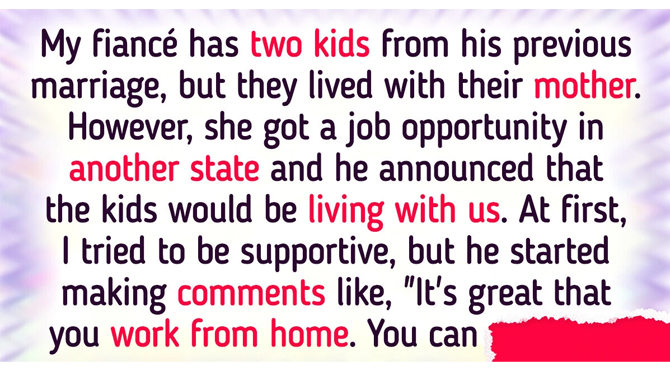
Everything was going great until about two months ago when Mark’s ex-wife, Lisa, got a job opportunity in another state. Suddenly, he announced that the kids would be living with us full-time.
At first, I tried to be supportive, but it quickly became apparent that Mark expected me to take on a significant role in childcare. He started making comments like, “It’s great that you work from home. You can watch the kids after school,” and “You’ll make such a wonderful stepmom.”
The breaking point came last week when I overheard a phone conversation between my fiancé and his ex-wife.
Him: “Yeah, don’t worry about it. She’s here all day, so she can handle everything.”
Her: “Are you sure? That’s a lot to put on her.”
Him: “It’s fine. She loves them, and honestly, it’s about time she started pulling her weight around here.”
I was furious. I confronted him as soon as he hung up.
Me: “Excuse me? ‘Pulling my weight’? Since when did I agree to be a full-time nanny?”
Him: “Come on, Sarah. They’re going to be your stepkids. It’s not babysitting; it’s parenting.”
Me: “But we never discussed this! I have a career, Mark. I can’t just drop everything to watch your kids.”
Him: “My kids? They’re going to be our kids. Don’t you want to be a family?”
The argument escalated, with Mark accusing me of being selfish and not caring about his children. He even went as far as to say, “If you loved me, you’d love my kids just as much.”
I was so hurt and angry that I packed a bag and left to stay with my sister. Now, Mark is blowing up my phone, alternating between apologies and guilt trips. His family is calling me an “a terrible partner” for “abandoning” the kids, saying I knew what I was getting into when I agreed to marry a man with children.
But I don’t think I did. I agreed to marry a man who had part-time custody, not to become an instant full-time mom. I love Mark, but I’m starting to wonder if we’re compatible. I’m considering calling off the engagement, but I can’t help feeling guilty about the kids.
Was I wrong to break off my engagement with my fiancé over his insistence that I take on the role of full-time caregiver for his children?
Best, Maya
Maya, your letter touches on a deeply personal and complex situation that many individuals face when entering relationships with partners who have children from previous marriages. Your dilemma highlights the importance of clear communication, mutual respect, and shared expectations in any relationship, especially when it involves blending families.
There was an unexpected shift in circumstances.
You entered this relationship with a clear understanding of Mark’s parenting arrangement – part-time custody, with his children living primarily with their mother. This sudden change to full-time care is a significant shift that would impact anyone’s life. It’s completely understandable that you feel overwhelmed and unprepared for this new reality.
The transition from being a weekend stepmom to a full-time caregiver is enormous, and it’s not a decision that should be made lightly or unilaterally. This abrupt change has understandably thrown your life into turmoil, forcing you to reconsider your role not just in Mark’s life, but in the lives of his children as well. It’s important to acknowledge the emotional whiplash you must be experiencing.
Going from occasional caregiver to full-time parent figure is a monumental shift that would challenge even the most prepared people, let alone someone who was on the fence about having children to begin with.
One of the most concerning aspects of your situation is the lack of open communication.
Major life changes, such as taking on full-time care of children, should always be discussed and agreed upon by both partners. Mark’s assumption that you would automatically take on this role without any prior discussion shows a lack of consideration for your feelings, career, and personal goals. Relationships are partnerships, and decisions that affect both parties should be made together. The fact that you overheard Mark’s conversation with his ex-wife, rather than being included in these discussions from the beginning, is a red flag that cannot be ignored.
This breakdown in communication suggests a deeper issue within your relationship. It raises questions about Mark’s respect for your autonomy and his willingness to include you in important decision-making processes. A healthy partnership requires transparency and mutual respect, both of which seem to be lacking in this situation.
You’re not selfish for having reservations about this new arrangement.
You entered this relationship with certain expectations and life goals, including maintaining your career. It’s perfectly valid to have boundaries and to express your own needs and desires within a relationship. Being a stepparent is a challenging role that requires careful consideration and preparation. You shouldn’t feel pressured to take on more than you’re comfortable with, especially when it comes to such a life-altering responsibility.
Your career and personal aspirations are not less important simply because Mark has children. A truly supportive partner would recognize this and work with you to find a solution that respects both of your needs. It’s important to remember that maintaining your identity and pursuing your personal goals doesn’t make you a bad partner or potential stepparent.
In fact, taking care of your own needs and maintaining your sense of self can make you a better, more fulfilled partner and role model for any children in your life.
It’s important to address the guilt you’re feeling.
Mark’s family calling you a “terrible partner” for “abandoning” the kids is unfair and manipulative. You didn’t abandon anyone – you removed yourself from a situation where your boundaries were being disrespected, and your voice was not being heard. It’s not your responsibility to sacrifice your entire life and career for a situation you never agreed to.
Love for a partner doesn’t automatically translate to being ready for full-time parenthood, especially when it’s thrust upon you without warning or discussion. The emotional manipulation you’re experiencing from Mark and his family is not a healthy foundation for any relationship, let alone one involving children. This guilt-tripping tactic is a form of emotional violence that seeks to control your behavior by making you feel responsible for others’ happiness at the expense of your own.
Remember, you have the right to make decisions about your own life without being vilified for it. Setting boundaries and prioritizing your well-being is not selfish – it’s essential for your mental and emotional health.
This situation has brought to light some fundamental differences in terms of expectations, communication styles, and life goals.
It’s wise of you to step back and reevaluate whether this relationship aligns with your vision for your future. Compatibility isn’t just about loving someone – it’s about shared values, mutual respect, and the ability to navigate life’s challenges together. If Mark is unable to consider your perspective and work towards a solution that respects both of your needs, it may indeed indicate a deeper incompatibility.
It’s crucial to consider whether these issues can be resolved or if they represent irreconcilable differences in your life paths. Take time to reflect on your long-term goals and whether this relationship, as it stands, aligns with those aspirations. Consider not just the immediate situation, but how you envision your life 5, 10, or 20 years down the line. A partnership should enhance your life and support your growth, not require you to completely sacrifice your dreams and autonomy.
It’s time to prioritize your own well-being.
Seeking support from friends, family, or a professional counselor can provide you with valuable perspectives and emotional support. Don’t hesitate to lean on your support network during this challenging time. It’s also important to give yourself permission to take the time you need to process your feelings and make decisions without rushing. Your mental and emotional health should be a priority, especially when facing such a significant life decision.
Consider engaging in activities that bring you joy and peace, whether it’s exercise, meditation, or pursuing a hobby. These self-care practices can help clear your mind and provide the emotional stability needed to make such an important decision. Remember, taking care of yourself isn’t selfish – it’s necessary for your overall well-being and will ultimately benefit those around you as well.
While your primary concern should be your own well-being and future, it’s also worth considering the impact on Mark’s children.
They are innocent parties in this situation and are likely also struggling with the sudden changes in their lives. However, this doesn’t mean you’re obligated to become their full-time caregiver.
If you do decide to end the relationship, it might be helpful to think about how to do so in a way that minimizes additional trauma for the children. This could involve having an honest conversation with them (if age-appropriate) or ensuring they have proper support during the transition. Remember that children are resilient, and while changes can be difficult, they can also adapt to new situations with proper support.
If you choose to stay in their lives in some capacity, be clear about your role and boundaries. If you decide to step away entirely, know that it’s okay to prioritize your own well-being. The children’s primary caregivers – their father and mother – are ultimately responsible for their emotional well-being.
While blended families can be beautiful and rewarding, they require careful navigation, open dialogue, and mutual understanding to succeed. Whatever you decide, remember that your feelings, career, and personal goals are valid and important.