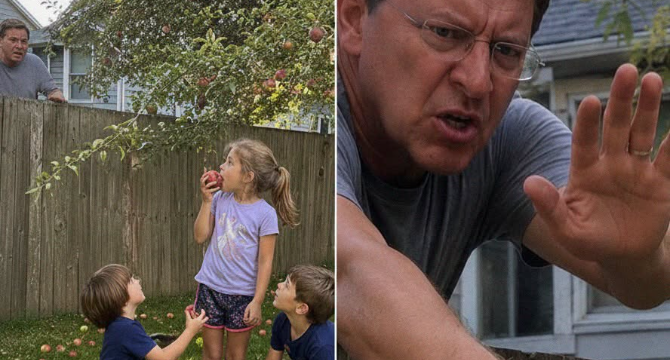
Her neighbor insisted every apple from his tree belonged to him, even after it landed in her yard. But when he made her six-year-old collect them one by one, her husband came up with a plan that made the neighbor regret claiming every last apple.
My neighbor stood at the fence and made my six-year-old carry apples across the yard to him, one armful at a time.
The tree is his.
About a third of it hangs over our fence, which means every August and September we get apples in our grass.
In the flower bed, under the swing set, in the driveway.
I’ve raked them.
I’ve bagged them.
Two years ago one rotted into the paint on our shed and left a mark that’s still there.
Last Sunday, the kids were out back after lunch.
Maya’s six and Leo’s seven.
They’d found a soft one and were seeing how far it would come apart against the fence post.
Then Dale came out on his side.
He’s 58.
He’s lived there longer than we have.
He just stood at the fence with his arms folded and looked at my children through the slats.
“Those are mine. Bring them here.”
Leo said, “What?”
“All of them. Every one that came off my tree. Bring them to the fence.”
“They fell on our side.”
“Doesn’t matter where they land. It’s my tree.”
And they did it.
That’s the part I can’t get out of my head.
They obeyed him like they’d done something wrong.
My kids went around their own backyard picking apples and walked over to the fence holding them in their arms. Meanwhile, he stood on his side, took them one load at a time, and dropped them into a bag.
Maya couldn’t carry more than three at a time.
She made four trips.
She kept looking up at the deck at me.
I said his name.
He didn’t turn his head.
When they were done, he pulled the bag shut. Then, he looked up and saw me standing there.
“Nice. Raising thieves young, are we?”
Maya cried.
Leo didn’t, which was worse.
He just stood in the middle of the yard with his hands dirty, looking at the ground, ears going red.
I wanted Rob to see what Dale had done to them.
I got two photos through the deck rail.
I sent them to Rob at work with one line, “He stood at the fence and made them bring him every apple in our yard.”
He called me 40 seconds later.
“Say it again.”
I said it again.
He went silent for a moment.
“Send those photos to my personal email, not my work one,” he said. “And don’t delete them off your phone.”
“Rob.”
“Sarah, I need you to not rake this year. Not one. Leave every single one exactly where it falls.”
I thought I’d misheard him.
“What?”
“Don’t rake the apples.”
“Why?”
“Just trust me.”
That is not a sentence husbands should use if they want their wives to remain calm.
“What are you planning?”
“Nothing stupid.”
“That doesn’t answer me.”
“It does in my head.”
“Rob.”
He exhaled.
“I’m going to find out exactly where the property line is and exactly what we’re allowed to do about that tree.”
I looked toward the yard.
Maya was inside now.
Leo was still near the fence, kicking at the grass.
“You want the apples to stay there for evidence?”
“Exactly.”
That word made me feel both relieved and slightly ridiculous.
Evidence. Over apples.
But then I looked at my son’s face again.
This wasn’t really about apples anymore.
That afternoon, Rob came home early.
The first thing he did was go into the backyard.
He didn’t knock on Dale’s door.
Didn’t yell across the fence.
He crouched beside the swing set and photographed everything.
The low branches hanging over our yard.
The apples in the flower beds.
The dents in the grass where several had fallen.
The stain on the shed.
Then he took pictures of the fence line itself.
Dale appeared ten minutes later.
“Got a photography hobby now?”
Rob didn’t look up.
“Just documenting our yard.”
“Those apples are mine.”
Rob finally turned.
“We know. You made that very clear to two little kids.”
Dale shrugged.
“They were taking what’s not theirs.”
“They were playing with fruit that fell into our yard.”
“From my tree.”
Rob stood.
“Right.”
Something in his tone made Dale frown.
“What?”
Dale stared at him.
Then at me.
Then disappeared inside.
That evening, Rob showed me what he’d been researching.
Not random online comments.
He’d called our town’s property office.
Then a local arborist.
Then, because apparently he was determined to become the world’s most overprepared husband, a property attorney who offered a short consultation.
The answer was annoyingly nuanced.
Rules about trees, fallen fruit, overhanging branches, and property boundaries can vary depending on where you live.
But in our area, one thing was clear.
We could not simply hack Dale’s tree apart.
We could, however, address branches extending onto our property so long as the work was done properly and didn’t recklessly damage the tree.
And if the overhang created a recurring nuisance or safety issue, documentation mattered.
“So the apples matter,” I said.
“The apples matter.”
“You’re really going to leave them all there?”
“Every one.”
“Do you know what our yard will smell like?”
“Justice.”
I stared at him.
“Rotten apples.”
“Justice can smell complicated.”
I laughed.
The next morning, Maya refused to go near the fence.
I found her sitting on the deck steps with a toy bucket.
“What’s wrong?”
“Nothing.”
“You wanted to play outside.”
She pointed toward the apple tree.
“I don’t want him to think I’m stealing.”
That did it.
I sat down beside her.
“You are not stealing anything.”
“But he said—”
“Dale was wrong.”
“Adults can be wrong?”
I almost laughed.
“Constantly.”
She thought about that.
“Even you?”
“Especially me.”
That got a small smile.
Leo was different.
He acted like he didn’t care.
But when an apple fell while he was on the swing, he jumped off and walked away from it.
He didn’t touch it.
That bothered Rob more than anything.
“This is their yard,” he said that night.
“I know.”
“They’re scared of fruit in their own yard.”
“I know.”
He looked toward Dale’s house.
“So we’re done being polite.”
For the next 11 days, we didn’t rake.
Every apple stayed where it fell.
I photographed them each morning.
At first, it looked almost funny.
Five apples.
Then nine.
Then 14.
By the second week, the yard didn’t look funny anymore.
Some bruised when they hit the ground.
Some split.
Wasps started appearing.
One apple rolled beneath the swing and burst under Leo’s shoe.
Another landed hard enough on the shed roof that I heard it from inside.
Rob documented everything.
Then he sent Dale a letter.
Not an angry one.
That annoyed me slightly.
It was painfully calm.
He wrote that the overhanging branches were dropping substantial fruit onto our property, including the children’s play area and driveway.
He noted that Dale had personally claimed ownership of every fallen apple.
Then came my favorite sentence.
“Since you have made clear that you consider all fruit from the tree your property, please arrange to collect your property from our yard each evening, or contact us to discuss professionally trimming the branches extending over the boundary.”
I read it twice.
“That’s petty,” I said.
“Thank you.”
“I didn’t say it as a compliment.”
“You meant it as one.”
Rob sent it by certified mail.
Dale received it two days later.
We knew because he came straight over.
He didn’t ring the bell.
He stood at the fence and shouted.
“Rob!”
Rob was grilling burgers.
He kept flipping one.
“Yeah?”
“What the hell is this letter?”
“Which part confused you?”
“You don’t get to threaten my tree.”
“I’m not threatening anything.”
“You said you’re cutting branches.”
“I said we should discuss professional trimming.”
“You touch that tree, and I’ll sue you.”
Rob nodded.
“Okay.”
That seemed to throw Dale off.
“Okay?”
“Then we’ll use the other option.”
“What other option?”
“You collect your apples.”
Dale stared at him.
“I’m not climbing over your fence every night picking up fruit.”
“Good. Don’t.”
“Then rake them.”
Rob smiled.
“Why would I handle your property?”
I turned away so Dale wouldn’t see me laugh.
His face went dark.
“You’re being ridiculous.”
Rob set down the spatula.
“No. Ridiculous was making my six-year-old make four trips across her own yard because you thought she was stealing rotten apples.”
“They were mine.”
“Then come get them.”
Dale walked away muttering.
He did not come get them.
Another week passed.
The smell got worse.
So did the wasps.
That part wasn’t fun.
We kept the kids away from the worst area and spent more time at the park.
Then the arborist arrived.
His name was Martin.
Dale appeared before Martin had even finished introducing himself.
“What are you doing?”
Martin pointed toward the tree.
“Assessment.”
“Who hired you?”
“I did,” Rob said.
“You don’t have permission to assess my tree.”
Martin looked at him calmly.
“I’m assessing the portions extending over their property and the condition of several limbs.”
Dale turned to Rob.
“I told you not to touch it.”
“No one’s touching anything today.”
Martin spent almost an hour looking at the tree.
Then he called us over.
One of the large limbs extended directly over the children’s swing set.
It had an old split near the junction.
Not an emergency.
But not something he’d recommend ignoring either.
“With the weight of fruit and wind,” he explained, “I’d want this reduced.”
My stomach tightened.
“Could it fall?”
“Any branch can fail. I’m saying this one has a defect worth addressing.”
Dale had been listening from the other side.
“That branch is fine.”
Martin looked at him.
“Have you had the tree inspected recently?”
“It’s been there for 40 years.”
“That wasn’t my question.”
Dale crossed his arms.
Martin continued measuring the overhang.
By the end, he estimated nearly a third of the productive canopy extended onto our side.
That was the part Dale cared about.
“You cut those branches, you’ll ruin the crop.”
Martin shook his head.
“Proper pruning won’t ruin the tree.”
“It’ll take half my apples.”
“Closer to a third.”
Dale stared at Rob.
“This is because of the kids.”
Rob looked at him.
“This is because you made our kids afraid to touch anything in their own backyard.”
Dale laughed.
“Oh, please.”
“No.”
Rob’s voice stayed calm.
“Don’t do that. Don’t turn this into us being dramatic.”
“It’s a few apples.”
“Then why did you make a six-year-old carry them to you one handful at a time?”
Dale had no answer.
“You want every apple because it’s your tree,” Rob said. “Fine. But then you also own the nuisance your tree creates on our side.”
Dale pointed at Martin.
“If he cuts anything, I’m calling my lawyer.”
Rob nodded.
“Call him.”
And he did.
Or at least somebody did.
Three days later, we received a letter from an attorney representing Dale.
Rob sent it straight to ours.
I thought this had gone completely insane.
All I had wanted was for a grown man not to bully my children over fallen fruit.
Now attorneys were writing letters about an apple tree.
But the legal back-and-forth ended faster than I expected.
Once the evidence was laid out, there wasn’t much left to argue about.
Our attorney responded with the arborist’s report, photographs, the property survey, and Rob’s written offer to resolve the issue without substantial pruning.
Dale suddenly became interested in talking.
He came over that Saturday.
This time, he knocked.
Rob let him stand on the porch.
“I don’t want that tree butchered.”
“It won’t be butchered.”
“You know what I mean.”
Rob nodded.
“So let’s settle it.”
Dale looked at me.
“What do you want?”
I almost said, An apology.
But that wasn’t enough.
“I want my kids left alone.”
He frowned.
“They shouldn’t take my fruit.”
I felt anger rise.
Rob interrupted before I could.
“Here’s the deal.”
He held up one finger.
“Fruit that naturally falls into our yard stays our problem. You don’t call my children thieves. You don’t order them to collect anything for you. You don’t stand at the fence policing what they’re doing.”
Dale opened his mouth.
Rob raised a second finger.
“In return, we prune only what Martin says is necessary for safety and basic clearance. We don’t pursue reducing every productive branch all the way back simply because it crosses the boundary.”
Dale stared at him.
“And if I don’t agree?”
“Then we proceed with every bit of trimming we’re legally entitled to perform, professionally, based on the advice we’ve already gotten.”
Dale looked toward the backyard.
The tree was visible above the roofline.
“You’d cut a third of it over a few apples?”
Rob’s expression changed.
“No.”
He spoke quietly now.
“I’m fixing the part of your tree you decided gave you authority over my children.”
Dale went silent.
That was the first time I’d seen him without a comeback.
He left without agreeing.
Two days later, he emailed Rob.
He refused the deal.
So we scheduled the pruning.
The crew came the following Thursday.
I expected Dale to make a scene.
He did.
Not a huge one.
Just enough.
He stood on his deck watching every cut.
At one point, Martin removed a heavy fruit-bearing limb that reached well past the fence.
Dale shouted, “That’s one of the best branches!”
Martin paused.
“It’s also the one with the structural defect.”
“I’ve had apples from that branch for twenty years.”
Martin looked at him.
“Then you’ve had a good run.”
I had to go inside.
By lunchtime, the tree looked noticeably different.
Still healthy.
Still full.
But the canopy no longer hung over half our backyard.
Most importantly, nothing hung above the swing set.
The crew cleaned up every branch.
Then they left.
Dale didn’t speak to us for almost a month.
That suited me perfectly.
The apples stopped almost entirely.
A few still dropped near the fence from smaller branches.
The first time Maya saw one, she froze.
Then she looked at me.
“Can I touch it?”
That question hurt more than I expected.
I crouched beside her.
“It’s in our yard.”
“But is it his?”
“It’s an apple.”
She waited.
I realized she needed more.
“Dale does not get to tell you what to do in your own backyard anymore.”
She picked it up.
Leo came running.
“Can we smash it?”
“No.”
“Why?”
“Because I said so.”
Maya grinned.
“Adults can be wrong.”
“Not this adult.”
They laughed.
Later that afternoon, they brought me four decent apples they’d found near the fence.
“Can we make pie?”
I looked toward Dale’s house.
His blinds were open.
For half a second, the petty part of me wanted to bake the pie and put it on the windowsill like a cartoon villain.
Instead, we made it because the kids wanted pie.
It was terrible.
Too much cinnamon.
The crust collapsed.
Leo ate two pieces anyway.
That evening, Dale came outside while Rob was taking the trash bins down.
I watched from the kitchen.
They spoke for maybe two minutes.
When Rob came back, I asked what he’d said.
“He apologized.”
I stared.
“For what?”
“Not exactly in those words.”
“Then he didn’t apologize.”
Rob shrugged.
“He said he shouldn’t have involved the kids.”
That was closer.
“Anything else?”
“He said he didn’t realize they’d taken it seriously.”
I laughed without humor.
“They’re six and seven. How else were they supposed to take a fifty-eight-year-old man calling them thieves?”
Rob kissed my forehead.
“He knows now.”
The next season, the tree produced plenty of apples.
Most landed on Dale’s side.
A handful landed on ours.
Nobody came to the fence.
Nobody demanded anything.
And my children stopped looking over their shoulders when they played near it.
That mattered more than every argument, every letter, and every branch.
Because the real problem had never been fruit.
It was an adult deciding that because something belonged to him, he could make two children feel like trespassers in their own home.
Rob’s plan wasn’t really about revenge either.
He didn’t destroy the tree.
Didn’t poison it.
Didn’t dump rotten apples on Dale’s porch.
He simply stopped cleaning up a problem we’d quietly absorbed for years and made Dale confront the consequences of insisting that every apple was his.
The moment he claimed ownership, Rob made sure he understood ownership worked both ways.
You don’t get to claim every benefit and hand every inconvenience to somebody else.
And you definitely don’t get to enforce that arrangement through children.
That fall, Maya drew a picture for school.
Our house.
The swing set.
The fence.
Dale’s apple tree still visible over the top.
She colored four little apples on our side.
I asked what they were.
“Ours.”
Then she corrected herself.
“No. Just apples.”
I smiled.
That was better.