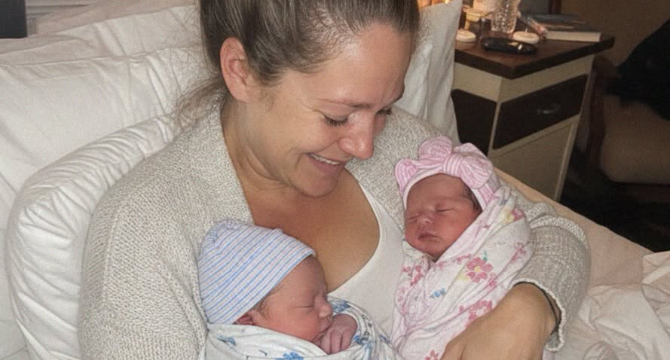
Most of Laura’s 12 rules for meeting her newborn twins sounded like ordinary new-parent boundaries. Then came the ban on one old blue blanket, and our mother reacted like Laura had just uncovered something she had spent decades trying to hide.
When my sister, Laura, gave birth to twins, our entire family was desperate to meet them.
A boy and a girl.
After three difficult years of trying, the babies felt like a miracle.
Laura kept the first few weeks quiet.
No visitors, no photos, and no dropping by.
Nobody complained.
Then she invited everyone to Sunday dinner.
“Don’t bring anyone else,” she texted. “Just family. Come at 4:00 p.m.”
My brother Kevin responded with six heart emojis.
My aunt offered to bring lasagna.
Mom called me and said, “Do you think it’s too much if I bring the blue blanket?”
I didn’t know what blue blanket she meant.
I said, “Probably not.”
The next night, Laura sent us a list.
Twelve rules for meeting the twins.
At first, I thought she was being careful.
“Wash your hands upon arrival and before touching either baby.”
“No kissing their faces or hands.”
“Don’t come if you’re sick, even if you think it’s ‘just allergies.'”
All these were reasonable.
Then the rules got strange.
“No photographs.”
“Don’t ask or comment on who the twins resemble.”
“Don’t ask me about breastfeeding.”
“Don’t ask why the boy wears a silver bracelet.”
“Don’t pick either baby up unless Ben or I hand them to you.”
And then came Rule Number 12.
“Grandma must not bring the blue blanket.”
I was sitting at Mom’s kitchen table when she read it.
She went completely still.
“What?” I asked.
Mom read the line again.
Then she picked up her phone and called Laura.
It went straight to voicemail.
She called her again, and there was no response.
Mom stood and reached for her coat.
“Cancel tomorrow’s dinner.”
I laughed because I thought she was overreacting.
“What?”
“Tell everyone it’s canceled.”
“Everyone is excited about tomorrow. Why are we canceling?”
“Because Laura knows.”
“Knows what?”
Mom looked at me.
For a second, she seemed much older than 78.
Then she said, “Not tonight.”
That was all I got. The next morning, I found her in our attic.
Technically it was her attic.
I’d been staying with her for a few weeks while my apartment building dealt with a plumbing problem.
She was kneeling beside a stack of boxes.
One old wooden box sat open in front of her.
Inside was a tiny blue baby blanket.
It had faded cotton and a white satin trim.
One corner had initials embroidered into it.
L. M. Laura’s initials.
Except underneath them, stitched in smaller letters, was another set.
J. M.
I touched the edge. “Who is J. M.?”
Mom shut the box, but it was too late; I already had questions.
“Mom.”
Before she could answer, someone pounded on the front door.
We both froze.
Then Laura yelled from downstairs. “Mom!”
I went down first.
Laura stood outside alone, with no babies or Ben.
She wore leggings, an oversized sweatshirt, and no makeup.
Her hair looked like she’d tied it up while it was still wet.
Her eyes were red.
“Where are the twins?” Mom asked behind me.
“They’re with Ben.”
Laura stepped inside, her eyes darting across the room.
“Are they okay?” Mom asked.
“They’re safe.”
Laura’s eyes then landed on the wooden box in Mom’s hands.
Her whole face changed.
“Give me the blanket.”
Mom tightened her grip and said in a shaky voice, “No.”
“Mom, please.”
“Why are you here, Laura?”
Laura’s voice cracked. “Because I knew you’d do this.”
“Do what?”
“Drag it out.”
I looked between them. “Would somebody please tell me what is happening?”
Laura burst into tears.
She covered her mouth with both hands and bent forward like she was trying not to be sick.
Mom reached for her.
Laura stepped back.
The blanket slipped.
Something fell from the folds and hit the hardwood floor.
An old and yellowed hospital bracelet.
Mom moved fast for a 78-year-old.
She bent down, but I got there first.
“Give me that,” she shouted.
I held it away from her.
At that exact moment, Laura turned and locked the front door behind her.
The click sounded much louder than it should have.
“Nobody is leaving until she says it,” Laura said.
Mom stared at her.
I looked down at the bracelet.
The plastic had gone cloudy with age.
A paper strip inside read: JULIAN M. MALE.
Then a date.
The same date as Laura’s birthday.
I read it twice.
My hands went cold.
“Who is Julian?”
Mom sat down, but Laura stayed standing. Neither answered.
Then I looked at Laura.
She laughed once.
It was a terrible sound.
“Mom. Tell her.”
“Please.”
“You wanted to keep it buried for 40 years. You don’t get another five minutes.”
I sat across from Mom.
“Who is Julian?”
She didn’t answer right away.
She looked at the bracelet in my hand.
Then she said, “Your brother.”
I actually looked toward the hallway, as if another person might walk in.
“My what?”
“Your brother.”
Mom continued.
“Laura was a twin.”
Some sentences take time to enter your brain.
That was one. I was so shocked that I simply stared at Laura.
She folded her arms tightly across her chest.
“His name was Julian.”
I looked at Mom again.
“And where is he?”
Mom’s mouth trembled. “He died.”
My mind was spiraling as I tried to absorb this news.
“How old was he?”
“Four months.”
I remember being angry before I understood why.
“Laura had a twin brother who died, and neither of us knew?”
Mom closed her eyes.
“Dad wanted to tell you when he got sick.”
Our dad had been dead for 11 years.
That somehow made me angrier.
“So everybody who could explain this decided not to?”
Laura said, “Pretty much.”
Mom looked at her. “That’s not fair, Laura.”
Laura’s voice sharpened. “Fair?”
“Your father wanted to tell you both.”
“Then why didn’t he?”
“Because I asked him not to.”
Mom twisted the blanket in her hands. “I couldn’t.”
Laura shook her head in disbelief. “You couldn’t say his name?”
“No.”
“So you pretended he never existed.”
“I did not pretend.”
“To us, you did.”
Mom started crying.
Laura didn’t move toward her. Neither did I.
Then I asked the question that mattered. “How did you find out?”
Laura wiped her face. “During my pregnancy.”
Mom looked at her. “You found the birth records?”
“It took a medical issue for me to find out.”
At her 20-week anatomy scan, one of the doctors saw something unusual with the boy’s heart.
They got a pediatric cardiologist to evaluate their suspicion.
The specialist asked for detailed family medical history.
Laura gave what she knew.
Mom’s high blood pressure.
Dad’s diabetes.
Our grandfather’s stroke.
Then the cardiologist asked whether there were any infant deaths in the family.
Laura said no.
A week later, Laura went through old insurance paperwork for genetic counseling.
In the documents, she noticed that Mom had once written “one infant son deceased” on a decades-old family history form.
At first, Laura thought it referred to a miscarriage.
She called Mom.
Mom said it was “a paperwork mistake.”
Laura didn’t believe her.
So she requested her own birth and newborn records from the hospital where she was born.
The hospital itself had closed years ago, but its records had been transferred to a regional medical archive.
Most of the chart was gone.
The archive could only provide scanned index pages and discharge summaries.
The summaries listed twin A as Laura M and twin B as Julian M.
“You lied at first? Why did you tell her it was a paperwork mistake?”
Mom whispered, “I panicked.”
Laura laughed bitterly. “Then I searched county records.”
She found Julian’s birth certificate.
Then his death certificate.
Cause of death: complications from a congenital heart defect.
At four months old.
“I found out I had a twin brother by accident,” Laura said.
Mom’s face folded. “I am sorry.”
“At the same time, the pediatric cardiologist told me my son had a related congenital heart defect.”
My stomach dropped. “But he is okay now?”
She said it fast. “He’s okay. He had surgery at 12 days old.”
“You didn’t tell us.”
“I couldn’t.”
“Laura.”
“I couldn’t handle revealing all these secrets while worrying about my baby’s health.”
Mom seemed genuinely stunned.
“You didn’t tell me?”
Laura’s eyes filled again.
“I couldn’t listen to you tell me everything would be fine when you’d already buried a baby with the same problem. A baby you kept a secret from us.”
“Oh, honey.”
Laura stepped back.
“He is fine now. The cardiologist says the repair went well. He still has follow-ups and wears a bracelet to monitor his heart function.”
I thought of Rule Number 9. “Never ask why the boy wears a silver bracelet.”
“It’s medical?”
“Yes. His name and condition are engraved on it.”
Laura looked toward the blanket.
“I found pictures of Julian.”
Mom went rigid. “Where?”
“In Dad’s old storage box. They were safely wrapped.”
Laura pulled out her phone.
She opened a photo.
Then handed it to me.
There was Mom, decades younger, sitting on a couch.
Two babies lay across her lap on top of the blue baby blanket.
One wore blue and the other one yellow.
The baby in blue looked so much like Laura’s son.
I could have easily mistaken the pictures Laura sent of her son with Julian’s.
They had the same round forehead, little mouth, and crease between the eyebrows.
“Oh, my God.”
Laura took the phone back. “Exactly.”
“I didn’t want everyone saying, ‘Who does he look like?’ I couldn’t deal with it.”
I finally understood the list.
Not all of it. Just enough.
Laura hadn’t written 12 rules because she wanted to control a family dinner.
She’d written them because she was terrified.
Still, I asked, “Why don’t you want the blue baby blanket?”
Mom’s shoulders dropped. “It was Julian’s first before they shared it.”
Laura closed her eyes as Mom explained.
When the twins were born, Laura spent two days in special care because she had trouble maintaining her temperature.
Julian stayed with Mom.
The blue blanket was the first blanket Mom wrapped around him.
Later, when both babies were home, she used it for both.
Mom added Laura’s initials after Laura came home, then Julian’s beneath them.
After Julian died, Mom couldn’t look at it.
She packed it away.
Laura walked to the window.
For a long time, none of us spoke.
Then she said, “Do you know what I thought when they told me my son needed heart surgery?”
Mom didn’t answer.
“I thought, ‘This is some sort of punishment.'”
She shook her head.
“I know it’s irrational.”
Her voice broke.
“But I had spent years trying to get pregnant.”
Laura held back tears as she spoke.
“Then I find out I had a twin brother nobody told me about.”
Mom looked shattered.
“And he died as a baby, and then I get pregnant with twins, and my son has a heart defect too.”
Laura turned around. “What if I lose him too?”
That was the moment Mom crossed the room.
This time, when she reached for Laura, Laura let her.
Mom held her face. “You are not me. You did nothing wrong.”
Laura cried harder. “I was still afraid.”
“You don’t have to be.”
“Why?”
“Because you know the condition your son has. We didn’t.”
Mom’s voice shook. “Julian looked healthy.”
She sat Laura down beside her, and for the first time in my life, Mom talked about him.
How Julian hated baths.
How he smiled whenever Dad whistled.
Laura used to sleep with one fist wrapped around his sleeve if Mom laid them close together.
“Every time I separated you, you’d wake up,” Mom said.
Mom continued.
“He had this little cough. I asked the doctor about it twice. They said babies cough.”
“What happened?”
“One morning he wouldn’t eat.”
Her voice became very quiet.
“Your father took us to the hospital. By that evening, they told us his heart was failing.”
Laura leaned into Mom. “He died the next day.”
I couldn’t stop the tears from flowing. Neither could Mom.
“I thought if I removed every reminder, you wouldn’t grow up feeling like half of something.”
Laura looked at her. “You should have told us. I had a brother, a twin.”
“Yes.”
“And you let me find him in an archive.”
Mom nodded. “I’m sorry.”
This time, Laura didn’t argue. She just cried.
Sunday dinner stayed canceled.
Ben brought the babies over later that afternoon, but only after Laura asked him to.
That was the first time I held either of them.
Her daughter slept through almost everything.
Her son was awake.
The silver bracelet looked tiny around his wrist.
Laura eventually said, “His name is Theo.”
I laughed through tears.
“I know his name.”
“I know. I just wanted to say it.”
Mom held him last. I watched her face when she looked down at him.
For one second, I understood why Laura had banned resemblance comments.
Because Mom looked like she could see Julian in him.
A week later, Laura called and apologized for the list.
Mom said, “Don’t apologize for being scared.”
Laura answered, “I can be scared without making everybody sign a treaty to see my babies.”
That was the first time any of us laughed about it.
Ben later told us Laura had barely slept since Theo’s surgery.
She checked his breathing constantly.
She read his discharge instructions over and over.
If he made a strange sound, she panicked.
Her obstetrician referred her to a therapist who specialized in postpartum anxiety.
Laura actually went.
Mom apologized so many times that Laura said she was not allowed to anymore.
Then she just started answering our questions.
“What did Julian weigh?”
“Seven pounds, two ounces.”
“What color were his eyes?”
“Blue at first. Then gray.”
I finally asked what I really needed to know. “Where is he buried?”
That question changed everything.
Two weeks later, we went together.
Mom, Laura, me, and Ben.
The twins stayed with Ben’s mother because Laura wanted the first visit to be quiet.
Julian’s grave was in the same cemetery as Dad’s.
I had walked past it before. That hurt more than I expected.
The stone said:
JULIAN M., BELOVED SON AND BROTHER.
Four months.
That was all the life between the dates.
Laura stood there a long time.
Then she said, “Hi. I’m sorry I didn’t visit sooner.”
A month later, we finally had the family dinner.
There was no rule list.
Kevin washed his hands without being told.
My aunt left her phone in her purse.
Nobody kissed the babies.
Nobody asked about Theo’s bracelet.
And nobody brought up the blue blanket.
Three months later, Laura asked Mom for it.
Mom brought the wooden box to her house.
Laura opened it.
The blanket looked even smaller beside two growing babies.
She spread it across her lap. Then Ben handed her Theo.
I handed her his sister, Emma.
Laura held both babies against her and traced the embroidered initials with one finger.
L. M.
J. M.
Theo grabbed the edge.
Laura smiled. Then she looked down at both of them.
“You had an uncle named Julian.”
Laura continued.
“He was my twin brother.”
Her voice shook, but she kept going.
“He was only here for four months. But he was here.”
No secret stays buried forever just because the person who buried it had a reason.
Mom thought silence would protect Laura.
Laura thought rules would protect her babies.
Maybe fear makes people confuse control with safety.
We’re trying to do something different now.
Theo is doing well. Laura still worries. Mom still carries guilt.
And none of us pretend Julian’s story has a happy ending.
But his name is no longer hidden in an attic.
The blanket is no longer something everyone is afraid to touch.
And Laura no longer has to wonder why her son looks like someone she was never told existed.
Sometimes healing is not fixing what happened.
Sometimes it is simply telling the truth before another generation has to discover it on their own.