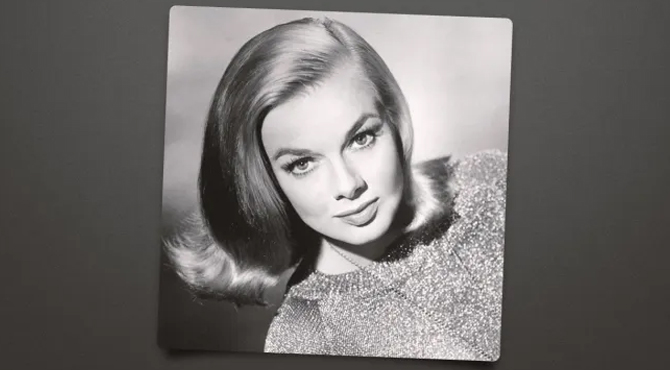
Leslie Parrish, the actress best remembered for playing Daisy Mae in the 1959 film adaptation of Li’l Abner and Jocelyn Jordan in John Frankenheimer’s acclaimed political thriller The Manchurian Candidate, has died at the age of 90.
Parrish lived in Washington state in her later years and died late in 2025, according to Erica Berdan, the daughter of her second husband, writer Richard Bach. Her death was not widely reported until recently.
Although she became known to audiences through Hollywood films and television, Parrish’s life extended far beyond acting. She was also an antiwar activist, political campaigner, environmentalist, producer, and advocate for the preservation of wildlife and natural land.
Her career took her from modeling and early television appearances to major Hollywood productions and memorable guest roles on some of the most popular programs of the 1960s.
A Memorable Hollywood Career
Parrish appeared in a number of notable films throughout the 1950s and 1960s.
She worked with major stars and directors, appearing opposite performers including Fred Astaire, Kirk Douglas, Vic Morrow, Jerry Lewis and Laurence Harvey.
Among her early film credits were A Man Called Peter (1955), Fred Astaire’s Daddy Long Legs (1955), and The Girl in the Red Velvet Swing (1955). After leaving 20th Century Fox, she moved to MGM, where she appeared in The Opposite Sex (1956) and Man on Fire (1957).
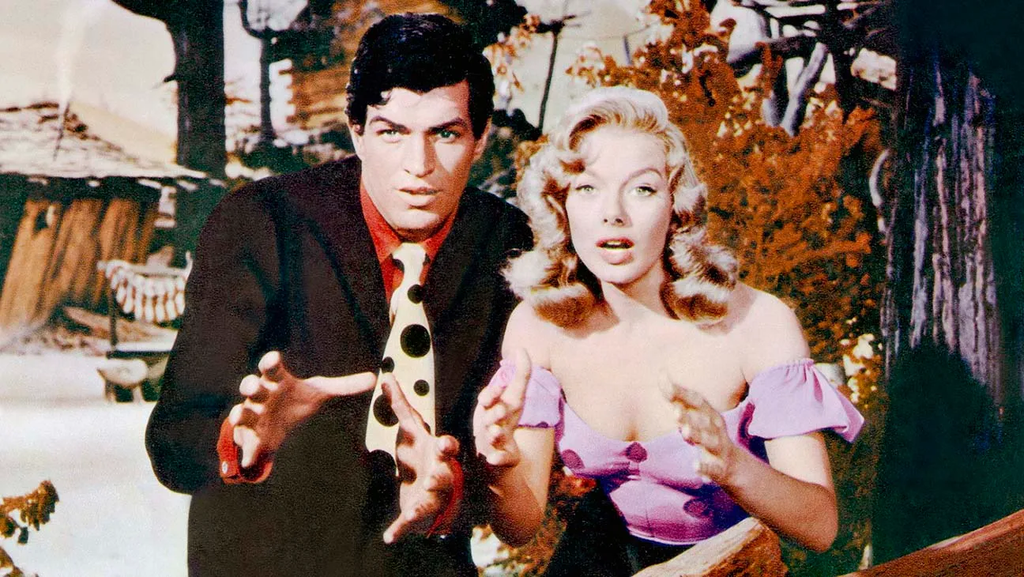
Her breakthrough came with Li’l Abner, the colorful 1959 musical comedy based on Al Capp’s enormously popular comic strip.
Daisy Mae in Li’l Abner
After Edie Adams had won a Tony Award for her performance as Daisy Mae in the Broadway musical, Parrish took over the role for the Hollywood film version.
She appeared opposite Peter Palmer, who had also played the title character on Broadway. Several other members of the stage production made the transition to the film, including Julie Newmar as Stupefyin’ Jones and Stubby Kaye as Marryin’ Sam.
Directed by Melvin Frank, the movie transported audiences to the fictional community of Dogpatch, USA, bringing the colorful world of Al Capp’s comic strip to the big screen.
For the role, Parrish adopted the name Leslie Parrish. She had previously been known professionally by her birth name, Marjorie Hellen. Frank reportedly told her that audiences would not remember an actress with two first names, leading to the name that would remain associated with her career.
Parrish’s performance as Daisy Mae helped make her one of the recognizable faces of the production.
Jocelyn Jordan in The Manchurian Candidate
Three years later, Parrish took on a very different role in one of the most celebrated political thrillers of the era.
In John Frankenheimer’s The Manchurian Candidate (1962), she played Jocelyn Jordan, the daughter of a liberal senator portrayed by John McGiver.
Her character becomes involved with Raymond Shaw, played by Laurence Harvey, a Korean War veteran who has been conditioned as a sleeper assassin.
The film remains one of the defining political thrillers of the 1960s, and Parrish’s appearance is particularly memorable because of the role played by her character’s striking costume.
At a party, the Queen of Diamonds costume worn by Jocelyn becomes part of the psychological trigger associated with Raymond Shaw.
Parrish later described Jocelyn Jordan as her favorite role.
Memorable Film Appearances
Parrish continued to work steadily throughout the 1960s.
She appeared opposite Vic Morrow in Portrait of a Mobster (1961), portraying a character in the crime drama centered on gangster Dutch Schultz.
In For Love or Money (1963), she was one of the daughters of Thelma Ritter’s character, appearing alongside Mitzi Gaynor and Julie Newmar in the Kirk Douglas comedy.
She later appeared in Jerry Lewis’ Three on a Couch (1966), playing a patient of Janet Leigh’s character who becomes involved with Lewis.
Her other film credits included Sex and the Single Girl (1964), The Money Jungle (1967), The Candy Man (1969), and The Devil’s 8 (1969).
A Familiar Face on Classic Television
Parrish was equally busy on television.
Her credits included appearances on some of the most recognizable programs of the era, including Bat Masterson, 77 Sunset Strip, Perry Mason, The Red Skelton Hour, The Wild Wild West, The Big Valley, Mannix, and Acapulco.
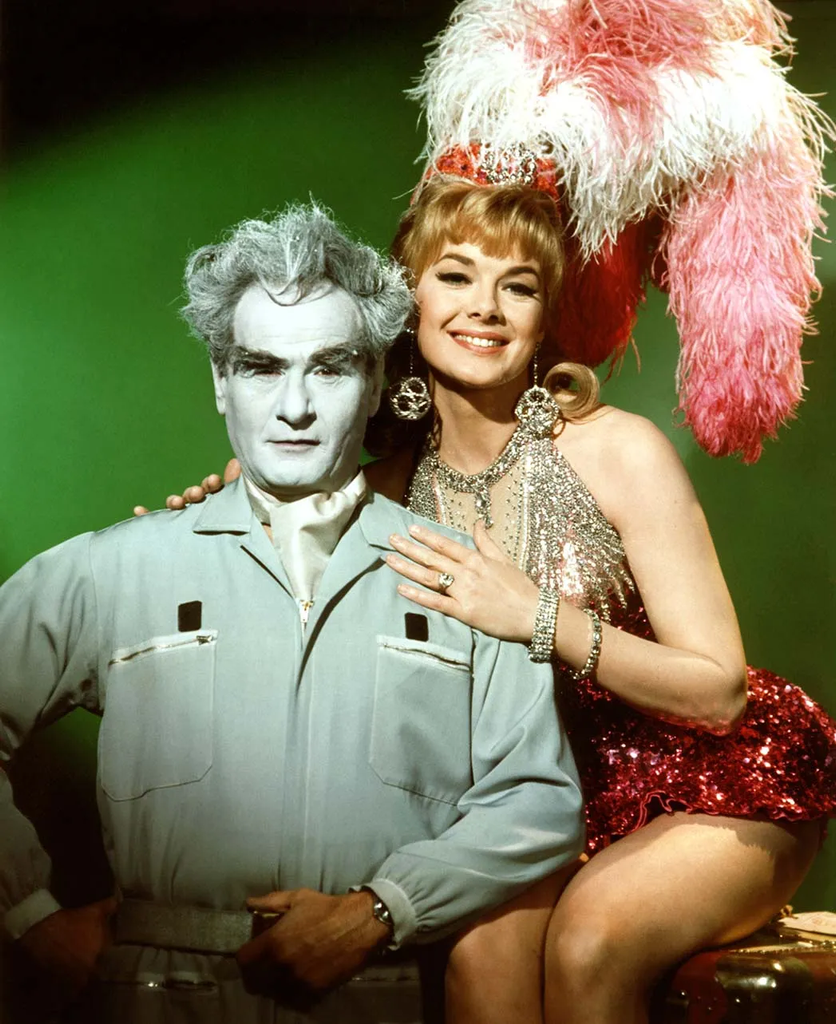
She also appeared twice on Batman.
During the show’s first season in 1966, she portrayed Hollywood starlet Dawn Robbins, who is kidnapped by The Penguin, played by the legendary Burgess Meredith.
The following year, she returned to the series in another memorable role, this time as Glacia Glaze, an attractive ice skater and associate of Mr. Freeze, played by Eli Wallach.
Her Memorable Star Trek Appearance
One of Parrish’s most enduring television performances came in 1967 when she appeared on the original Star Trek.
In the episode “Who Mourns for Adonais?”, she portrayed Carolyn Palamas, an archaeology and anthropology officer aboard the USS Enterprise.
The episode famously explored the idea of the Greek god Apollo encountering the crew of the Enterprise and demanding that humanity return to worshipping the old gods.
Parrish’s role gave her an opportunity to play a character far removed from the glamorous parts for which she was often known.
Her appearance remains a favorite among fans of classic Star Trek and is another example of the wide range of television productions in which she participated.
From Hollywood Actress to Activist
As the 1960s progressed, Parrish became increasingly involved in political and social causes.
The Vietnam War profoundly affected her, and she became a passionate antiwar activist.
In June 1967, after completing her work on Star Trek, Parrish joined thousands of demonstrators in a peace march in Century City while President Lyndon B. Johnson was in Los Angeles attending a Democratic Party fundraiser.
The demonstration resulted in clashes with police, with numerous people arrested and many others injured.
Parrish increasingly believed that actors and other public figures had a responsibility to remain aware of the suffering and political struggles taking place around them.
In 1968, she explained her position by saying that an actress works with emotions and therefore should be conscious of the anguish and suffering happening around her.
Her activism eventually became a major part of her life.
Working for Peace
Parrish helped establish STOP! — Speakers and Talent Organized for Peace, an organization designed to involve entertainers and public figures in the peace movement.
She also helped produce concerts and other events that raised money for peace-related causes.
Her political involvement went beyond the antiwar movement.
She participated in demonstrations surrounding the 1968 Democratic National Convention in Chicago and supported Tom Bradley during his campaigns for mayor of Los Angeles in 1969 and 1973.
She was also involved in the development of KVST-TV, a Los Angeles television station that operated briefly during the 1970s and was considered an early local public-affairs broadcasting effort.
A New Chapter With Richard Bach
Parrish’s life took another significant turn when she married writer Richard Bach in 1981.
Bach was internationally known as the author of Jonathan Livingston Seagull, the bestselling novella about a seagull whose desire to fly becomes a metaphor for freedom, individuality, and spiritual discovery.
Parrish became deeply involved in Bach’s life and work.
She later served as an associate producer on the 1973 film adaptation of Jonathan Livingston Seagull. Her responsibilities included hiring members of the production team and helping care for the birds used during filming.
Despite her considerable involvement, she received only a “researcher” credit from writer-director Hall Bartlett.
Parrish and Bach’s relationship would eventually inspire aspects of Bach’s later books, including The Bridge Across Forever and One.
The couple divorced in 1999.
Fighting to Preserve Bach’s Work
Parrish demonstrated remarkable determination when Bach encountered financial difficulties.
In 1981, Bach declared bankruptcy and surrendered the rights to royalties from his books to the government.
Parrish later recalled gathering essentially every penny she had in order to purchase back the copyrights.
It was an extraordinary act of loyalty and commitment to her husband’s work.
The episode demonstrated a side of Parrish that was not always visible during her Hollywood years: she was fiercely protective of the people and causes she cared about.
A Passion for Nature and Conservation
In later years, Parrish became deeply involved in environmental conservation.
She and Bach donated conservation easements that eventually helped protect 168 acres of forest and wildlife habitat on Washington state’s Orcas Island.
The land became part of the Spring Hill Wildlife Sanctuary on Mount Woolard.
For Parrish, conservation was not simply another charitable cause. It represented something she hoped would survive long after her own lifetime.
She expressed particular pride in knowing that the protected land would remain available for future generations.
In many ways, her environmental work became one of the most lasting parts of her legacy.
A Life Much Bigger Than Hollywood
It is tempting to remember Leslie Parrish simply as the beautiful actress from Li’l Abner, The Manchurian Candidate, Star Trek, or Batman.
But doing so would tell only a small part of her story.
She lived through several dramatically different periods of American history.
She began as a young woman in Pennsylvania who studied piano before moving to New York in 1953. She worked as a model for the Conover Agency and became involved in early color television demonstrations at NBC.
She moved to Hollywood after signing with 20th Century Fox in 1954.
She became a recognizable actress.
She worked with major stars.
She appeared in some of the most memorable films and television shows of the 1950s and 1960s.
And then she used her public position to become increasingly involved in political activism, environmental preservation, and independent causes.
Her life was therefore not confined to a Hollywood studio lot.
Her Early Years
Parrish was born Marjorie Hellen on March 18, 1935, in Melrose, Massachusetts.
She was raised in Upper Black Eddy, Pennsylvania, and studied piano before eventually moving to New York City.
Her first career step was modeling.
She worked with the Conover Agency and, in one fascinating episode from the early years of television, spent hours in front of NBC technicians who were experimenting with the emerging technology of color television.
It was an unusual beginning for someone who would later become a recognizable face of classic Hollywood cinema.
Within a few years, she had made the transition from modeling to acting.
Her Marriage to Ric Marlow
Before her marriage to Richard Bach, Parrish was married to singer and lyricist Ric Marlow, best known for co-writing the popular song “A Taste of Honey.”
Their marriage lasted from 1955 until 1961.
Her personal life, like her professional career, was intertwined with the rapidly changing world of entertainment during the middle decades of the 20th century.
An Actress Who Refused to Be Defined by One Career
One of the most interesting aspects of Leslie Parrish’s life is the way she continued to reinvent herself.
She began in entertainment.
She became a film and television actress.
She moved into activism.
She became involved in production.
She worked on environmental preservation.
She supported political causes.
And she became a devoted guardian of her husband’s literary legacy.
Each chapter was different, yet all of them reflected the same willingness to become involved rather than simply remain on the sidelines.
Remembering Leslie Parrish
For classic-film enthusiasts, Leslie Parrish will always have a special place in the movies and television programs of the 1950s and 1960s.
She was Daisy Mae in Li’l Abner.
She was Jocelyn Jordan in The Manchurian Candidate.
She was Carolyn Palamas in Star Trek.
She appeared on Batman and countless other classic television programs.
Her performances captured the glamour and energy of an extraordinary period in American entertainment.
But her legacy extends beyond those credits.
She was also a woman who became increasingly concerned with the world outside Hollywood.
She stood up for peace.
She supported political causes.
She worked to preserve natural habitats.
And she devoted herself to protecting the literary legacy of Richard Bach.
A Lasting Legacy
Leslie Parrish’s career began in the golden years of Hollywood and continued into a life that was increasingly defined by activism, conservation, and personal conviction.
Her story reminds us that actors are often far more complicated and interesting than the roles they play.
On screen, Parrish could be a glamorous movie star, a romantic heroine, a television guest star, or a character caught in the middle of a science-fiction adventure.
Away from the cameras, she became an activist and conservationist who devoted significant energy to causes she believed would benefit future generations.
That may ultimately be the most fitting way to remember her.
Her movies remain.
Her television appearances remain.
Her work with Jonathan Livingston Seagull remains part of that film’s history.
And the land she helped protect will continue to exist beyond her lifetime.
Farewell to a Remarkable Woman
Leslie Parrish lived for 90 years and experienced a remarkable range of American life.
She witnessed the birth of color television, became a Hollywood actress, appeared alongside some of the biggest names in entertainment, worked in classic films and television series, participated in the political activism of the 1960s, and later devoted herself to conservation.
She was never simply one thing.
She was an actress.
An activist.
A producer.
A conservationist.
A wife.
And a woman determined to make her life mean something beyond the screen.
For generations of movie and television fans, she will remain the beautiful and talented actress who appeared in Li’l Abner, The Manchurian Candidate, Star Trek, Batman, and so many other productions from the classic era.
But her greatest legacy may be the things she did after the cameras stopped rolling.
The performances gave audiences memories.
Her activism gave her a voice.
And her conservation work helped leave something tangible behind for future generations.
Rest in peace, Leslie Parrish (1935–2025).
Your films will continue to introduce new generations to your talent, while the causes and natural spaces you cared about ensure that your legacy reaches far beyond Hollywood.
You were much more than a movie star.
You lived a remarkable life, and you will be remembered.