A woman became suspicious after six housekeepers quit working for her 75-year-old mother, all refusing to explain why. So her sister went undercover as the next cleaner, only to discover something upstairs that revealed their mother had been hiding a secret for years.
My 75-year-old mother had lived alone since Dad died.
At least, that was what my sister Rachel and I believed.
Mom had always been fiercely independent. Even after Dad passed away, she refused every suggestion that she move closer to either of us.
“I’ve lived in this house for 42 years,” she would say. “I know where everything is. Why would I leave?”
For a while, she managed fine.
Then cleaning became harder.
The house had four bedrooms, two floors, and more furniture than any reasonable person needed. Rachel and I finally convinced Mom to let us hire someone to come once a week.
The first housekeeper quit after one shift.
The second lasted four hours.
The third left without collecting her pay.
By the sixth housekeeper, I knew something was wrong.
“I’m sorry. I can’t go back there.”
But none would tell us why.
One woman told the agency she felt “uncomfortable.”
Another said the house was “not what she’d been told to expect.”
The woman who left without her pay refused to answer my calls altogether.
Mom insisted they were simply unreliable.
“People don’t want to work anymore,” she complained.
“Six people, Mom?”
“I’ve had bad luck.”
“Six times?”
She shrugged.
There was always an explanation.
One housekeeper was lazy.
Another was nosy.
One had broken a vase.
One had gone upstairs even though Mom specifically told her not to.
That last part caught my attention.
“Why couldn’t she go upstairs?”
“She could. Just not into the guest room.”
“What’s in the guest room?”
“Nothing.”
“Then why can’t anyone go inside?”
Mom stared at me.
“That room has been closed since your father died. I don’t want strangers going through his things.”
That was plausible.
Dad had died four years earlier, and Mom still kept half his clothes in their bedroom closet.
Grief makes people preserve strange things.
So I let it go.
Rachel didn’t.
My sister had always been the suspicious one.
After housekeeper number six quit, she called me.
“There is something happening in that house.”
“Like what?”
“I don’t know.”
“You think Mom is terrorizing the cleaning staff?”
“I think six people don’t independently decide to quit the same job after a few hours for no reason.”
She had a point.
Unfortunately, Rachel lived almost six hours away.
She also hadn’t seen Mom in nearly three years.
They’d had a terrible argument after Dad died. Rachel wanted Mom to sell the house, and Mom accused her of trying to dismantle Dad’s life before he’d been gone six months.
They still spoke.
Birthdays. Holidays. Occasional phone calls.
But Rachel hadn’t been back.
Then she came up with an idea that sounded ridiculous until it worked.
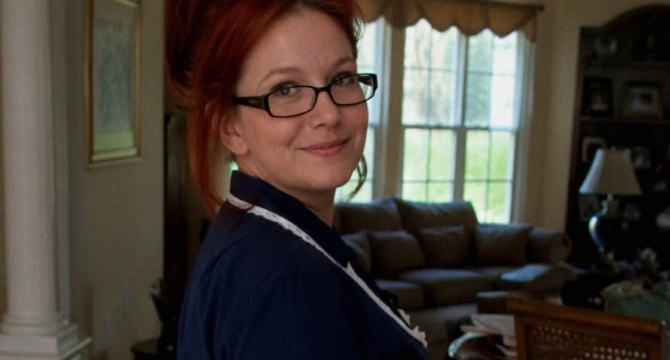
She applied through the same cleaning agency using her middle name, Anne, instead of Rachel.
She used an old photograph.
Her hair had been blond in the picture.
Now it was dark brown and cut much shorter.
She bought inexpensive glasses she didn’t need and borrowed a cleaning uniform from a friend.
I still thought Mom would recognize her immediately.
Rachel disagreed.
“Mom hasn’t seen me in three years.”
“She gave birth to you.”
“Thirty-eight years ago.”
“She’ll recognize your voice.”
“I’ll barely talk.”
“This is insane.”
“So is six housekeepers quitting.”
The agency hired her.
On Tuesday morning, Rachel drove to Mom’s house.
I spent the first hour staring at my phone.
Finally, she texted, “She didn’t recognize me.”
I called immediately.
“You’re serious?”
“Completely.”
“How?”
“She’s 75, I’m wearing glasses, and apparently this haircut has changed my entire identity.”
“Anything weird?”
“Not yet.”
For the first few hours, everything seemed normal.
Mom showed her where the supplies were kept.
She complained about dust.
She asked Rachel to clean underneath furniture that probably hadn’t moved since the Reagan administration.
Basically, Mom behaved exactly like Mom.
Then she gave Rachel one strange instruction.
“You can clean anywhere except the upstairs guest room.”
That room had been locked since Dad died.
Or so we thought.
At 3:17 p.m., Rachel texted me, “I know why they quit.”
I immediately called.
No answer.
My stomach dropped.
A minute later, Rachel sent me a photograph.
The guest-room door was open.
Inside were six cleaning uniforms neatly folded across the bed.
Each had a name tag.
I recognized two immediately from the agency.
They belonged to the six women who had quit.
I called Rachel again.
This time, she answered.
But she was whispering.
“Someone’s upstairs with me.”
“Mom?”
“No. Mom’s in the garden.”
Then I heard a floorboard creak through the phone.
Rachel stopped breathing.
Another creak.
Closer.
“Rachel?”
Nothing.
Then I heard a man’s voice.
“Anne?”
Rachel didn’t answer.
A few seconds passed.
Then the man said something else.
“Rachel?”
My entire body went cold.
The call ended.
I grabbed my bag and ran to the car.
Mom lived about 40 minutes away.
I made it there in 31 minutes.
I spent the entire drive calling Rachel.
No answer.
I called Mom.
No answer.
By the time I pulled into the driveway, my hands were shaking so badly that I almost dropped my keys.
The front door was unlocked.
I pushed it open.
“Rachel?”
Voices came from upstairs.
Mom was shouting.
“You had no right!”
Then Rachel said, “You lied to us!”
I ran upstairs.
Mom stood outside the guest room.
Rachel was against the opposite wall.
And sitting halfway down the staircase was a man I’d never seen before.
He looked to be in his late 40s.
He had thinning brown hair and a gray sweatshirt several sizes too big.
Both hands were pressed tightly over his ears.
He was rocking slightly.
Mom saw me.
Her face collapsed.
“Oh, God.”
I looked at the man.
Then at her.
“Who is he?” I asked.
Nobody answered.
The man lowered his hands.
He stared at me.
Then he said my name.
Not a question.
“Claire.”
I froze.
“How do you know my name?”
He looked toward the guest room.
Rachel spoke quietly.
“He has pictures of us.”
I walked past Mom.
The guest room wasn’t a guest room anymore.
There was a bed, a dresser, a television, shelves filled with books and puzzles, and several model trains arranged carefully along the windowsill.
The six uniforms were still folded across the bed.
But that wasn’t what caught my attention.
Two thick photo albums sat on the desk.
One had “CLAIRE” written across the front.
The other said “RACHEL.”
I opened mine.
My high school graduation picture.
A photograph from college.
My wedding.
Me holding my first child.
A family Christmas photograph I’d mailed Mom two years earlier.
There were dozens.
Maybe hundreds.
I turned toward the doorway.
“Mom? Who is he?”
She closed her eyes.
“His name is Thomas,” she replied.
The man on the stairs looked up when she said it.
“Who is Thomas?”
Mom’s mouth trembled.
“Your brother.”
I stared at her.
“No.”
“Half-brother.”
“No.”
“Your father’s son.”
Rachel let out a bitter laugh.
“You might want to sit down. Apparently we’ve had a brother our entire lives.”
I didn’t sit.
Dad had never mentioned another child.
Not once.
Mom led us downstairs.
Thomas remained upstairs.
I could hear him walking around above us.
Mom sat at the kitchen table.
“Thomas was born before your father and I married.”
“Did you know about him?” I asked.
“Not when we married.”
That surprised me.
She stared at her hands.
“Your father told me Thomas had died.”
The room went silent.
“He told you his son was dead?”
“Yes.”
“But he wasn’t.”
“No.”
Thomas’s mother had been Dad’s girlfriend when they were young.
They separated before Thomas was born.
Dad paid child support quietly for years.
When he met Mom, he told her there had been a child but that the baby had died shortly after birth.
It was a lie.
Dad continued sending money.
For decades.
Thomas had developmental disabilities and struggled with change, unfamiliar people, and living independently. His mother cared for him until she died 12 years earlier.
That was when Dad became more involved.
“He moved Thomas into a supported apartment about 20 minutes from here,” Mom explained.
“And you still didn’t know?”
“Not at first.”
“How could Dad hide an entire person?”
“Because you girls were grown. You had your own lives. Your father said he was going fishing. Running errands. Seeing friends.”
Three years before Dad died, Mom found bank statements she didn’t recognize.
She confronted him.
The truth finally came out.
“I almost left him,” she said.
Rachel stared at her.
“You should have told us.”
“I know.”
“Why didn’t you?”
“Because I was humiliated.”
Mom’s voice cracked.
“I’d been married to that man for almost 40 years, and suddenly I discovered there was an entire part of his life I’d never been allowed to see.”
I looked toward the ceiling.
“So how did Thomas end up here?”
“Your father got sick.”
As Dad’s health deteriorated, he worried constantly about what would happen to Thomas.
The supported apartment had worked, but Thomas spent weekends with Dad.
Eventually, those weekends became longer.
Then Dad died.
“And you kept him?” Rachel asked.
Mom’s expression hardened.
“He isn’t a stray dog, Rachel.”
“I didn’t mean it like that.”
“Then don’t say it like that.”
For the first time, I heard something in Mom’s voice that surprised me.
Protectiveness.
“Why didn’t you tell us after Dad died?”
She was quiet for a long time.
“Because I hated him.”
I thought she meant Thomas.
Then she continued.
“Your father.”
Mom looked toward the window.
“I was so angry. But Thomas had done nothing. He’d lost his mother. Then he lost the father he’d only recently gotten to know properly.”
Dad’s last request to Mom had been simple.
“Don’t punish him for what I hid.”
So she didn’t.
She let Thomas stay.
At first temporarily. Then permanently.
“He has support workers,” Mom explained. “He goes to a program three days a week. He’s not locked in this house.”
“Then why hide him?”
Mom looked at Rachel.
“Because I knew what you’d think.”
“What would we think?”
“That your father had betrayed us. That Thomas was part of that betrayal.”
“He isn’t.”
“I know that.”
“Do you?”
Rachel’s face changed.
Mom wiped her eyes.
“Every time I thought about telling you, I imagined having to explain everything your father had done. And then I imagined Thomas hearing you say he shouldn’t be here.”
“So instead you pretended you lived alone.”
“Yes.”
“For four years.”
“Yes.”
I couldn’t believe it.
Then I remembered the uniforms.
“What happened with the housekeepers?”
Mom’s face tightened.
“That was a misunderstanding.”
“Six misunderstandings?”
She didn’t answer.
I went upstairs again.
Thomas was standing in his doorway.
He stepped back when he saw me.
I stopped several feet away.
“Can I ask you something?”
He nodded.
I pointed toward the uniforms.
“Why are those here?”
He looked embarrassed.
“They left them.”
“All six?”
“Yes.”
“Why?”
He looked at Mom, who had followed me upstairs.
She sighed.
“The first woman frightened him.”
Thomas immediately corrected her.
“I frightened her.”
Mom looked at him.
He continued.
“She didn’t know I was here.”
The first housekeeper had gone into the laundry room to change after spilling cleaning solution on herself.
Thomas had come downstairs looking for Mom.
The woman turned around and found a strange man standing silently behind her.
She screamed.
Thomas panicked.
She left so quickly she abandoned part of her uniform.
He kept it.
“Why?” I asked.
Thomas stared at the floor.
“Dad said if somebody leaves something, they’re coming back.”
Apparently Dad had once told him that after Thomas became upset when a support worker left a jacket at his apartment.
It had become a rule in Thomas’s mind.
Something left behind meant the person would return.
The second housekeeper discovered Thomas upstairs.
The third found him holding the first woman’s uniform.
By then, Mom was desperately trying to keep anyone from discovering him.
And every attempt made things worse.
“Did you take all of these?” Rachel asked.
Thomas shook his head.
“Some.”
Mom admitted she’d collected others after workers abandoned them or asked the agency for replacements.
I stared at her.
“Why would you keep doing that?”
“Because throwing them away upset him.”
“Mom, you had six uniforms laid out in a locked bedroom. Do you understand what that looks like?”
“I know.”
But there was more.
One housekeeper had asked Thomas why he was upstairs.
He had told her:
“She won’t let me leave until you come back.”
Rachel stared at him.
“Who is she?”
Thomas pointed at Mom.
Wonderful.
I could suddenly understand why the woman had fled without collecting her pay.
Mom explained what he’d meant.
Thomas’s supported apartment was still technically available, but after Dad died, he became terrified Mom would send him back permanently.
Whenever a housekeeper quit, Thomas interpreted it as proof the household was changing.
He wanted them to return because routine meant safety.
Mom had told him repeatedly that they would discuss his living arrangements once things were stable.
In Thomas’s mind, that became: He couldn’t leave until the housekeeper came back.
The sentence sounded terrifying.
The reality was sadder.
“Why didn’t any of them tell us?” I asked.
“Some told the agency,” Mom said. “I asked them not to discuss Thomas because his medical information was private.”
Rachel stared at her.
“So you made yourself sound even more suspicious.”
Mom sighed.
“I understand that now.”
For the first time all afternoon, I almost laughed.
Not because any of it was funny.
Because the alternative was screaming.
Then Thomas picked up the photo album with Rachel’s name.
He held it toward her.
“Dad said you were my sisters.”
Rachel didn’t move.
Thomas opened it.
There she was at 16.
At graduation.
On her wedding day.
Holding her daughter.
Dad had apparently collected photographs for years.
Thomas knew our husbands’ names.
Our children’s names.
He knew Rachel hated mushrooms.
He knew I had broken my arm when I was 11.
He knew I had wanted to become a veterinarian when I was little.
He knew us.
We knew nothing about him.
Rachel sat on the edge of the bed.
“Did you ever ask Dad to meet us?”
Thomas nodded.
“What did he say?”
“He said later.”
One word.
That was all.
Later.
Dad had used it for years.
Mom had used her own version of it after he died.
Not yet.
When things settle down.
When the time is right.
And somehow an entire human being had disappeared inside those words.
Rachel started crying.
Thomas looked frightened.
“Are you mad?”
She wiped her face.
“Not at you.”
He considered that.
“Dad?”
Rachel laughed through her tears.
“Yeah. Dad.”
That evening, the four of us ate dinner together.
It was awkward.
Thomas ate exactly 12 green beans because apparently that was what he always did.
Rachel kept staring at him when she thought he wasn’t looking.
Mom looked exhausted.
And I kept noticing pieces of Dad in Thomas.
The way he held his fork.
The way he frowned when he concentrated.
Once, he laughed at something Rachel said, and I had to look away.
I was angry with Mom.
I stayed angry for a long time.
But Rachel and I agreed on one thing immediately.
Mom couldn’t continue handling everything alone.
Not at 75.
Not while pretending none of it existed.
We met with Thomas’s support coordinator.
We learned what help he already had and what additional services were available.
Most importantly, we asked Thomas what he wanted.
He wanted to keep living with Mom for now.
So that’s what happened.
But this time there was a plan for what would happen when she could no longer care for him.
A plan he understood.
A plan he helped choose.
As for the housekeepers, Mom eventually hired another one.
This time, there were no secrets.
I happened to be there on her first morning.
Mom introduced them immediately.
“This is my stepson, Thomas. He lives here too.”
Thomas stood awkwardly beside the stairs.
The new housekeeper smiled.
“Nice to meet you.”
He nodded.
She spent four hours cleaning.
When she packed her supplies, Thomas appeared in the hallway.
“Are you coming back?”
“Next Thursday.”
He thought about that.
“Okay.”
Then he went upstairs.
He didn’t follow her.
He didn’t take anything.
And there was no uniform waiting on his bed afterward.
The six old ones were gone.
So were the locks on the guest-room door.
Rachel and I are still working through what Dad did.
Mom is too.
Finding Thomas didn’t turn Dad into a monster, and learning the circumstances didn’t make his lies acceptable.
If anything, it made grief more complicated.
But Thomas was never the lie.
He was the person everyone else had lied about.
Dad had spent decades treating him like a secret he needed to manage.
Mom had spent years treating him like a truth she was afraid to tell.
It took six frightened housekeepers for the rest of us to finally do the simplest thing anyone should have done from the beginning.
Say his name.