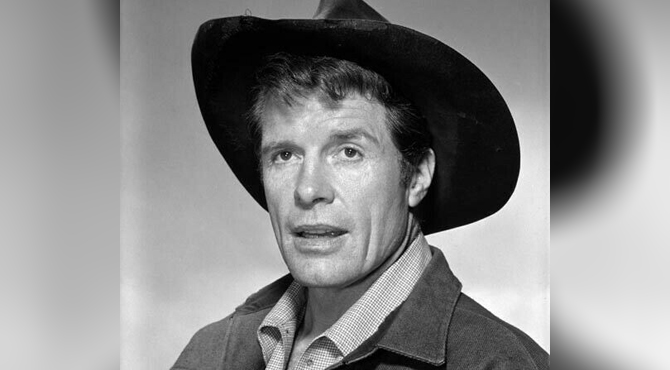
Robert Horton was one of the familiar faces of the golden age of American television Westerns. With his strong screen presence, confident manner, and unmistakable voice, he became a favorite of audiences during the great era when Western series dominated television.
Best remembered as Flint McCullough on the long-running television Western “Wagon Train,” Horton built a career that extended well beyond one famous role. He appeared in films, television programs, and stage productions, and he remained closely associated with the classic Western genre throughout his life.

When Robert Horton died on March 9, 2016, at the age of 91, the world lost another important link to the golden age of television Westerns.
Today, his work remains a reminder of a time when the American West was one of the most popular subjects in entertainment.
The Early Life of Robert Horton
Robert Horton was born on July 29, 1924, in Los Angeles, California.
Growing up in Southern California, Horton was surrounded by the motion-picture industry, but his path to acting was not immediate.
His early life was shaped by the events of his generation, including the Second World War. Like many young Americans of his era, he served in the military before beginning his professional entertainment career.
After the war, Horton pursued acting and began building experience in Hollywood.
The entertainment industry was changing rapidly in the years following the war. Television was beginning to emerge as a major form of entertainment, while Hollywood studios were producing a tremendous number of Western films.
Horton eventually found himself perfectly suited to both worlds.
The Road to Hollywood
Horton began obtaining small film and television roles during the late 1940s and early 1950s.
His early film appearances included work in productions such as “The Silver Whip,” “Apache War Smoke,” “The Long Gray Line,” and “The Man from Colorado.”
Like many actors of his generation, he spent years developing his craft through supporting roles before receiving the opportunity that would define his career.
His tall appearance, rugged good looks, and commanding presence made him a natural fit for Western stories.
But Horton was more than a handsome Western leading man.
He possessed an understated acting style that allowed him to communicate determination and emotion without relying on excessive gestures.
That quality would become especially valuable when television gave him his defining role.
Flint McCullough in “Wagon Train”
In 1957, Robert Horton joined the cast of “Wagon Train.”
He was cast as Flint McCullough, the trail scout responsible for guiding wagon trains across the dangerous and often unpredictable American frontier.
The series became one of the most successful Western television programs of its era.
“Wagon Train” followed groups of settlers traveling westward and featured a rotating collection of characters and stories. Each episode could introduce new faces, new conflicts, and new adventures.
At the center of many of these stories was Flint McCullough.
Horton’s portrayal of Flint helped make the character one of the memorable Western heroes of television.
Flint was courageous, capable, independent, and resourceful. He was a man who understood the dangers of the frontier and knew how to survive them.
But he was not portrayed simply as a fearless gunfighter.
Horton gave Flint a thoughtful and human quality.
The character could be tough when necessary, but he was also compassionate and intelligent.
That balance helped make Flint McCullough a character audiences could admire.
The Golden Age of Television Westerns
Robert Horton’s greatest period of fame coincided with one of the most important eras in television history.
During the late 1950s and 1960s, Westerns were everywhere.
Programs such as “Gunsmoke,” “Bonanza,” “Rawhide,” “The Rifleman,” “Maverick,” and “Wagon Train” became enormously popular.
Millions of viewers welcomed these shows into their homes every week.
For many people, actors like Robert Horton became familiar household faces.
Television Westerns were more than stories about cowboys and gunfights. They frequently explored themes of courage, justice, loyalty, family, friendship, sacrifice, and survival.
The frontier setting provided a dramatic backdrop for stories about human nature.
Horton understood this world exceptionally well.
Through Flint McCullough, he became one of the actors who helped define the image of the television Western hero.
A Star Who Could Carry a Story
One of Robert Horton’s greatest strengths was his ability to command the screen.
He did not need to be surrounded by elaborate effects or complicated dialogue.
His presence alone could establish the mood of a scene.
Whether Flint was riding across the frontier, confronting danger, helping travelers, or trying to resolve a difficult situation, Horton brought credibility to the role.
He looked like someone who belonged in the American West.
That quality was particularly important in an era when television Westerns depended heavily on believable characters.
Audiences needed to believe that these men and women could survive the harsh landscapes portrayed on screen.
Robert Horton made Flint McCullough believable.
Beyond “Wagon Train”
Although “Wagon Train” became the role most closely associated with Robert Horton, his career was not limited to the series.
He appeared in numerous other television productions and films throughout the 1950s and 1960s.
Among his film appearances was the classic Western “The Man Who Shot Liberty Valance.”
He also appeared in productions such as “The Dangerous Days of Kiowa Jones,” further strengthening his connection with the Western genre.
His television credits included appearances on several popular programs of the period.
These roles demonstrated his versatility and allowed him to work with many of the leading performers and creative figures of the era.
Leaving “Wagon Train”
Robert Horton remained with “Wagon Train” for several seasons before leaving the series in 1962.
His departure marked the end of one of the most recognizable chapters of his career.
By then, however, his place in television Western history was already secure.
Flint McCullough had become a character remembered by generations of viewers.
Horton’s decision to move beyond the role also reflected his desire to explore other areas of entertainment.
He continued acting and eventually devoted considerable attention to theatre and musical performances.
The Stage and Musical Theatre
Robert Horton had a strong interest in music and theatre.
His talents extended beyond acting in front of a television camera.
He appeared in stage productions and musical performances and demonstrated that he was capable of performing in a different artistic environment.
The theatre gave Horton an opportunity to connect directly with audiences.
Unlike television and film, theatre requires performers to maintain their energy and concentration throughout an entire live performance.
Horton embraced that challenge.
His work on stage became another important part of his long career.
A Voice That Audiences Remembered
One of Robert Horton’s distinctive qualities was his voice.
Deep, confident, and unmistakably masculine, it complemented the Western characters he portrayed.
His voice helped give Flint McCullough an additional sense of authority.
Even today, fans of classic Western television can immediately recognize the qualities that made Horton’s performances memorable.
His voice, appearance, and manner combined to create a screen persona that became strongly associated with the American frontier.
A Different Kind of Western Hero
The television Western hero could easily become a stereotype.
The genre often featured the same familiar elements: horses, revolvers, dusty towns, saloons, lawmen, outlaws, and endless frontier landscapes.
But the most memorable actors brought something more to their roles.
Robert Horton gave Flint McCullough intelligence and restraint.
Flint was not simply a man who knew how to handle a gun.
He was a guide, a protector, and a problem solver.
He often had to make difficult decisions, and his strength came from experience rather than bravado.
That approach helped distinguish Horton’s performance.
He represented a version of the Western hero who could be strong without constantly proving his strength.
Working During Hollywood’s Changing Years
Robert Horton’s career also provides a fascinating glimpse into the evolution of American entertainment.
He began working when the traditional Hollywood studio system was still extremely influential.
He then witnessed the explosive growth of television.
The Western became one of television’s most successful genres, and Horton found himself at the center of that transformation.
As the 1960s progressed, however, television audiences began changing.
New genres became popular, social attitudes evolved, and the dominance of the traditional Western gradually declined.
Horton adapted to these changes by continuing to work in different areas of entertainment.
His career therefore represents more than a successful run on one television series.
It represents a journey through one of the most transformative periods in American popular culture.
Remembered by Western Fans
For classic television fans, Robert Horton will always be associated with “Wagon Train.”
The series remains one of the defining Western programs of its generation.
Its stories captured the imagination of viewers who were fascinated by the idea of westward expansion and the people who traveled across the American frontier.
Horton was an essential part of that world.
For many fans, Flint McCullough was their introduction to the actor.
Even decades after the original broadcasts, the character continues to attract new viewers through reruns, classic television channels, DVD releases, and online discussions of vintage television.
That is a remarkable achievement.
His Place in Western Television History
The history of American television Westerns would be incomplete without Robert Horton.
He belonged to a generation of performers who helped transform the Western from a familiar Hollywood movie genre into a television phenomenon.
Actors such as James Arness, Lorne Greene, Michael Landon, Chuck Connors, Steve McQueen, Clint Eastwood, and Robert Horton became closely identified with the Western television era.
Each brought something different to the genre.
Horton brought dignity, confidence, and quiet strength.
His Flint McCullough remains one of the memorable characters from the golden age of television Westerns.
Later Years
Robert Horton continued to work after his most famous television years had passed.
He appeared in additional television productions and remained active in theatre and other entertainment projects.
Although he eventually stepped away from the intense schedule associated with television stardom, he never completely disappeared from the world of performance.
He remained appreciated by fans who remembered his earlier work.
Over time, his career became part of the history of classic American television.
The Passing of a Western Star
Robert Horton died on March 9, 2016, at the age of 91.
His passing marked the loss of one of the last major representatives of the classic television Western era.
For fans who grew up watching “Wagon Train,” the news was more than the death of an actor.
It was the passing of a familiar face from their childhood and youth.
It was another reminder that the generation that created the great television Westerns was slowly disappearing.
But Horton left behind something that cannot be taken away.
He left behind his performances.
Remembering Robert Horton
There is something special about classic Western television.
The stories may have been fictional, but the memories they created were real.
Families gathered around television sets and watched brave characters ride across the frontier.
Children imagined themselves riding horses across the open range.
Adults followed stories about justice, courage, friendship, and survival.
Actors like Robert Horton became part of those memories.
His work as Flint McCullough gave audiences a character they could trust.
He represented the capable frontier guide who could face danger without fear and who understood that survival required more than physical strength.
That image remains powerful.
A Lasting Legacy
Robert Horton’s legacy is not measured only by the number of films or television episodes in which he appeared.
It is measured by the affection audiences still have for his work.
His performance in “Wagon Train” continues to introduce him to new generations.
Classic television fans continue to discuss his career, revisit his episodes, and remember the era in which he became famous.
That is the true measure of an entertainer’s legacy.
An actor may leave the screen, but if audiences continue to watch, remember, and appreciate the work, the performer is never completely gone.
Robert Horton belongs to that special group.
His career is part of the history of Hollywood.
His face is part of the history of television.
And his name remains part of the history of the American Western.
Farewell to Robert Horton
Robert Horton died at the age of 91, but the character of Flint McCullough continues to ride across the television frontier.
The years have changed.
The technology has changed.
Television has changed.
The Western itself has changed.
But the classic performances remain.
Robert Horton gave audiences a memorable television hero and helped establish “Wagon Train” as one of the defining Westerns of its time.
For those who remember him, he will always be more than an actor from an old television show.
He will be Flint McCullough.
The scout on horseback.
The man who knew the trails.
The calm presence in a dangerous world.
The Western hero who became part of American television history.
Today, we remember Robert Horton with admiration and gratitude for the many years of entertainment he gave to audiences.
His work remains a part of the golden age of television, and his contribution to the Western genre deserves to be remembered.
The trail may have ended for Robert Horton, but his journey across the American television frontier continues every time “Wagon Train” returns to the screen.
Rest in peace, Robert Horton.
July 29, 1924 – March 9, 2016.
A classic Western star.
A memorable actor.
And a lasting part of television history.