Compassion doesn’t just feel good in the moment — it changes how much stress is even allowed to land. Researchers at Yale and Penn State tracked people’s stress and mood every day for two weeks and found something remarkable: on days people helped others more than usual, stress had almost no measurable effect on their mood or mental health at all — as if compassion quietly canceled it out before it could take hold. Kindness, in other words, isn’t just a nice thing to do on a hard day. It might be the actual buffer that gets you through one.
These 10 real stories are full of exactly that kind of quiet protection — small, generous acts of empathy that ended up guarding someone’s entire day, happiness included.
1.
My grandfather carried a pocketknife his whole life. Nothing special. Old, dull, wooden handle. He held it constantly — turning it, rubbing the handle, like a worry stone. After he passed my grandmother told us the story. He bought it with his first paycheck at 16. The day he met her, he used it to cut a flower from a bush on her street because he couldn’t afford one from a store.
He carried a $2 knife for 62 years because it was the tool he used to steal a flower for a girl he’d loved ever since. She kept the flower — pressed in a novel, brown and flat as paper. He kept the knife. Two people holding opposite ends of the same moment for six decades. We buried him with the knife. She asked us to. She said, “He might need to cut me a flower when I get there.”
2.
I’m a waitress. A man sat alone on Valentine’s Day. Ordered for two. Ate his meal. The other plate went untouched. When I brought the check I said, “Can I box that up for you?” He said, “No. Leave it. She would’ve ordered that.”
She passed in October. He came to their restaurant on their night and ordered her meal so the table wouldn’t feel empty. He sat across from her plate for an hour. I didn’t charge him. I told my manager why. My manager — a tough guy who yells about ticket times — said, “Comp it. And if he comes back next year, comp it again.” He came back. We comped it.
Some tabs aren’t about money.
3.
My mother-in-law and I haven’t always gotten along. Fifteen years of careful distances and polite smiles. We survive each other. That’s the honest version. When I got diagnosed, she was the first person at my door. Not my friends. Not my sister. Her. With a suitcase.
She said, “I’m staying until you don’t need me.”
I said, “We don’t even like each other.”
She said, “I know. But my son loves you. And that makes you mine to protect whether we like each other or not.”
She stayed for six weeks. Cooked, cleaned, drove my kids, held my hair during chemo. We still don’t agree on most things. But something shifted in that house. She didn’t become my friend. She became something harder to name and impossible to forget.
4.
My daughter is 6 and draws constantly. Last month she drew a picture of our family. Me, her, the dog. No dad. He’s not in the picture because he’s not in our life. Her teacher called, worried. I said, “She drew everyone who shows up.” That night she added someone. Not her father. She drew her teacher. She said, “Miss Ramirez is nice to me every day. She belongs in our family picture.”
A 6-year-old’s definition of family has nothing to do with blood. It has to do with who shows up and how they make you feel when they do. Her teacher didn’t earn a spot by being related. She earned it by being kind. Consistently. Daily. Until a child drew her into the family with a purple crayon and decided she belonged.
5.
I run a convenience store. A woman came in at midnight, bought a single can of formula, and paid entirely in coins. She was counting them on the counter, hands shaking, baby crying in the car seat on her arm. She was $1.30 short. She started taking coins back. I said, “You’re good.” She said, “I’m not. I’m $1.30 short.” I said, “No, I mean YOU’RE good. Take it.”
She stood there. Then she said, “Nobody’s said that to me in a long time.” She wasn’t talking about the formula. A woman buying milk for her baby at midnight needed $1.30 and three words. I had both.
6.
I work at a shoe store. A boy came in wearing shoes that were falling apart. His mom said, “We just need the cheapest ones that fit.” I measured him. Brought out three pairs in his budget. He tried them on carefully. Picked the plainest pair. His mom paid. As they were leaving he looked at the window display, the shoes he actually wanted, and said nothing. Just looked. Then walked out.
I bought them after my shift. Drove to the address from the receipt. Left them on the porch with a note: “Every kid should get the pair they actually want at least once.”
His mom called the store the next day crying. She said, “He’s sleeping in them.” Not wearing them. Sleeping in them. Like they might disappear if he takes them off.
7.
My wife lost her job three months before our wedding. She wanted to cancel. Scale down. Wait. I said, “We’re getting married in the backyard. I’ll handle it.”
I built an arch from lumber scraps. My mom made the cake. My buddy played guitar. Neighbors lent chairs. My daughter scattered dandelions instead of petals. Total cost: $340. She walked down our porch steps in a dress she already owned and I cried harder than any man at any venue has ever cried. She said after, “This was better than the plan.”
It was. Because the plan was a wedding. This was a neighborhood deciding our marriage mattered enough to show up with chairs.
8.
I volunteer at a food pantry. A man came through the line, took the minimum, and said, “That’s enough.” It wasn’t. He had two bags for a family of five. I packed an extra box anyway. He pushed it back. “Someone needs it more.” His 7-year-old daughter tugged his sleeve and said, “Daddy, WE need it more.” He looked at her. Then at me. Then he took the box.
A man so used to being last in line that his own daughter had to remind him he counted too. She didn’t understand sacrifice. She understood empty. And empty was something she wasn’t willing to accept on her father’s behalf.
9.
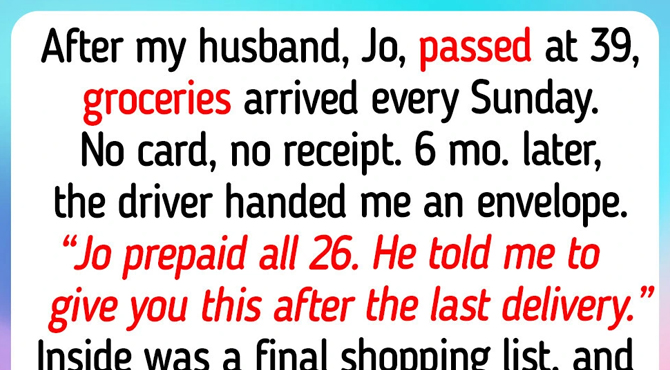
After my husband, Jo, passed at 39, groceries arrived every Sunday morning, placed on my porch. No card, no receipt inside. 6 months later, the delivery driver got out of his car and knocked on my door. He handed me an envelope and said, “Jo prepaid all 26 groceries. He told me to give you this after the last delivery.”
Inside was a final shopping list, and a last instruction for the driver: It said, “After the last delivery, tell her who you really are, and tell her I asked you to do this on purpose.” Turns out the man on my porch wasn’t a delivery driver at all, just Luke, Jo’s old college roommate, someone I’d heard about for years but never actually met.
Weeks before he passed, Jo called him out of nowhere, terrified I’d spend the rest of my life disappearing into grief alone, the way his own mother had after his father passed. He asked Luke, who was moving back to town anyway and still single after years of, as Jo used to joke, “waiting for someone worth the trouble,” to quietly deliver groceries every Sunday under a made-up job, not to force anything, but simply so I’d have one steady, familiar face checking in on me once the casseroles and sympathy calls stopped coming.
Luke admitted he almost refused, uncomfortable with the secrecy, until Jo told him, “I’m not asking you to fall for her. I’m just asking you to make sure she still has a life worth living, and if something more ever grows from that on its own, I’d only be glad I introduced you.” I stood there holding a list that was never really about groceries, understanding that my husband’s last act of love wasn’t just making sure I survived his absence, it was quietly leaving the door open for me to be happy again, in whatever way life decided to give that back to me.
10.
My father died when I was 12. For years, I thought the hardest part was losing him. Then, on my 18th birthday, my mother handed me a small envelope she’d kept in her dresser. Inside was a receipt from a diner and a note in my father’s handwriting. He had written it six months before he died.
It said, “If I’m not here when she turns 18, take her to this place. Order her pancakes. She’ll pretend she’s too old for them, but she’ll want them.”
My mother laughed when she told me. Then she cried. I cried too. The next morning we drove to that diner. The waitress looked at the note, recognized my father’s name, and said, “He came in every Saturday for months. He told me he was worried he wouldn’t get to see this day.”
She brought me pancakes without asking what I wanted. Then she put a second plate on the table and said, “Your dad paid for this one a long time ago.” My mother reached across the table and held my hand. For the first time since he died, losing him didn’t feel like the only thing he had left me.