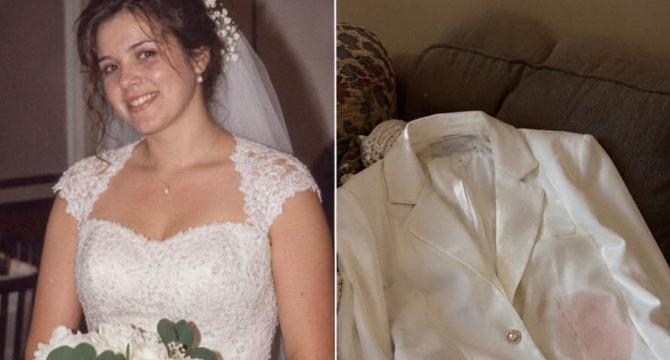
I thought lending my neighbor one sentimental blazer was a harmless favor. Days later, I found a red stain and an explanation that made no sense.
The blazer had never been worth much money.
That was the strange part.
If somebody had offered me exactly what I paid for it, I probably would have laughed.
If somebody had offered me $300, I still would have said no.
It wasn’t valuable because of what it cost.
It was valuable because I got married in it.
I’d had that white blazer for 12 years.
It lived in a garment bag on the left side of my closet, tucked behind the clothes I actually wore.
I had bought it for $38 from the consignment shop on Grand because that was what we could afford in 2014.
My husband and I weren’t planning some elaborate wedding.
There was no ballroom, photographer, or towering cake.
I wore the blazer over a blue dress at the courthouse with 11 people watching.
That was enough.
Over the years, I had donated plenty of old clothes.
I had thrown out shoes I once loved and dresses that no longer fit.
But every time I cleaned the closet, the blazer stayed.
I wasn’t sentimental about everything.
Just certain things.
Dana knew that.
She lived next door, and we had been friendly for years.
Not the kind of friendship where we talked every morning, but the comfortable neighborhood kind.
We collected each other’s packages.
We borrowed ingredients.
We complained about garbage pickup and exchanged knowing looks whenever somebody parked badly on our street.
She had also watched my dog for a week in March.
When I tried to pay her afterward, she wouldn’t take the money.
“Don’t be ridiculous,” she’d told me.
So when she knocked on my door one Thursday, I was happy to help.
Dana stood in my entryway looking more anxious than I had seen her in months.
Her son was bringing his girlfriend to dinner Saturday.
It would be Dana’s first time meeting her, and apparently that had turned Dana’s closet into a crisis.
She’d been through the whole thing twice.
“I want to look like somebody she’d want to be around.”
I smiled because I understood exactly what she meant.
Dana could be blunt, but underneath that was a woman who cared intensely about what people thought of her.
She wanted her son’s girlfriend to walk away believing he had a warm, polished, interesting mother.
We talked through a few options.
Then I remembered the blazer.
I went upstairs and pulled the garment bag from the left side of my closet.
For a second, I almost chose something else.
That hesitation bothers me now.
I brought the blazer downstairs anyway.
I told her what it was before I handed it over.
I said it out loud, standing in my hallway with the garment bag over my arm.
It wasn’t a casual warning.
I wanted her to understand.
“This is the blazer I got married in.”
Dana’s expression softened.
She knew about our courthouse wedding. We’d talked about it before.
She carefully touched one sleeve.
“I’ll get it cleaned. I’ll bring it back Sunday.”
I said yes.
I said it fast, too.
Maybe I didn’t want to look overly protective.
Either way, I handed it to her.
Saturday came and went.
I wondered briefly how the dinner had gone, but I didn’t text her.
I figured she’d tell me later.
Sunday passed too.
That didn’t bother me much.
Dana was sometimes late returning things. Never terribly late. Just enough that you learned not to expect your casserole dish back the morning after a party.
She brought the blazer back Monday night.
Except she didn’t knock.
She left it on my porch chair, sealed in a dry cleaner’s plastic.
That’s the part I keep coming back to.
I saw the plastic, and I thought she had cleaned it.
I had no reason to inspect it.
I carried it upstairs and hung it in the closet without opening it.
It stayed there for four days.
Friday afternoon, I was rearranging a few things when I noticed the hanger sitting crooked inside the plastic. I pulled the blazer out to straighten it.
Then I saw the left lapel.
There was a stain on it.
It was about the size of a nickel, dark red and dried, with a lighter ring around it where somebody had rubbed at it with water.
I stared at it longer than I should have.
At first, I didn’t feel angry.
I felt confused.
The blazer had supposedly gone to the cleaner.
Why was there a stain that looked like someone had tried to scrub it themselves?
I carried it downstairs and stood near the kitchen window where the light was better.
The mark was unmistakable.
Wine, sauce, lipstick. I couldn’t tell.
Whatever it was, it had not been there before.
I knew that with absolute certainty.
I had checked the blazer in the hallway before giving it to Dana.
For several minutes, I tried to invent explanations that didn’t involve her being dishonest.
Maybe the cleaner had missed it.
Maybe Dana had planned to tell me and forgotten.
Maybe she hadn’t noticed.
Then I remembered the porch.
No knock.
No text.
No explanation.
Just plastic.
I put the blazer back on the hanger and walked next door.
Dana answered after my second knock.
She looked from my face to the blazer.
I held the lapel toward her.
She looked at it for maybe two seconds.
“It was like that when you gave it to me.”
Something inside me went very still.
I said it wasn’t.
I said I checked it in the hallway, in front of her.
Dana shifted her weight and put her hand on the doorframe.
Then her voice changed.
It became the voice you use with a child who’s making a scene.
“You’re going to ruin a friendship over a blazer? Go buy yourself a new one.”
For a moment, I honestly didn’t know what to say.
Not because her argument made sense.
Because it didn’t.
This wasn’t about the cost of replacing a blazer.
It wasn’t even entirely about the stain anymore.
If Dana had opened the door and said, “I’m so sorry. Something spilled at dinner, and I panicked,” I probably would have been upset for an hour.
Maybe two.
Then I would have forgiven her.
Accidents happen.
But she hadn’t apologized.
She had returned it silently, hidden under plastic, and waited for me to discover what happened.
Now she was telling me I had given it to her that way.
I looked at the woman whose packages I had carried inside during storms.
The woman who knew exactly why that blazer mattered.
The woman I had trusted inside my house and with my dog.
She didn’t look embarrassed.
She looked annoyed that I had noticed.
Then she said she had to get dinner started, and she closed the door.
Not hard.
Slowly.
Like she was being patient with me.
I stood on her porch holding the blazer.
That small detail changed something.
The slow door.
The calm expression.
The complete absence of guilt.
That was the moment I understood she’d done it on purpose and didn’t feel guilty.
I went home without knocking again.
I hung the blazer over a dining chair and left it there overnight.
By morning, I wasn’t wondering whether Dana would apologize anymore.
I knew she wouldn’t.
So the next morning, I came up with the plan to teach her a nice lesson.
I didn’t want to damage Dana’s property.
I didn’t want to embarrass her in front of the whole neighborhood either.
What I wanted was much simpler.
I wanted her to understand why “go buy yourself a new one” wasn’t an answer.
So I started with the blazer.
That Saturday morning, I took it to a cleaner across town.
I didn’t use the one whose plastic Dana had returned it in.
The woman behind the counter was named Priya. She examined the lapel under a bright light.
“Someone already worked on this,” she said.
My stomach tightened.
“What do you mean?”
She pointed to the pale ring around the stain.
“Water, probably. Maybe soap. They rubbed it instead of blotting it.”
“Can you get it out?”
Priya hesitated.
“I can try. White fabric is unforgiving.”
I told her to do whatever she could.
Before leaving, I asked one more question.
“Does this look like something a dry cleaner already treated?”
She shook her head.
“If a professional treated it, I wouldn’t expect it to look like this.”
That answer bothered me more than I expected.
Dana hadn’t just lied at her door.
The plastic had been part of it.
I went home and thought about every small favor we’d exchanged over the years.
I had trusted her because trust had become routine.
That was what hurt.
On Sunday afternoon, I texted her.
“Can you come over for coffee tomorrow? I don’t want things to stay weird between us.”
She answered seven minutes later.
“Sure. I don’t either.”
The next day, Dana arrived carrying a bakery box.
She smiled as if we had experienced a minor disagreement over hedge trimming.
“I brought muffins.”
“Thanks.”
I poured coffee.
For 20 minutes, I didn’t mention the blazer.
We talked about her son’s dinner instead.
“It went well,” Dana said. “His girlfriend is sweet. Very put together.”
“I’m glad.”
“She loved my outfit, actually.”
There was something almost triumphant in her tone.
I asked what she had worn.
Dana smiled.
“The blazer.”
Of course.
She took another sip.
Then she sighed.
“Olivia, about the other day. I don’t like fighting with people.”
“Neither do I.”
“I just think sometimes objects become more important than they should.”
I looked at her.
“You mean my blazer.”
Dana pressed her lips together.
“I mean things in general.”
That was when I knew an apology still wasn’t coming.
So I moved to the next part of my plan.
“I actually wanted to ask you a favor.”
Her shoulders relaxed immediately.
“Sure.”
“I have a dinner next weekend. Could I borrow that green silk scarf you wear sometimes?”
Dana blinked.
“My green scarf?”
“The one with the gold border.”
Her face changed.
Not dramatically.
Just enough.
That scarf mattered to her.
She had told me once that her mother bought it during a trip they took together before she died.
Dana set down her cup.
“I don’t really lend that one out.”
I nodded.
“Why not?”
She looked surprised by the question.
“Because it has sentimental value.”
I waited.
Dana stared at me.
Then she realized what I’d done.
“Oh, come on.”
“I haven’t said anything.”
“You don’t have to.”
Her cheeks reddened.
“That’s completely different.”
“How?”
“My mother gave me that scarf.”
“And I got married in that blazer.”
“That’s not the same thing.”
“Why?”
Dana stood.
“Because you’re doing this to make a point.”
“Yes.”
At least that part was finally out in the open.
She paced once toward the window.
“You invited me over just to trap me?”
“No. I invited you because I wanted to give you another chance to tell me what happened.”
“I already told you.”
I reached for my phone.
Dana’s eyes narrowed.
“What are you doing?”
I opened a photograph.
It showed the blazer under the cleaner’s inspection light.
“I took it somewhere else.”
Her expression froze.
“The cleaner said someone tried to work on the stain with water before I brought it in.”
Dana crossed her arms.
“So?”
“So you told me it was already stained when I gave it to you.”
“It was.”
“And you promised you’d get it cleaned.”
“I did.”
“Where?”
She hesitated.
It lasted only a second.
But after years of knowing Dana, one second was plenty.
“I don’t remember the name.”
“You don’t remember the cleaner you used ten days ago?”
Her jaw tightened.
“I have a lot going on.”
I felt strangely calm.
That surprised me.
For days, I had imagined this conversation ending with shouting.
Instead, I mostly felt tired.
“Dana, I wouldn’t have cared this much if you’d spilled something on it.”
She looked away.
“I would’ve been upset, but accidents happen.”
She said nothing.
“What I care about is that you hid it. Then you looked me in the face and told me I gave it to you that way.”
Dana’s eyes moved toward the table.
For the first time, she looked uncomfortable.
Finally, she exhaled.
“It was wine.”
There it was.
Quiet and ordinary.
Red wine.
She sat down again.
“Her glass tipped during dinner,” she continued. “I grabbed the blazer before it hit the floor.”
“You mean your son’s girlfriend spilled it?”
Dana shook her head.
“I did.”
I hadn’t expected that.
“I was reaching across the table. I knocked my own glass.”
“Then why didn’t you just tell me?”
Her eyes filled, though she quickly blinked the tears away.
“Because I’d made such a big deal about looking perfect.”
I stayed quiet.
Dana rubbed her thumb against the edge of her cup.
“I wanted that dinner to go well. My son has been distant lately. I thought if she liked me, maybe things would feel normal again.”
Her voice had lost its sharpness.
“When I spilled the wine, I panicked. I tried water. It spread. Then I thought you’d be furious.”
“So you put it in dry cleaning plastic.”
She nodded.
“The plastic was from something I’d picked up months ago.”
I almost laughed, but there was nothing funny about it.
“You planned the lie.”
“Yes.”
“And when I confronted you?”
Dana looked ashamed now.
“I doubled down.”
The room stayed quiet.
Then I asked, “Do you understand the scarf now?”
She gave a small, miserable laugh.
“Yes.”
That was the lesson.
Not ruining her scarf.
Not humiliating her.
Just making her imagine handing something irreplaceable to someone she trusted and getting it back damaged, hidden, and denied.
Two days later, Priya called.
The stain didn’t disappear completely, but she got most of it out.
A faint shadow remained on the lapel.
When I brought the blazer home, I stood in front of my closet for a while.
Twelve years earlier, I’d worn it into a courthouse, believing marriage would be built from grand promises.
Life had taught me something quieter.
Trust was usually built through small things.
So was distrust.
Dana paid the cleaning bill.
She apologized without defending herself.
We never became as close as we had been.
Maybe that was the part she hadn’t expected.
Forgiveness didn’t restore everything automatically.
Sometimes an apology repairs the damage.
Sometimes it only stops the damage from getting worse.
I kept the blazer.
The faint mark is still there.
Strangely, I don’t hate it.
It reminds me of the courthouse, my blue dress, those 11 people, and the life that came afterward.
And now it reminds me of something else too.
Sentimental things cannot always be replaced.
Neither can trust.
Dana finally learned something without me touching her precious scarf at all.