Hardship has a way of stripping life down to the essentials. In those moments, people may not need a grand solution—they may simply need someone willing to notice what is happening and step closer.
A stranger who stays with someone in distress, a passerby who offers practical help, or an ordinary person who finds the courage to act can change the course of a frightening day.
These 10 real-life stories capture unexpected moments of help, courage, kindness, empathy, and compassion, showing how strangers can become a source of strength when someone is at their most vulnerable.
1.
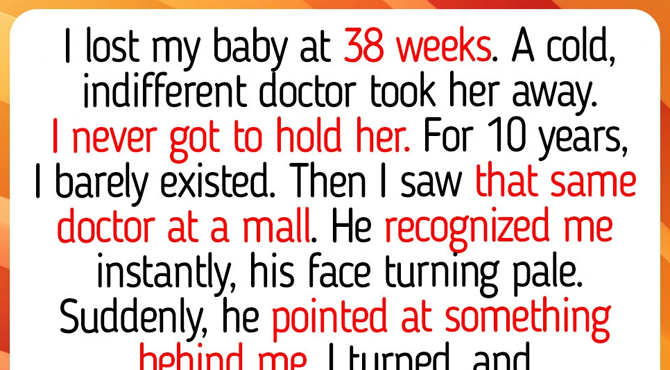
I lost my baby at 38 weeks. Full term. Her name was going to be Clara. The doctor was efficient and cold — he took her away before I’d understood what was happening, and I never got to hold her.
I’ve spent ten years trying to forgive myself for not demanding that. For being too shocked to speak. For 10 years I barely existed. Grief that size doesn’t announce itself — it just quietly hollows you out and leaves you functional on the outside and empty on the inside.
Then I saw him at a mall. He recognized me instantly. I watched his face drain of color — a man who’d clearly carried something too, which I hadn’t expected or allowed myself to imagine. He stared, then pointed behind my shoulder.
I turned around. A little girl, maybe nine, was standing at a toy store window with her nose pressed against the glass. Dark hair. Serious face. Looking at things with her whole self. I turned back to him, confused.
He said quietly, “That’s my daughter. She was born at 25 weeks. Spent three months in the NICU.” He paused. “I thought about your case every single day in that ward.” What he told me next was something he’d apparently needed to say for a long time.
His daughter’s premature birth had cracked open the professional distance he’d built over years — lying beside her incubator night after night, he’d finally understood from the inside what he’d taken from me. The coldness. The efficiency. The baby removed before the mother could process what was happening.
He’d gone back to his hospital and advocated for a policy change. Families now had time with babies lost late in pregnancy — time that was theirs by right. Time he hadn’t given me. “I don’t expect anything from telling you this,” he said. “I just needed you to know she mattered. That you mattered.”
I looked at his daughter, still at the window, completely unbothered. I didn’t forgive him in that moment — forgiveness isn’t something that happens in thirty seconds in a mall, and I won’t pretend otherwise.
But something shifted. The man I’d turned into a symbol of everything wrong about that day turned out to be a person who’d also been broken by it, differently, and had done something real with the breaking.
His daughter noticed him and waved. He waved back with the specific love of someone who almost lost everything. I understood that wave in my whole body. The compassion I hadn’t been able to find for him in ten years arrived quietly, without announcement.
Not because he deserved it on some clean moral ledger — but because I was exhausted from carrying the alternative, and because he’d turned out to be human after all, which is the thing grief sometimes hides from you about people who hurt you.
Clara would have been ten. I thought about her the whole drive home, the way I always do. But it felt different — less like being crushed and more like something I was finally learning to carry. That’s not a happy ending. It’s just a true one.
2.
My dad walked out on me when I was 14, but he kept in touch with my older brother. He bought my older brother a car, a $3,000 DSLR camera (when they were a new thing), took him on trips, etc. He hasn’t said a word to me since I was 14, though. It’s a mess.
Anyway, when I turned 16 my grandfather went out and bought me a car. He’d have me over a couple weekends every month to help him around the house, help work on the boats with him, etc.
At the time I thought he just needed help. I thought my problems with my dad were my fault for misbehaving for something, and that nobody in my family knew about them except me and my mom.
The older I get, the more I realize my mom must have gone to him over the way my father was treating me, and he stepped in to help raise me. He was the best man I ever knew.
3.
I was on dialysis for two years in Salmon, Idaho. Three days a week, four hours a chair, and a 90-minute drive each way to the nearest center. No one in my family was a match. My sister got tested and was out in a week. The transplant list in Utah was moving so slowly I stopped checking my place on it.
One night in March, I posted in a Facebook group for kidney patients. I’m not a poster. I wrote something like, “Two years in, no donor, just putting this out there.” I expected nothing. A man named Gary commented about an hour later: “I’m O-negative. Let’s get tested.”
He lived in Billings, Montana, about 400 miles away. I’d never heard of him. He messaged me that night and said his brother Danny had passed of kidney failure ten years earlier, and he’d decided back then that if he ever got the chance, he’d do something about it. He just never had a place to put it.
Screening took six months. Blood work, a CT scan, a psychological evaluation, and two trips to Salt Lake City for each of us. We met in person for the first time in the hospital parking garage before the surgery. He was shorter than I expected and wearing a Carhartt jacket. He shook my hand and said, “Well, here we are.”
The surgery was in September. We were in neighboring rooms, and I could hear him through the wall arguing with a nurse about the Wi-Fi.
We talk every day now. I tried to thank him once and he cut me off. He said the kidney wasn’t really the gift. The gift was finally having somewhere to put what he’d been carrying since Danny’s passing.
In June, he drove down to Idaho and brought Danny’s old fishing rod. We stood in the Salmon River for three hours, and I caught nothing. Gary looked at my empty line and said, “Danny would’ve had three by now.”
4.
I was nineteen, first time living alone, completely broke, and my boiler broke in January and the landlord wasn’t answering. I slept in my coat for two nights before admitting to anyone that I didn’t know what to do.
My university tutor, who I’d emailed about something unrelated, read between the lines of my message and called me. Walked me through my tenant rights, helped me draft the letter to the landlord, told me exactly what to say and what to document.
The boiler was fixed within forty-eight hours. He had no obligation to do any of that. He just heard something in my email and followed it. His act of kindness was making a call he wasn’t required to make. Empathy that reads an email properly and hears the thing behind the thing. Compassion that walks a nineteen-year-old through the adult world one step at a time. Wisdom in knowing what a cold January and a first flat alone actually feels like. Mercy for my two nights in a coat. Kindness and forgiveness for my landlord’s silence came from a tutor who picked up the phone.
5.
I am a chef and I have cooked professionally for thirty years and I want to say something that sounds simple but that I believe completely: feeding someone is an act of profound attention.
To cook for a person you have to think about them — what they need, what they love, what they can’t eat, what would make them feel cared for specifically and not generically. You have to hold them in your mind while you work.
The best cooking I have ever done has been when I knew exactly who I was cooking for. The worst has been when I forgot there was a person at the end of it.
I have seen this truth work in the other direction too — the people who have fed me at the moments when I most needed feeding have always done it with that quality of attention, as if they had held me in their mind while they made the thing, as if the food arrived already containing the thought of me.
My grandmother did this. A stranger in a hospital cafeteria did this once when I was very low and handed me soup that tasted like someone had considered me. I don’t know how else to say it. The consideration is an ingredient. You can taste it. I swear you can taste it.
6.
Last October I came across a car accident on Highway 87 outside Billings. One driver was already gone. The other was barely conscious, and I stayed with her until the ambulance came. After they took her, the deputy said the coroner was an hour out and I could leave.
I stayed anyway. I put a blanket from my truck over the man and sat with him on the gravel until someone came for him. I never learned his name.
There’s a new wool blanket on the seat of my truck now, and I slow down at that mile marker every time I drive by.
7.
A text came in at 11 p.m. from a number I didn’t know, clearly meant for someone else: “I don’t think I can do this anymore. I’m sorry.”
I could have ignored it. I wrote back: “I think this reached the wrong number, but I don’t think that matters right now. Are you safe? I’m here if you want to talk, stranger to stranger.”
We texted for four hours. Close to 3 a.m., she agreed to call 988 and to phone her sister. Her last message was, “Thank you, stranger.” I never found out her name.
Her number is still in my phone, saved as “Wrong Number.” I check it every time my phone buzzes late at night.
8.
Aunt was gonna be short for her rent. I paid the landlord and told him to say that she paid it earlier in the month. She was so happy about it. Made steaks for supper and paid extra on other bills so she’d be ahead of them.
9.
I’ve been a conductor on SEPTA Regional Rail for 22 years, mostly the Paoli/Thorndale line into Center City. You don’t make friends on a commuter train, but you learn people. Who sleeps with their mouth open, who’s always late by one minute, who needs to be woken up at 30th Street.
Walt rode the 7:12 out of Ardmore for at least nine years. Car three, left side, same seat, a thermos between his feet. He’d hold his monthly pass up without looking at me and say, “Morning, chief.” That was our whole relationship.
One Monday in February, he wasn’t there. Then Tuesday, then the rest of the week. By the second week it was bugging me more than I wanted to admit. I asked a woman named Denise who rides the same car and knits the whole way in.
She said she’d heard through a neighbor that Walt was in Lankenau Hospital, in bad shape, and that he didn’t have anyone. No kids nearby, wife passed years ago. I went on my day off with a bag of those butterscotch candies he always had in his coat.
I figured I’d stay ten minutes. I stayed two hours. We mostly talked about the Phillies. I went back about once a week for two months. Some days he was too tired to talk, so I just sat there with the TV on.
He’s home now. Last month he told me those visits did more for him than half the medicine did. I told him to knock it off. On Monday morning he got on at Ardmore like nothing had happened, took car three, left side, and held up his pass without looking at me. “Morning, chief.” I punched it anyway.
10.
I am passing away. I want to say that plainly because it is plain — I have a terminal diagnosis, the timeline is what it is, I am not going to recover. What I want to tell you is not about passing. It’s about what happened when I started telling people the truth about my situation.
Something I had not expected: people became more themselves around me. The pretending dropped away. Conversations that would normally take years of friendship to reach happened immediately, on park benches, in waiting rooms, at dinners.
People told me real things. People said I love you who had never said it before. People appeared at my door with their actual faces on, not the faces they usually wore.
I think the proximity of an ending made people realize that the version of themselves they were presenting was not the version they wanted to have spent their time being, and they corrected toward something truer, and the correction happened with me, and it has been one of the most extraordinary gifts of my life.
I am passing and the last year has been full of the realest conversations I have ever had. I do not recommend this route to those conversations. But I am grateful for them. I keep every one.