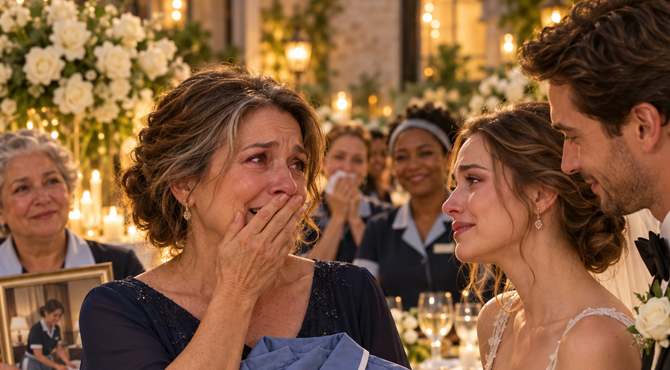
When my daughter asked me to wear my old cleaning uniform to her wedding, I thought I had misunderstood.
Then she placed the faded blue dress on my kitchen table.
“I had it cleaned,” she said.
I stared at the little white buttons. The crooked pocket. The place near the hem where I had stitched a tear with thread that never quite matched.
“Emma,” I said carefully, “is this supposed to be funny?”
She reached for my hand.
I moved it away.
My name is Ruth. I’m fifty-eight years old, and for twenty-seven years, I cleaned rooms at the Bellweather Hotel.
Bathrooms first.
Then beds.
Then the little things guests noticed only when you missed them.
A fingerprint on a mirror. A hair beside a sink. A coffee stain underneath a saucer.
My husband, Daniel, died when Emma was six.
After the funeral, I had eighty-three dollars in our checking account and a child who kept asking whether heaven had a telephone.
The hotel offered me full-time work.
I took it before they finished telling me the hours.
For years, I left home before sunrise. My neighbor watched Emma until school, and I collected her afterward with my hands smelling of bleach, no matter how carefully I washed them.
Sometimes she would fall asleep against me on the bus.
I always folded my cardigan between her cheek and my uniform.
I didn’t want her breathing in the cleaning chemicals.
That was the sort of thing I worried about back then.
Small things.
The larger ones were beyond anything I could fix.
Emma was a bright child.
She borrowed library books faster than I could return them. At twelve, she announced she wanted to become an architect.
“Why buildings?” I asked.
She looked around our kitchen, where rain had stained the ceiling above the stove.
“Because people should feel safe inside them.”
I worked extra shifts after that.
When she needed a computer, I cleaned offices on Sundays.
When her class traveled to Washington, I sold my wedding earrings and told her the hotel had given me a bonus.
She believed me.
Children usually believe the version of things that lets them remain children.
I wanted her to have that for as long as possible.
The first time I met her future mother-in-law, I nearly spilled water down the front of my blouse.
Vivian wore a cream suit and a bracelet that probably cost more than my car.
She asked where I worked.
“The Bellweather,” I answered.
“Oh, lovely. In management?”
I should have corrected her immediately.
Instead, I hesitated.
Emma spoke before I could.
“My mom works in housekeeping.”
There was nothing embarrassed in her voice.
The embarrassment belonged entirely to me.
Vivian smiled.
“That must be demanding.”
“It pays the bills,” I said.
For the rest of dinner, I kept my hands beneath the table.
My knuckles were swollen that evening. There was a small split beside my thumbnail.
I suddenly wished I had worn gloves all my life.
On the drive home, Emma asked why I had gone quiet.
“Just tired.”
She looked at me for a moment.
Then she let me have my lie.
When Emma and James became engaged, I started saving for a dress.
A proper one.
Something soft and navy, with sleeves to my elbows.
I found it in a shop window downtown. For six weeks, I walked past it on my way to the bus.
When I finally bought it, I hung it on the outside of my wardrobe.
Every morning, I looked at it before getting dressed.
For once, I would walk into a beautiful room without carrying a cart.
Then Emma brought me the uniform.
“I thought you threw that away,” I said.
“You left a box at my apartment when you moved. It was inside.”
I touched the pocket.
There was still a faint mark where my name badge had sat.
“Why would you want me wearing this?”
Her eyes filled.
“There’s something we’ve planned for the reception.”
“We?”
“James and me.”
I stepped back from the table.
“Does his family know?”
“Mom—”
“Do they want pictures? Is that it? The cleaning lady whose daughter married well?”
Emma went white.
“No.”
“I bought a dress.”
“I know.”
“A nice one.”
Her mouth trembled.
“I know, Mom.”
I opened the kitchen door.
“Then you should understand why I’m not wearing that.”
She stood very still.
Finally, she picked up the uniform.
“I’m sorry,” she whispered. “I wanted to explain it properly.”
“Then you should have started there.”
We barely spoke for four days.
She called. I answered practical questions.
Yes, I had arranged a ride.
Yes, I had my shoes.
No, I didn’t need anything.
On the fifth evening, a message arrived.
Please wear your navy dress. I shouldn’t have made your clothes part of a surprise. I love you, and I want you there.
I read it twice.
Then I sat on the edge of my bed and cried with the dress hanging in front of me.
Because I wanted to believe I had misunderstood my daughter.
And because I was frightened that I hadn’t.
The wedding took place at a restored country house with tall windows and a garden full of white roses.
James met me near the entrance.
“You look beautiful, Ruth.”
“Thank you.”
He offered me his arm.
I had expected an usher.
Something about the simple courtesy nearly undid me.
Inside, Emma was waiting in a small room beside the staircase.
When she saw me, she pressed both hands to her mouth.
“Oh, Mom.”
For a moment, neither of us moved.
Then she crossed the room and hugged me so tightly that one of my earrings caught in her veil.
We laughed while trying to untangle it.
It was the first easy sound between us all week.
“I’m sorry,” she said against my shoulder.
“I know.”
“I never wanted you to feel small.”
I closed my eyes.
“Then don’t ask me to guess what you mean when it matters.”
She nodded.
“I won’t.”
I made it through the ceremony with only two tissues.
That felt like an achievement.
At the reception, a place card waited for me at the front table.
Beside my chair stood an elderly woman wearing a dark green dress.
I recognized her before she turned.
“Mrs. Alvarez?”
She smiled.
“Hello, Ruth.”
For years, she had supervised the hotel laundry.
She was the person who showed me how to wrap my wrists when they hurt. The person who slipped an extra sandwich into my bag when she knew Emma was home sick.
I hadn’t seen her since she retired.
“What are you doing here?”
“Your daughter invited me.”
Then I noticed the others.
Marjorie from the third-floor housekeeping team.
Leon, who worked nights polishing the lobby floors.
Mrs. Patel, who used to cover my shifts during parent-teacher conferences.
They were seated together near the dance floor.
Marjorie lifted her glass.
“About time we saw you dressed up.”
I laughed.
But my throat had begun to tighten.
After dinner, Emma stood with a microphone.
“I need to tell you about the first building I ever designed,” she said.
A few people smiled.
“I was nine. It was made of cereal boxes, and the roof kept collapsing.”
I remembered it immediately.
We had used nearly an entire roll of tape.
“My mother had just finished a double shift. She sat on the kitchen floor in her work uniform and held the walls together while the glue dried.”
Emma looked at me.
“She fell asleep sitting there.”
The room grew quiet.
“I used to think that was a funny memory. Now I understand how tired she must have been.”
I lowered my eyes to my napkin.
“Most of you know my mother worked at the Bellweather Hotel. Some of you don’t know that her coworkers helped raise me.”
She turned toward their table.
“They switched shifts so she could come to school plays. They brought groceries when she had pneumonia. They checked my math homework in the staff room while she finished upstairs.”
Mrs. Alvarez dabbed at her eyes.
“My degree has my name on it,” Emma said. “But there were a lot of people holding those walls together.”
James moved beside her.
He held a large frame.
Inside was my old blue uniform.
For one sharp second, I stiffened.
Then I saw what lay beneath it.
A photograph.
Emma at nine, asleep on our kitchen floor beside her crooked cardboard house.
And me beside her.
Still wearing my work shoes.
“The hotel was going to throw away its old staff photographs when they renovated,” Emma said. “Mrs. Alvarez saved this one. Mom had given her a copy years ago.”
I remembered doing it.
Emma had won a ribbon at school. I had carried that photograph in my bag for weeks.
“I wanted Mom to wear the uniform because I thought it would show everyone what she’d done for me.”
Emma took a breath.
“But she reminded me that she gets to choose how she enters a room.”
Her eyes found mine.
“So, Mom, I’m sorry I asked you to put it back on.”
The tears came then.
Quietly at first.
Then too quickly to hide.
“There’s one more thing,” James said.
He handed the microphone back to Emma.
“James and I decided a few months ago that we didn’t need wedding gifts,” she said. “We asked anyone who wanted to give something to help us start a small education fund.”
Behind her, a screen lit up.
The Ruth Bennett Education Fund.
I stared at my name.
“The first grants will help hotel housekeeping and laundry staff pay for school supplies, training courses, and college application costs for their children.”
My hand went to my mouth.
Emma was crying now too.
“You sold your earrings for my school trip,” she said.
I looked up sharply.
“Oh, sweetheart.”
“I found the receipt years ago. You tucked it into the little box Dad gave you.”
I had forgotten the receipt.
I had never forgotten the earrings.
“I couldn’t buy back the same pair,” she said. “But I thought we could help another mother keep hers.”
I don’t remember standing.
I remember Emma meeting me halfway.
I remember the microphone making a small, awful noise when she dropped her hand.
And I remember holding my grown daughter while everyone around us disappeared for a moment.
“You didn’t have to do all this,” I whispered.
“I know.”
“I just wanted to see you get married.”
She pulled back and wiped my cheek with her thumb.
“I wanted you to see what you made possible.”
Later, Vivian found me beside the framed uniform.
For a moment, we stood together without speaking.
Then she said, “At that first dinner, I asked you whether you worked in management.”
I smiled awkwardly.
“I remember.”
“I realized afterward that I made you correct an assumption I shouldn’t have made.”
“You were being polite.”
“Perhaps. But I could have been more thoughtful.”
She glanced toward the dance floor, where James was attempting to follow Emma through a turn.
“You raised someone my son can build a good life with,” she said. “I’m very grateful.”
This time, I didn’t hide my hands.
“Thank you,” I told her.
Near the end of the evening, Mrs. Alvarez sat beside me.
“Do you remember your first week?” she asked.
“I cried in the linen cupboard.”
“Twice.”
“Three times.”
She laughed.
Then she took my hand.
“You always thought Emma would remember what you couldn’t give her.”
Across the room, my daughter had taken off her wedding shoes.
She was dancing barefoot with Leon, who moved far better than any of us had expected.
“What do you think she remembers?” Mrs. Alvarez asked.
I looked at the uniform.
For years, I had seen the missing button I replaced. The stubborn stains. The garment I hurried to change out of before school events.
My daughter remembered sitting beside it on the kitchen floor.
She remembered that I stayed.
The next morning, Emma called while I was making tea.
“Did you have a good time?”
“I did.”
“Really?”
“Your mother stayed until the chairs were being stacked. What do you think?”
She laughed.
Then her voice softened.
“Are we okay?”
I leaned against the counter.
“Yes, sweetheart. We’re okay.”
After we hung up, I went to put my navy dress away.
There was a loose thread near the sleeve.
I fetched my sewing tin, sat by the window, and fixed it.
Then I hung the dress in the middle of my wardrobe, where I could reach it easily.
I intended to wear it again.