I still remember the sound of the zipper.
That’s what stuck with me. Not the door closing, nor the words.
Just the zipper on that suitcase after my husband, Edward, finished packing, as if he were heading out for a weekend trip, not walking out on a newborn.
I was sitting on the bed, our son, Brennan, barely a week old, in my arms.
That’s what stuck with me.
Edward didn’t even look at him when he said it.
“I didn’t sign up for this.”
“This” was our son, born with one leg shorter than the other.
That was it.
One sentence. One suitcase. And he was gone.
The next 16 years didn’t come easily.
There were doctor’s appointments, braces, and adjustments. Physical therapists pushed Brennan harder than I thought was fair. But he just kept going.
Edward didn’t even look at him.
I watched my son learn to stand and walk, wobbling as if the ground weren’t steady beneath him. I watched him fall more times than I could count. Then he’d get up every single time.
When Brennan decided he wanted to run, I almost said no.
Not because I didn’t believe in him, but because I didn’t want him to get hurt.
“Mom,” he told me one night, “I don’t want to be careful. I want to be fast.”
I didn’t argue after that.
He’d get up every single time.
By 16, Brennan wasn’t just running. He was winning!
Local meets turned into regional ones. Regional meets turned into state qualifiers for the fastest boy. Then came the calls: coaches, scouts, emails about scholarships, and opportunities I couldn’t have given him on my own.
Running was my son’s way out.
Yesterday was the state finals.
The biggest race of his life.
Running was my son’s way out.
The stadium was packed. I sat halfway up the bleachers, hands ready to press “record” on my phone.
Next to me sat Dana, Caleb’s mom. We’d been through years of track meets together.
Her son used to run too, before a car accident took away his ability to walk and his dream to race.
Caleb, Brennan’s best friend, was on the field now, near the track, sitting in his wheelchair, watching.
He and Brennan had been inseparable since middle school.
Her son used to run too.
The gun went off.
Brennan took the lead early.
He moved in a controlled and steady manner. Everything we’d worked for was right there.
When the final stretch came into view, my son suddenly slowed!
At first, I thought I had imagined it.
Then he stopped and stepped off the track.
The entire stadium went quiet.
“What’s he doing?” Dana whispered.
I was already on my feet, eyes wide with disbelief.
My son suddenly slowed!
Brennan walked over to Caleb, who sat there, shaking his head.
I later heard from those close by that Caleb said, “I can’t.”
But my son didn’t hesitate.
“Yeah, you can. We finish this together,” Brennan apparently responded.
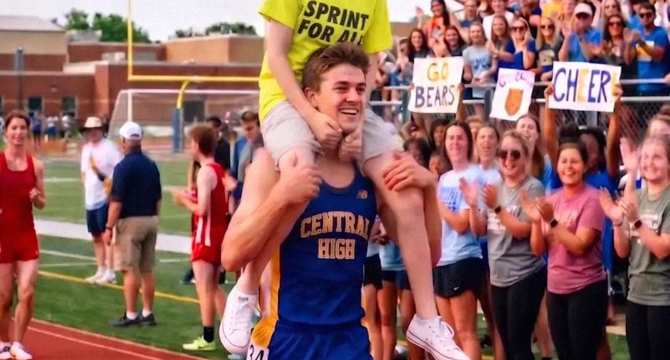
Before anyone could react, Brennan bent down, helped Caleb up, and lifted him onto his shoulders.
There was a moment, just a second, where it looked impossible.
Then my son adjusted his stance and started running the last stretch!
“We finish this together.”
He wasn’t as fast as before, but he was steady and determined despite how slow and painful it was.
The crowd gasped as Caleb clung to him tightly.
I heard someone behind me say, “He’s throwing it away.”
But instead, the other runners slowed.
One by one, they stopped and stepped aside.
No one passed Caleb and Brennan.
“He’s throwing it away.”
Caleb, his face pressed against Brennan’s shoulder, started laughing through tears.
Dana covered her mouth, shaking beside me.
By the time the two boys reached the finish line, the entire stadium was on its feet!
Not cheering for a winner, but for something else.
Brennan and Caleb crossed together before the former lowered the latter gently.
The noise hit all at once!
Applause. Shouting. People standing.
I didn’t even realize I was crying until Dana pulled me into a hug.
The entire stadium was on its feet!
The officials gathered near the track.
There was confusion at first; then, after a quick discussion, one of the judges stepped forward with a microphone.
“Today we recognize something greater than speed.”
The stadium quieted again.
They called Brennan forward.
They placed a medal around his neck for a special first-place honor.
I watched my son look down at it.
Then, without a word, he turned to Caleb and placed it over his head!
There was confusion at first.
Brennan later told me he said to Caleb, “You were always the real champion.”
That move broke whatever was left in the audience. People around us cried openly.
I thought the story had ended right there.
It didn’t.
The next morning, my phone rang just after 7 a.m.
“Nancy?” the voice said. “This is Mr. Henderson. I need you and Brennan in my office this morning.”
People around us cried openly.
There was something in his tone that made my stomach clench.
“We’ll be there,” I said.
The school felt different that morning.
Brennan walked beside me, hands in his pockets.
“You think I’m in trouble?” he asked.
I glanced at him. “Did you do something wrong?”
He thought about it.
Then shook his head. “No.”
“Then we’ll deal with whatever it is.”
I said it as if I believed it. I wasn’t sure I did.
“We’ll be there.”
Mr. Henderson, the school principal, didn’t smile when we walked in.
He stood behind his desk, a thick black folder before him.
“Have a seat.”
Henderson took a deep breath and continued.
“Do you even know what this reckless act will cost your son?”
My heart dropped.
I felt it, sharp and immediate.
Brennan didn’t respond.
He just sat there, waiting.
Henderson took a deep breath and continued.
Henderson opened the folder, pulled out a document, and slid it across the desk toward Brennan.
“This,” he said quietly, “explains all the consequences.”
My son picked it up. I watched his eyes move across the page.
Then his jaw tightened just slightly.
“What does it say?” I asked.
He didn’t answer, just handed it to me.
And the moment I started reading, I felt everything we’d built begin to slip.
“What does it say?”
It wasn’t a warning or a suspension. It was a withdrawal.
The scholarship committee — the state athletics board — had officially disqualified Brennan.
“Violation of race protocol.”
“Interference with a competitive outcome.”
Cold, final words.
My hands froze.
Every early morning, late-night drive, and time he pushed through pain and told me he was fine when I knew he wasn’t.
All of it, reduced to a paragraph.
It was a withdrawal.
“I didn’t think…” Brennan started.
Then he stopped. He didn’t sound sorry, just steady.
Henderson leaned back in his chair.
“That race,” he said, “wasn’t just a race.”
Brennan looked up.
“The board reviewed everything: the footage and the reports. They ruled that by leaving your lane and assisting another participant, you interfered with the official outcome.”
“So that’s it?” I asked. “He’s out?”
“For that scholarship, yes.”
I felt stumped.
He didn’t sound sorry.
Before he went to class, I stopped my son, “Are you okay? I’m sorry that what you worked so hard for is gone.”
Brennan looked at me. “I knew it might be.”
I blinked. “You knew?”
“I didn’t know for sure, but I figured there’d be consequences.”
“And you still did it?”
He didn’t hesitate. “Yeah.”
There was no anger or doubt in his voice.
Just certainty.
I didn’t say anything after that.
“I knew it might be.”
My drive home was filled with replays from the day before.
That day, I couldn’t sit still.
I stood in the kitchen for a long time, staring at nothing.
Then I grabbed my phone.
I had a video. The moment Brennan stepped onto the track, I hit record.
My hands shook as I watched it back.
It didn’t look like a mistake.
It looked like something people don’t see often.
That day, I couldn’t sit still.
I opened the community group’s social media page and started typing.
I didn’t overthink it, just told the truth.
What happened and what it cost my son.
Then I posted the video.
For a second, nothing happened.
Then the notifications started.
Comments. Shares. Messages.
People I didn’t know: parents, coaches, former students.
By evening, the video had spread further than I’d expected.
Then I posted the video.
I also called the local paper. I asked if they could cover a story about Brennan’s race and consequences.
“We’d like to cover the story,” Ted, the paper’s editor, said. “But we’d need to speak with Brennan and Caleb.”
“I’ll have to talk to Caleb’s parents first.”
“Of course,” Ted replied. “We’ll wait to hear from you.”
When I hung up, I stood there for a moment, planning how I’d approach Dana and her husband.
My actions weren’t about attention; they were about ensuring that what Brennan had done didn’t just cost him his life.
“We’d like to cover the story.”
The next morning, my phone rang again about two hours after I dropped Brennan at school.
“Nancy, we need you back in the office,” Henderson said. “There’s something we need to discuss.”
“Is Brennan in more trouble?” I asked.
“Just come in,” the principal said.
I didn’t wait. I drove straight to the school.
When I stepped into the office, Brennan was already there.
He sat by the principal’s desk.
Henderson sat behind it.
“Is Brennan in more trouble?”
But this time, there was something different in the principal’s expression.
“Please have a seat.”
I did.
Henderson opened a folder again, but instead of the official documents, he pulled out a single sheet of paper.
It had no letterhead or logo.
Just a typed note.
He slid it across the desk.
“A donor read and saw your video about yesterday’s race.”
I glanced at Brennan.
He pulled out a single sheet of paper.
Henderson continued, “It’s someone who funds a private foundation. They don’t usually get involved at the high school level, but they look for something very specific.”
“What?” Brennan asked.
“Character under pressure,” Henderson continued. “They saw a young man with everything to gain walk away from it for someone else.”
I felt my chest tighten again, but this time it wasn’t fear.
Henderson tapped the paper lightly.
“They’ve offered to cover full college tuition and medical support for both Brennan and Caleb.”
Brennan blinked. “Both of us?!”
“Yes.”
“It’s someone who funds a private foundation.”
I looked at my son, and he looked at me.
Neither of us spoke for a second.
“And the scholarship?” I asked quietly.
Henderson gave a small nod.
“Still gone.”
Brennan exhaled, relieved.
“I’d do it again,” my son said.
For the first time since we walked in, Henderson smiled.
“I figured you would.”
“I’d do it again.”
Later that afternoon, Brennan asked me to drive him to Caleb’s house.
Dana opened the door before we had even knocked.
“I heard about the scholarship,” she said, pulling me into a quick hug. “Is it true?”
I nodded.
Caleb was in the living room.
When Brennan walked in, he looked up and smiled.
Brennan had a stupid grin on his face, too!
The boys hugged, and I shed a tear beside Dana.
“Is it true?”
“You lost your scholarship because of me,” Caleb lamented.
“But we gained more,” Brennan responded with a glint in his eye.
Caleb frowned. “What do you mean?”
Brennan sat down across from him.
“We got a new one. Both of us.”
He explained everything.
The donor. The offer. The support.
Caleb just stared at him.
“What do you mean?”
“You’re serious?!” he asked.
“Yep!”
“And you’re okay with this?”
Brennan shrugged. “We finally got the recognition we deserve.”
I saw it in Dana’s face, in the way Caleb blinked, trying to process it.
During that visit, I told Dana about my call with the local paper, and she loved the idea but had to pass it by her husband first.
“And you’re okay with this?”
A few weeks later, the full story, including the offer from the new donor, ran in the paper.
Then online.
Then further.
But Brennan didn’t change.
He still woke up early, trained, and showed up.
The difference was that he wasn’t running alone anymore.
Caleb started coming to practice again.
Not to compete.
But to coach, guide, and stay involved.
He wasn’t running alone anymore.
I realized that my son had a future that didn’t look like the one we had imagined.
But somehow, it felt stronger.
Sixteen years ago, Edward walked away from us.
But sitting there, watching my son, I saw him show up for himself, anyway.
Every single time.
And now, he wasn’t just running toward a future.
He was building one.
Not alone.
But side by side with his best friend.
Exactly the way he chose to cross that finish line.