Greta had stopped calling it living a long time ago. What she had now was survival, plain and simple.
For four years, ever since her husband Patrick walked out and never really looked back, her life had become a string of early mornings, aching feet, and late nights spent figuring out how to stretch too little money across too many needs.
Every week felt like a puzzle with missing pieces.
Rent came first. Food came second. Everything else had to wait its turn. New clothes, small treats, and any kind of comfort belonged to a world she no longer expected for herself.
Still, for Daisy, Greta kept trying to build a life that felt gentle, safe, and full of love.
Her daughter was five years old and full of light in ways Greta could not explain. Daisy had a way of making even the worst days feel softer. She laughed with her whole heart, asked impossible questions, and saw things in people that Greta often missed because she was too tired to look.
Greta had spent years trying to shield her from the sharpest edges of their life, wrapping hard truths in bedtime stories and warm hugs.
That afternoon, they were walking home together under a gray sky, Daisy skipping a few steps ahead before circling back to take her mother’s hand.
Greta was already thinking about the evening.
She still had laundry to finish, lunches to prepare, and another shift the next morning. Her shoulders ached, and there were coins in her coat pocket that she had counted twice already.
Then they passed the mansion.
It stood behind a rusted iron fence, old and silent, with cracked windows and vines creeping up its walls. Even abandoned, it looked grand. Greta slowed without meaning to. The place had the hollow beauty of something that had once been full of music, laughter, and expensive things.
Now it looked lifeless.
Near the gate, an elderly man stood beside a few scattered belongings from the house. A small table held old books, tarnished silver, framed paintings, and bits of porcelain.
He was not calling out to anyone or trying to bargain. He simply stood there, quiet and still, as if he belonged to the house as much as the peeling walls did.
Greta paused, drawn to the vintage items despite herself. She told herself she was only looking.
Looking was free.
Daisy stared at the man for a long moment with the open, fearless curiosity only a child could manage. Before Greta could guide her along, Daisy spoke.
“You’re very kind,” she said, looking straight at him. “You remind me of my dad. Your eyes are kind… but they’re not happy.”
Greta’s stomach dropped.
“Daisy,” she said quickly, her face burning. She turned to the man at once. “I’m so sorry, she didn’t mean…”
“It’s okay,” the old man said with a soft smile. His voice was gentle, almost tired. “You have a wonderful daughter.”
Greta let out a breath, though her embarrassment did not leave.
Daisy only stepped closer, studying him with those wide, serious eyes of hers.
The man bent slightly and reached into a worn leather bag resting at his feet. For a second, Greta thought he was pulling out some old trinket to show them. Instead, he drew out a doll.
It was beautiful in an old-fashioned way, with a faded dress, soft curls, and carefully painted features. It looked delicate, far nicer than anything Greta could have afforded, even when life had been easier.
Daisy’s eyes lit up at once.
The man gently handed it to her. “This isn’t just any doll,” he said quietly. “One day, you’ll understand. I’ve been saving it for this moment.”
Greta looked up sharply, unsure what to make of that. There was no smile on his face now, only a strange kind of certainty.
“That’s very kind of you,” Greta said carefully, “but I can’t take something like this for free.”
He nodded as if he had expected that. “Then buy it from me.”
She reached into her pocket, ready to offer the few dollars she could spare, but he lifted one finger.
“One cent.”
Greta blinked. “One cent?”
“Yes, one cent,” he repeated.
She hesitated, then dug through her pocket until she found the smallest copper coin among the nickels and dimes. She placed it in his palm, and he closed his hand around it as though it mattered.
Daisy clutched the doll to her chest the entire walk home.
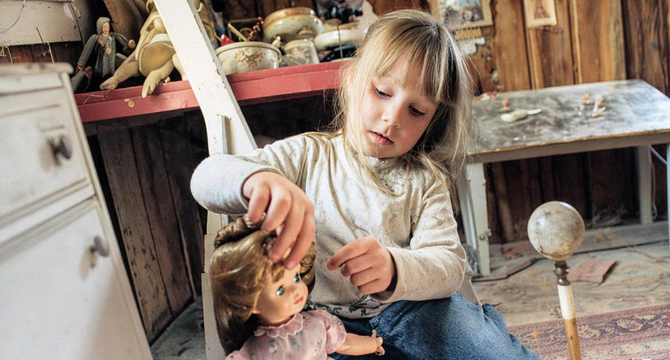
That evening, their apartment felt warmer than usual, filled with Daisy’s delighted chatter as she introduced the doll to her other toys, gave it a voice, and tucked it under her arm like a real baby.
Greta watched from the worn sofa, too exhausted to play much, but grateful for the sound of her daughter’s happiness.
It was rare enough to feel precious.
Later, as they sat together on the floor, Daisy tugged at the doll’s clothes with small, impatient fingers.
“Careful, sweetheart,” Greta murmured, leaning in.
Then there was a tiny rip.
Greta reached for the doll, expecting ordinary wear from an old toy, but the moment she looked closer, her breath caught. The tear was too neat, too deliberate. This wasn’t an accident. The cut had been made intentionally.
Her pulse quickened.
Very carefully, Greta slipped her finger inside the doll through the opening.
She felt paper.
Her eyes widened instantly.
“What the…?” she whispered.
Greta’s fingers trembled as she pulled the folded paper from inside the doll.
For a moment, she only stared at it. The apartment seemed to go silent around her. Daisy sat beside her on the rug, watching with wide, curious eyes, still unaware that something had shifted.
“Mommy?” Daisy asked softly. “What is it?”
Greta swallowed and forced herself to unfold the note.
The handwriting was neat, shaky in places, as if age had pressed itself into every line.
“If you are reading this, then the doll reached the right child. Please come back tomorrow. I owe you the truth. Bring the girl. Please.”
There was no signature.
Greta read it twice, then a third time, her chest tightening more with each word.
“The man?” she whispered to herself.
Daisy leaned against her arm.
“Is it from the kind grandpa?”
Greta folded the note quickly, though there was no point hiding it from a child too young to understand. “Maybe,” she said.
“Are we in trouble?” Daisy’s voice came out small.
Greta turned at once and cupped her daughter’s cheek. “No, sweetheart. No, of course not.”
But long after Daisy had fallen asleep, Greta remained awake at the kitchen table, reading the note again and again. She tried to be practical. Maybe the old man was lonely. Maybe he was confused. Maybe this was a mistake.
And yet she could not shake the way he had looked at Daisy.
Or the strange weight behind his words.
One day, you’ll understand. I’ve been saving it for this moment.
The next afternoon, Greta took Daisy’s hand and walked back to the mansion.
The old man was there waiting, seated this time in a wooden chair near the gate, as though he had known they would come. He rose slowly when he saw them. There was relief in his face, followed by something deeper, something fragile.
“You came,” he whispered.
Greta stopped a few feet away, keeping Daisy close to her side. “You left a note inside that doll.”
“I know.”
“Why?”
He looked at Daisy first, then at Greta. “Because I needed to be sure.”
Greta’s patience frayed. “Sure of what?”
The man exhaled slowly. “Please. Sit with me for a moment.”
There was a bench by the fence. Greta remained standing at first, but Daisy wandered toward the old man without fear, holding the doll in her arms. When he smiled at her, Greta finally sat, tense and alert.
“My name is Walter,” he said. “I am 72 years old. That house belonged to my family for many years. My wife and I lived there until she passed away, and after that, it became too large, too empty.”
He paused.
“My son was supposed to fill it with life again. But he left when he was young, and I never saw him after that.”
Greta listened without speaking.
Walter’s hands rested on his cane. “I made mistakes with him. More than I can count. I was proud, cold, and far too certain I had time to fix things later. By the time I was ready to be better, he was gone.”
Daisy looked up at him. “Did you miss him?”
Walter smiled sadly. “Every day.”
Something in Greta softened, but only slightly.
“What does this have to do with us?”
His eyes moved to Daisy’s face, and Greta felt her breath catch before he even spoke.
“A few weeks ago,” Walter said quietly, “a man came to see me.”
Greta went still.
“He stood right where you are now. He was older, tired, and ashamed. But he had my wife’s eyes, and I knew him at once.” Walter’s voice shook. “It was my son, Patrick.”
The name hit Greta like a blow.
“No,” she whispered.
Walter nodded slowly. “He told me about you. About Daisy. He told me he had failed both of you and did not deserve forgiveness. He was ill, Greta. Very ill. He said he had wasted too much of his life running from everyone he loved.”
Greta stared at him, unable to speak.
Walter reached into his coat and took out an envelope. “He asked me to give this to Daisy when the time was right. He said if she were anything like you, she would grow up surrounded by love, even if he had not given enough of it himself.”
Greta’s eyes filled before she could stop them. “Where is he now?”
Walter lowered his head. “He died eight days ago.”
The words split something open inside her.
Greta pressed a hand to her mouth as tears spilled down her cheeks. She hated Patrick for leaving. She hated the years of silence, the birthdays missed, and the empty space he had forced her to carry alone.
But beneath all that anger was the memory of a younger man she had once loved, and the cruel ache of knowing Daisy would never get the answer to the question she had not yet learned to ask.
Daisy looked between them, confused. “Mommy, why are you crying?”
Greta pulled her into her arms and held her tightly. “Because sometimes,” she whispered against her daughter’s hair, “people make mistakes they cannot fix.”
Walter’s eyes glistened.
“I cannot change what my son did. But I would like to know my granddaughter, if you will allow it. Slowly. In whatever way you think is right.”
Greta looked at him for a long moment. In his face, she could see traces of Patrick, not in the shape of him, but in the sadness, in the regret, and in the kindness Daisy had somehow spotted at once.
Daisy lifted the doll between them. “Can he come have tea with us one day?”
A broken laugh slipped through Greta’s tears.
She brushed them away and nodded once.
“Yes,” she said quietly. “One day, he can.”
And for the first time in years, the future did not feel like something to survive. It felt like something that might still hold room for healing.