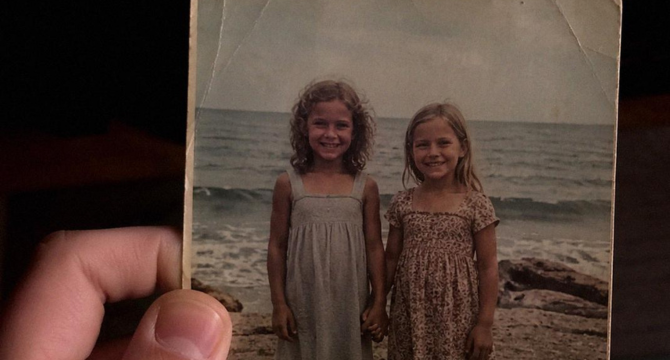
I was 14 when I found the photograph that changed two lives and, in a weird way, changed mine too.
I live in a small town where privacy is more of a joke than a real thing. We have one school, a few grocery stores, one church that somehow manages to host every funeral and every bake sale, and one library that smells like dust and old paper.
If your grandpa got into a fight in 1972, the lady at the post office still remembers who threw the first punch.
That afternoon, I went to the library because I did not want to go straight home.
My grandma and I lived together in a little white house just a few blocks from the church. My mom worked two towns over and got home late most days, and my grandma believed in knowing where I was at all times.
If I got home too early, she would put me to work peeling potatoes, carrying laundry, or listening to one of her friends talk about blood pressure medicine.
So I stopped at the library to kill an hour.
Alvarez, the librarian, gave me her usual smile when I walked in. She always acted like seeing me was the best part of her day.
“Homework?” she asked.
I shrugged. “Avoiding chores.”
She laughed. “Honesty is a good trait in a young man.”
I wandered into the history section, then the travel shelf, even though I had no real reason to be there. Most of those books were old anyway. Faded covers, yellow pages, pictures of beaches and cities that looked like they belonged to another world.
I pulled one out at random, some battered travel guide with a cracked spine, and sat by the window. When I opened it near the middle, a photograph slipped out and landed face-up on my lap.
It was old and faded, the kind of photo that looked soft around the edges, like time had breathed on it too many times. Two little girls stood on a beach, barefoot, maybe five or six years old.
They were holding hands. Both were smiling so hard it made something ache in my chest for reasons I could not explain.
I turned it over.
On the back, in shaky blue ink, it said:
“For my sister. I’ll find you one day. – Emily, 1984.”
I stared at it for a long time.
There are objects that are just objects, and there are objects that feel like they are carrying a piece of someone else’s life. This was the second kind. I did not know why. I just knew.
I got up and took it to the front desk.
“Alvarez,” I said, “do you know who these people are?”
She looked down casually at first.
Then her face changed.
Not in a dramatic movie way. More like all the color quietly left her at once.
“Where did you get this?” she asked.
“It fell out of a book.”
She took the photo carefully, like it might tear if she breathed too hard. For a few seconds, she said nothing. Then she looked at me over her glasses.
“You should sit down.”
That sentence has never led to anything good in human history.
I sat.
Alvarez lowered herself into the chair across from me and turned the photograph over again. Her thumb brushed the writing on the back.
“I think,” she said slowly, “these are Emily and Grace.”
The names meant nothing to me, so I said, “Okay.”
She gave me a sad look. “You are too young to remember. Most people your age wouldn’t know the story.”
Then she told me.
A long time ago, before I was born, two sisters named Emily and Grace had lived in town with their parents in a little house near the edge of Miller Road. Then there had been a fire. A bad one, and their parents died in it.
The girls survived, but everything else was gone.
For a while, neighbors took them in until relatives could be contacted and arrangements could be made. People meant well, Alvarez said.
Emily went with one family for a little while. Grace stayed with another.
Then there were delays, confusion, paperwork, distant relatives arguing over who could take whom, and somewhere in the middle of all that, one of the families moved away.
“They lost track of each other?” I asked.
Alvarez nodded.
“Completely?”
“Completely.”
I looked back at the picture. The girls in it looked so happy that it made the story feel even crueler.
“No one found them again?” I asked.
She gave a slow shake of her head. “People used to talk about it for years. Small town legend, almost. Two sisters who vanished from each other’s lives.”
I swallowed. “So this could be… important?”
Her eyes flicked to the writing again. “I think it could be everything.”
That was how a normal, boring afternoon turned into the strangest week of my life.
Alvarez asked if she could take a picture of the photo and post it in the community group online. My grandma was in that group, along with every person in town over thirty-five.
She posted things there all the time: lost dogs, church events, weather warnings, and long complaints about teenagers walking too late at night.
I called Grandma from the library.
“What did you do?” she asked immediately.
“Why do you think I did something?”
“Because you never call me this sweetly unless there is trouble.”
I told her what happened. There was a long pause.
Then she said, “Don’t move. I’m coming.”
She arrived in 20 minutes, still wearing her house slippers and carrying her purse like she was ready to fight fate in a parking lot.
Alvarez explained everything again. Grandma took one look at the photograph and crossed herself.
“Oh, those poor babies,” she whispered.
The three of us sat there while Alvarez uploaded the image and wrote a post asking if anyone recognized the girls and knew where they were today. Within minutes, people started commenting.
I recognized the sisters.
They were attached to the hip and loved their long beach walks.
My mother used to talk about those sisters.
Try old church records.
Is Emily still alive?
My grandma muttered, “Now everybody in town will suddenly remember details they never bothered mentioning for 40 years.”
By dinner time, half the county seemed invested.
That evening, I was at the kitchen table pretending to do algebra while Grandma made meatloaf and kept refreshing the community page like it was election night. Then the phone rang.
Grandma answered with her usual, “Hello.”
Her face changed.
Not scared exactly. More like stunned.
She covered the receiver and looked at me. “It’s about the photograph.”
Then she handed me the phone.
I almost dropped it.
“Hello?”
For a second, I heard nothing but breathing. Then a woman’s voice came through, shaky and thin.
“The photo,” she said. “It is signed on the back, yes?”
I looked down at it where it sat beside my math book.
“Yes,” I said. “It says, ‘For my sister. I’ll find you one day. – Emily, 1984.'”
“Oh my God,” she whispered. “Oh, my God. I left it hidden in the community library years ago.”
Grandma stood frozen by the stove.
Alvarez, who had come over after closing the library because none of us could stop talking about it, pressed a hand to her mouth.
“I wrote that,” the woman said. “I wrote that. That’s my handwriting.”
“Are you Emily?” I asked.
She started crying harder.
“Yes.”
I did not know what to say. I was 14. I had never reunited anybody with anyone. I barely knew how to talk to girls in my own class.
Alvarez came closer and whispered, “Ask her where she is.”
I did.
“Ohio,” Emily said. “I’ve lived in Ohio for years. I saw the post because someone shared it.” Her voice cracked. “I have long lost hope about finding my sister. But I hoped she was the one who found it.”
I felt this wild rush of relief, like maybe the world was actually about to do something right for once.
Then Emily said, very quietly, “Since she isn’t the one who found it, it may be too late anyway.”
My stomach dropped.
“What do you mean?” I asked.
There was silence for a moment. When she spoke again, her voice sounded full of shame.
“Because I think she hates me.”
The kitchen went completely still.
Emily told us the story in pieces, stopping now and then to cry or catch her breath.
A few years after the fire, when she was older and finally had some control over her own life, she came back to town looking for Grace. She had remembered the street, the church, the old general store. But by then, the family caring for Grace had already moved away.
No forwarding address.
No new phone number.
No trail.
She asked around, but she was a grieving teenager with no money and no power. Adults gave her vague answers, told her they were sorry, told her maybe it was better not to stir things up.
Someone eventually told her Grace had gone out of state.
Someone else claimed Grace was doing fine and did not want to look back. So, devastated and not knowing what to do, she took the only picture they had together and hid it inside a travel book in the library.
It was a book she and her sister loved to pore over as they imagined one day leaving their small town to explore the world.
Believing she might someday return for it, she tucked a small note behind the photograph before walking away.
Years later, Emily heard another rumor about her sister, this one worse.
“That Grace thought I abandoned her,” Emily said. “That she believed I never came back.”
Her voice broke on the last word.
“I tried,” she said. “I did try. But after a while…” She inhaled shakily. “After a while, I started thinking maybe she had moved on. Maybe she was better off. Maybe I was the only one still carrying all of it.”
Grandma took the phone from me for a second.
“Honey,” she said in the soft voice she usually saved for funerals and newborns, “have you stopped loving your sister?”
Emily let out a broken laugh through tears. “Never.”
Grandma nodded like Emily could somehow see it. “Then don’t talk like it’s too late. She may have also not stopped loving you.”
Finding Emily was one thing. Finding Grace turned out to be much harder.
For the next three days, my life became a bizarre detective story. After school, I went straight to the library. Grandma came too. Alvarez pulled out old town directories, church newsletters, archived newspapers on microfilm, and boxes of records that smelled like dust and cardboard and forgotten years.
At one point, I sneezed five times in a row, and Grandma said, “History is trying to kill you.”
We built a timeline.
Fire in late 1983.
Girls were placed with separate families.
Emily linked to relatives in Ohio.
Grace apparently taken by a couple named Sutton for temporary care, then gone.
Alvarez found a tiny article in an old newspaper about the Suttons relocating “for employment opportunities” two states away. No city listed. Just a state.
“That is the most useless sentence in journalism,” I said.
Alvarez sighed. “Small-town reporting had different standards.”
Grandma called the old neighbors. Alvarez messaged people from the community post. I searched social media with every combination of Grace, Sutton, Walker, and the names of towns I could think of.
By the fourth day, I was more emotionally invested in two women I had never met than in my own report card.
Then Grandma found the first real lead.
She had called an elderly man named Harold, who had once lived next door to the Suttons. He remembered that they had a niece in Pennsylvania. He also remembered, because old people in my town remember everything, that the niece’s married last name might have been Bell.
That led Alvarez to an online obituary.
That obituary led to a Facebook profile.
That profile led to a woman named Grace Bell living in Delaware.
I remember staring at the screen and saying, “Is that her?”
Alvarez leaned closer. “The age matches.”
Grandma whispered, “Dear Lord.”
The profile picture showed a woman in her forties standing in a garden with gray starting at her temples. She had kind eyes. Sad eyes too, somehow. The kind of face that made you think she smiled for other people more than for herself.
Emily was on speaker when we found it.
“Grace?” she whispered.
No one answered for a second.
Then Emily started crying again.
Alvarez sent the first message because she had the calmest wording.
Hello. This may sound unusual, but we are trying to reconnect you with someone from your childhood. Please let us know if you are open to talking.
Grace replied the next morning.
Who is this about?
Alvarez wrote back: Emily.
The typing bubble appeared. Disappeared. Appeared again.
Finally, Grace sent: No.
Just that. One word.
Emily made a strangled sound on the phone.
“Ask her again,” she said. “Please. Please tell her I came back. Tell her I looked for her.”
Alvarez did. She wrote carefully, explaining about the photograph, the message on the back, and the years Emily spent searching. She told Grace I had found the picture hidden in a library book. She told her Emily had never stopped loving her.
For nearly an hour, there was nothing.
Then Grace called.
She did not call Emily. She called the library.
Alvarez put her on speaker. Her voice was sharp from the first second.
“Is this a prank?”
“No, ma’am,” Mrs. Alvarez said gently.
“Because if this is a prank, it is a cruel one.”
“It isn’t.”
I could hear how hard Grace was breathing.
“I was told she never came back,” Grace said. “I was told she did not ask for me. I was told she went with family and that was that.”
Emily, who was on the other line, merged in and whispered, “Grace?”
Dead silence.
Then Grace said, very coldly, “No.”
Emily started crying instantly. “Please don’t hang up. Please. I have looked for you for years.”
“You left me.”
“I was 16,” Emily said. “I came back, and they were gone. No address or number. I kept asking. Nobody told me where you were.”
Grace laughed, and it was one of the saddest sounds I have ever heard.
“Do you know what I was told?” she said. “That my sister had a real chance at a new life and chose it. That she didn’t want to drag around a little girl who reminded her of a fire.”
Emily gasped. “Who told you that?”
“I don’t even remember anymore. One of the adults. Maybe more than one. It all blurs together.”
“Grace, I would never say that. Never.”
There was a pause so long I thought the call had dropped.
Then Grace said, quieter now, “I waited for you to find me.”
Emily was openly sobbing. Grandma was crying too. Alvarez had taken off her glasses and was wiping her eyes with the edge of her sleeve. I was sitting there feeling like my chest had been filled with gravel.
“I know,” Emily whispered. “I know. And I am so sorry I couldn’t get to you.”
Grace’s next words came out trembling.
“I hated you for years.”
Emily said, “You had every right.”
“No,” Grace shot back. “Don’t do that. Don’t make me the wounded one and you the saint. I hated you because it was easier than missing you.”
I had never heard pain sound so honest.
Emily inhaled raggedly. “I missed you every day.”
The line went quiet again.
Then Alvarez held up the photograph so it faced no one and everyone at once, like somehow the little girls inside it were listening, too.
“Grace,” she said softly, “the note says, ‘For my sister. I’ll find you one day.’ She meant it.”
Grace broke.
Not loudly or all at once. Just a small, shattered breath, and then, crying, she had probably held back for decades.
“I still have dreams about the beach,” she whispered. “I still remember your hand.”
Emily could barely speak. “I remember the pink sandals you loved wearing on our walks.”
There was another silence, but this one felt different. Softer. Alive.
Finally, Grace said, “I don’t know what to do with all this.”
Grandma, who had somehow become the emotional commander of the operation, leaned toward the phone.
“You start with the truth,” she said. “Then you let the rest catch up.”
Three days later, Grace agreed to come.
The reunion happened in the library.
That felt right somehow. A place they both loved as kids.
Alvarez closed early that afternoon and put a sign on the door. Grandma brought tissues and lemon bars because she believes every major life event requires baked goods. I stood near the window pretending I was not nervous enough to throw up.
Emily arrived first.
She was smaller than I expected, with nervous hands and eyes so red it looked like she had not slept in a week. She kept clutching the photograph like she was afraid someone might take it away.
“You’re the one who found it?” she asked me.
I nodded.
She looked at me like I had personally reached into the past and dragged something precious back for her.
“Thank you,” she said.
I felt awkward and embarrassed and said, “It just fell out of a book.”
Her mouth trembled. “Still. Thank you.”
Then Grace’s car pulled into the lot.
I do not think I breathed.
She got out slowly and stood there for a second with both hands gripping the open car door. Emily moved toward the entrance, then stopped, like she was afraid going one step farther might scare Grace away.
The front door opened. Grace walked in.
For one long second, neither of them said anything.
Forty years is a long time. It is long enough to become different people. Long enough to build entire lives around an absence. Long enough for hurt to harden into something that feels like fact.
And still.
The second they looked at each other, I could see it. They knew.
Emily said it first, barely above a whisper.
“Gracie.”
Grace’s face crumpled.
No one had called her that in years. You could tell.
“Em,” she said.
Emily dropped the photograph.
Then they were moving.
They collided in the middle of the room and held onto each other like drowning people. Not graceful or polite. Full-body sobbing, shaking, clutching, and the kind of crying that comes from somewhere older than language.
“I’m sorry,” Emily kept saying. “I’m sorry, I’m sorry, I’m sorry.”
Grace clung to her and cried into her shoulder. “I thought you left me. I thought you didn’t want me.”
Emily pulled back just enough to hold Grace’s face in both hands.
“Never,” she said fiercely. “Do you hear me? Never.”
Grace let out this broken sound. “I wanted to hate you forever.”
Emily gave a helpless little laugh through tears. “I know.”
“But I couldn’t stop loving you.”
That made Emily cry even harder.
Neither of them cared that there were witnesses. Grandma was openly sobbing into a tissue. Alvarez had abandoned all dignity.
I had to look at the floor for a second because my own eyes were burning.
Eventually, they sat down together on the reading room couch, still holding hands, still staring at each other like if they looked away, the other might disappear.
At one point, Grace said, “I needed you when I got married.”
Emily covered her mouth and cried.
At another point, Emily said, “I almost named my daughter after you.”
Grace reached over and squeezed her hand so tightly her knuckles turned white.
That was the worst part and the best part. Watching them realize the villain in their story had mostly been distance, confusion, and the careless cruelty of adults who made assumptions and moved on.
By the end of the evening, Grace leaned her head against Emily’s shoulder like it had been yesterday instead of forty years.
“I don’t know how to do this,” Grace admitted.
Emily kissed the top of her head. “We do it badly at first.”
Grace laughed softly. “That sounds right.”
Then Emily said, “But we do it.”
I still think about that sentence.
These days, Emily and Grace talk all the time. They visit. They fight a little, according to Grandma, which she says is healthy because “real sisters are never peaceful for too long.”
They have pictures now. New ones. Side by side, older and sadder and wiser, but together.
Alvarez framed a copy of the original photograph and hung it behind the front desk with a little note beneath it that says: Returned to family, after all this time.
Sometimes I stand there and look at it.
Two girls on a beach. Holding hands. Smiling at a future they could not possibly understand.
I think about how close that picture came to staying hidden forever inside a forgotten library book.
I think about how many lives can turn on one tiny accident.
A page opened to the right place. A photo slipping loose. A sentence written in blue ink by a little girl who refused to stop promising.
“For my sister. I’ll find you one day.”
She did.
It just took almost 40 years, one small-town librarian, my nosy grandmother, and one bored 14-year-old trying to avoid peeling potatoes.