Three weeks after my mother died, I still could not bring myself to clear out her house.
Every room felt frozen in time, as if she might walk in at any moment carrying a stack of library books and asking whether I wanted tea.
My mother, Vivian, had been an archivist for nearly 40 years.
She spent her life surrounded by dusty history books, old records, and faded photographs.
She was quiet, gentle, and predictable in the best possible way.
At least, that was who I thought she was.
She had no living relatives, no close friends, no secrets.
Or so I believed.
The afternoon everything changed, rain tapped softly against the kitchen windows while I sorted through drawers and cardboard boxes.
Grief made every task feel heavier than it should have.
I wandered into her bedroom and sat on the edge of her neatly made bed.
On top of her dresser sat a vintage mahogany jewelry box I had seen my entire life.
I stared at it for several seconds.
“Maybe I could find something small to keep,” I thought to myself.
It would be nice to wear a necklace she always wore, or a bracelet that would remind me of her each time I looked at it.
Something that still carried a piece of her.
I carried the box to the bed and slowly opened the lid.
The familiar scent of lavender drifted upward.
Inside were a few rings, several brooches, and the pearl earrings she always wore to special occasions.
My throat tightened.
“I miss you, Mom,” I whispered.
As I reached inside, I noticed a dark smudge beneath the velvet tray.
I lifted the tray to wipe it clean.
Something shifted.
I frowned.
The bottom of the jewelry box moved slightly beneath my fingers.
For a moment, I thought my imagination was playing tricks on me.
Then I pressed again.
A faint click answered.
My heart skipped.
The wooden panel lifted just enough to reveal a narrow compartment hidden underneath.
I froze.
My mother hated clutter. She never hid anything.
Why would she have a secret compartment?
Suddenly nervous, I slid my fingers inside and pulled out a small bundle wrapped in yellowed tissue paper.
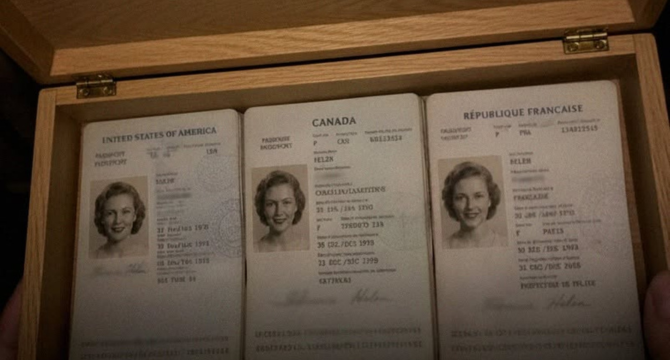
When I unfolded it, three expired passports fell into my lap.
I stared at them.
American.
British.
French.
My pulse began hammering.
Slowly, I opened the first one.
The photograph nearly made me drop it.
It was my mother.
There was no doubt about it.
The same eyes.
The same smile.
The same face I had known my entire life.
The name read Vivian.
I frowned and reached for the second passport.
The woman in the photograph looked almost exactly like her.
Not identical, but close enough to make my stomach twist.
Different name.
Different nationality.
I opened the third.
The resemblance was just as striking.
Three passports.
Three countries.
One belonged to my mother.
The other two belonged to women who looked so much like her that I couldn’t understand how it was possible.
“No,” I whispered.
I flipped through the pages of the other two passports.
Stamps filled them.
London.
Paris.
Montreal.
Edinburgh.
Brussels.
Cities my mother had never visited.
Her own passport was left unstamped.
When I was a child, I used to beg her to travel.
She would smile and say, “I’m happiest right here.”
Now, I wasn’t sure what to believe.
A cold sweat spread across my neck.
Who was the woman who raised me?
Had she been lying to me?
Why were these passports hidden?
And why did the women in them all look like her?
I searched the compartment again.
There had to be an explanation.
Instead, I found something even stranger.
A small brass key.
Attached to it was a faded tag.
A London address.
A safety deposit box number.
My stomach tightened.
Beneath the key sat an official-looking letter.
I unfolded it.
The notice came from a London bank.
According to the letter, the contents of a safety deposit box would be forfeited if nobody claimed them by next Friday.
I checked the date.
Four days.
I had four days.
I reread the letter three times.
Then, I looked back at the passports.
Nothing made sense.
Yet, one thing was clear.
My mother had hidden these items for a reason.
And whatever answers existed were waiting in London.
That evening, I barely slept.
I spread the passports across my dining room table and examined every detail.
The documents looked authentic.
The photographs showed nearly identical women, but with different hairstyles.
Still, the resemblance was uncanny.
I searched the names online.
Nothing useful appeared.
No criminal records.
No news articles.
No clues.
All kinds of things popped into my head.
Why would my mother hide three passports?
Why were there different names?
Why had she never mentioned any of these countries?
Had she been living some kind of secret life before I was born?
The more I stared at the documents, the less sense they made.
By morning, I had made my decision.
I booked a last-minute flight to London.
When the confirmation email arrived, anxiety crashed over me.
Maybe grief was clouding my judgment.
Maybe there was a simple explanation.
But if I ignored the letter and the box was destroyed, I would spend the rest of my life wondering what I had missed.
Two days later, I sat at the airport gate with the brass key in my hand.
Passengers chatted around me.
Children laughed.
Suitcases rolled across polished floors.
Everything looked normal.
But nothing felt normal anymore.
For 34 years, I had believed I knew everything about my mother.
Now I was not even sure I knew her whole story.
The boarding announcement echoed through the terminal.
People lined up.
I remained seated for a moment longer.
“What were you hiding?” I whispered.
Only silence answered.
Several hours later, after a sleepless flight and a blur of customs lines, I stepped into London.
Gray clouds hung low over the city.
A light drizzle coated the streets.
The address on the key tag led me to a quiet neighborhood lined with brick townhouses.
I checked the number again.
My heart pounded.
This was it.
The place connected to the mystery my mother had carried for decades.
I climbed the steps slowly.
Every instinct told me to turn around.
Instead, I raised my hand and knocked.
Footsteps approached.
The door handle turned.
And the moment the door opened, every assumption I had made about my mother’s secret life shattered.
My knees nearly gave out.
The woman standing in the doorway looked exactly like my mother.
Not vaguely similar.
Not a passing resemblance.
Exactly like her.
The same eyes.
The same smile.
The same features.
My heart slammed against my ribs.
I stumbled backward.
The woman frowned.
“Can I help you?”
Before I could answer, another woman appeared behind her.
I gasped.
She looked just like the first woman.
And just like my mother.
For several seconds, nobody spoke.
The second woman looked between us.
“Margaret?” she asked quietly.
The first woman kept staring at me.
Then her eyes widened.
“You look familiar.”
My throat tightened.
“So do you.”
The women exchanged confused glances.
Finally, the second woman stepped forward.
“I’m Claire.”
The first nodded.
“And I’m Margaret.”
I swallowed.
“My name is Elena.”
They waited.
I pulled a passport from my bag.
Margaret froze.
Claire’s hand flew to her mouth.
“Where did you get that?” Claire whispered.
“It belonged to my mother.”
The two women stared at each other.
Then back at me.
“Your mother?” Margaret asked.
I nodded.
“Vivian.”
The silence that followed felt endless.
Margaret’s eyes filled with tears.
Claire gripped the doorframe.
“No,” she whispered.
“That’s impossible.”
My stomach dropped.
“Why?”
The women exchanged another look.
Then Margaret spoke.
“Because Vivian was supposed to be here.”
The words hit me like a punch.
“What?”
Claire nodded.
“We’ve been waiting for her.”
The brass key suddenly felt heavier in my pocket.
Margaret stepped aside.
“Please come inside.”
The sitting room was warm and comfortable.
Photographs lined the shelves.
Tea sat untouched on a tray.
As if they had been expecting a guest.
As if they had been expecting my mother.
“We don’t understand,” Claire admitted.
“We’ve been writing to Vivian for months.”
My pulse quickened.
“Writing?”
Margaret nodded.
Then, she disappeared briefly and returned carrying a stack of envelopes.
Every one of them was addressed to Vivian.
“She even responded to some letters,” Claire said. “Then, she just stopped sending mail.”
I recognized my mother’s handwriting immediately.
My breath caught.
“She found us last year,” Margaret explained.
“Or rather, she found a lead.”
Claire smiled sadly.
“We were triplets.”
I stared.
Neither woman looked away.
“We grew up together in foster care,” Claire continued.
“Until we were teenagers.”
“Then different families adopted us,” Margaret added.
“I went to England.”
“Claire went to Canada.”
“And Vivian went to America.”
Claire looked down.
“We promised we’d stay in touch.”
Margaret laughed softly.
“But life happened.”
“Addresses changed.”
“People moved.”
“And eventually, we lost each other.”
A lump formed in my throat.
For decades, my mother had believed she had no family.
Now I was learning she had spent half her life missing two sisters.
“Last year, Vivian found us again,” Margaret said.
“We couldn’t believe it.”
Claire smiled through tears.
“She wrote first.”
Then, Margaret opened a box sitting beside the sofa.
Inside were photographs.
Postcards.
Letters.
Memories.
“We started sending pieces of our lives to each other.”
I picked up a photograph.
Three teenage girls stood together outside a foster home.
Even then, they looked alike.
My eyes filled.
“The passports?” I asked.
Claire nodded.
“We sent her copies of our expired passports.”
Margaret smiled.
“She wanted proof that we’d all really found each other again.”
I thought back to the hidden compartment.
Suddenly, it made sense.
Those weren’t evidence of lies.
They were evidence of reunion.
Margaret reached for the brass key.
“That was for next week.”
I frowned.
“What do you mean?”
“We arranged to meet in person.”
Tears burned my eyes.
They were waiting for her.
They truly believed she was coming.
I looked down at my hands.
Then I finally said the words I had been avoiding.
“My mother died three weeks ago.”
The room fell silent.
Margaret stared at me.
Claire began crying.
“No,” Margaret whispered.
The three of us cried together.
Three strangers connected by one woman.
After a long time, Margaret squeezed my hand.
Margaret turned the brass key over in her hands.
“We were supposed to use this together.”
I frowned.
“The box belonged to the couple who fostered us,” Margaret explained.
My eyebrows lifted.
“The people who raised you?”
“They cared for us for almost 12 years,” Claire said. “Longer than anyone else ever had.”
Margaret nodded.
“They tried everything to keep us together when the adoptions happened. But the courts had already made their decision.”
Claire looked down at the key.
“They always felt guilty about what happened.”
For a moment, neither woman spoke.
Then Margaret continued.
“Years ago, they placed something in a London safety deposit box for the three of us.”
“What?” I asked.
“We’re not completely sure,” Claire admitted.
“They never told us everything.”
Margaret gave a small laugh.
“They wanted us to discover it together.”
Claire reached for a folder on the table and pulled out several letters.
“After Vivian found us, we started comparing old paperwork.”
She handed me one of the letters.
“Our foster parents left instructions with a solicitor.”
I quickly scanned the page.
The document stated that the contents of the safety deposit box were to remain sealed until all three sisters had been located.
My pulse quickened.
“Why?”
Margaret smiled sadly.
“They said it was their final gift to us.”
Claire nodded.
“We know it includes records from our childhood.”
“And legal documents,” Margaret added.
“But according to the solicitor, it also contains something valuable.”
“Valuable?” I repeated.
Neither sister answered immediately.
Finally, Claire shrugged.
“The solicitor never gave us an exact number.”
“He did say our foster parents spent decades protecting it.”
Margaret looked toward the window.
“They never stopped hoping we’d find each other again.”
Her voice cracked slightly.
“When Vivian contacted us, it felt like a miracle.”
She tightened her grip on the brass key.
“We should go to the bank,” I suggested.
An hour later, we sat in a private room inside the London bank.
A bank officer named Priya helped us access the safety deposit box.
Inside were dozens of documents, photographs, and letters from their years in foster care.
But that wasn’t all.
Near the bottom sat a thick sealed envelope from the solicitor.
Margaret carefully opened it.
As she read, her eyes widened.
Claire leaned closer.
“What is it?”
Margaret looked up at us.
“Our foster parents created a trust.”
My stomach tightened.
“A trust?”
She nodded.
Claire grabbed the papers with trembling hands.
Over the decades, the funds had been invested and protected.
The amount listed at the bottom made all three of us stare.
It was enough to change lives.
For a moment, nobody spoke.
Then Claire wiped her eyes.
“They really never gave up on us.”
Margaret smiled through tears.
“No.”
She looked at a photograph of the three girls standing together outside their foster home.
“They hoped we’d find our way back to each other.”
For several minutes, none of us spoke.
The trust documents sat on the table between us.
The money was life-changing.
The inheritance was real.
But somehow, it felt like the least important thing in the room.
My attention kept drifting back to a faded photograph lying beside the paperwork.
Three teenage girls stood shoulder to shoulder outside a foster home.
Their arms were wrapped around one another.
Their smiles were wide.
And despite everything that had happened afterward, they looked certain they would never be separated.
Claire picked up the photograph and traced the edge with her finger.
“We always thought we’d find our way back to each other.”
“You did,” I said softly.
Both women looked at me.
Tears filled Margaret’s eyes.
“Not in time.”
The sadness in her voice nearly broke me.
I reached across the table and took her hand.
“My mother found you.”
The room fell quiet.
“She spent years looking for you,” I continued. “She never stopped.”
Claire wiped her eyes.
“And we found her too late.”
“No,” I said.
Both women stared at me.
Then I looked at the letters, the photographs, the passports, and the trust documents spread across the table.
“You found her.”
My voice cracked.
“And because you found her, I found you.”
Neither woman spoke.
Margaret simply stood and wrapped her arms around me.
Claire joined us a second later.
The three of us stood there crying.
Not because of the money.
Not because of the mystery.
But because a family that had been broken apart decades earlier had finally found its way back together.
Later that evening, we returned to Margaret’s house.
We ordered takeout, spread old photographs across the dining room table, and stayed up far too late sharing stories.
For the first time since my mother’s funeral, I found myself laughing.
Really laughing.
At one point, Claire disappeared into the kitchen and returned with three mugs of tea.
She set them down and smiled.
“You know,” she said, “Vivian would have loved this.”
Margaret laughed through her tears.
“She planned this entire reunion.”
I looked at the empty chair beside us.
For a moment, the grief returned.
Then something unexpected happened.
Instead of feeling alone, I felt surrounded by pieces of her.
In their stories.
In their smiles.
In the way they laughed.
The woman I had spent weeks mourning suddenly felt closer than she had since the day she died.
As the evening wound down, Margaret reached across the table and squeezed my hand.
“We lost a sister.”
Claire nodded.
“But we gained a niece.”
A laugh escaped me through my tears.
Then Margaret smiled.
“And we’re not letting you disappear again.”
Outside, rain tapped softly against the windows.
Inside, three cups of tea cooled beside a stack of photographs.
I had traveled to London expecting to uncover a secret.
Instead, I uncovered a family.
My mother spent decades searching for the sisters she had lost.
In the end, she found them.
And when she was gone, they found me.