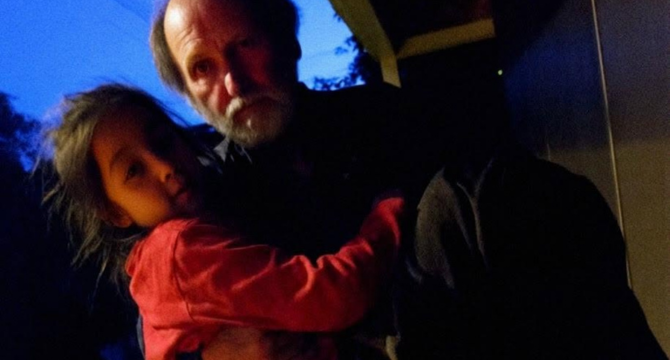
I was making chicken stir-fry when I realized Emma was late.
She was supposed to be home by 4:00 p.m.
By 4:30 p.m., I had called her twice and gotten voicemail both times, which wasn’t entirely unusual because Emma had a genuine talent for letting her phone die at the most inconvenient possible moments.
By 5 p.m., I was standing at the living room window watching the street and doing the thing mothers do when their children are late — cycling through explanations that started reasonable and became progressively less so.
I told myself so many things.
She was probably talking to friends outside school. She had probably stopped at the corner store. She had probably missed the bus and was walking, and had no way to tell me because, once again, her phone was dead.
That last one turned out to be exactly right.
The doorbell rang at 5:10 p.m. I was already moving toward the door before the sound had finished, and when I swung it open, I stopped completely.
I wasn’t expecting this.
Standing on my porch was a man in worn, weathered clothes with an unkempt beard and the particular tiredness in his face that comes not from one hard day but from a very long string of them.
Beside him, backpack still on her shoulders and expression arranged into a preemptive apology, was my daughter.
“Mom, I’m sorry,” Emma said quickly. “I missed the bus.”
The man nodded politely, a small, careful gesture.
“I found her a few miles away. Her phone was dead, and she didn’t know the way back.” His voice was quieter than I expected — measured, with the slightly formal quality of someone who had learned to choose his words carefully around strangers.
I let out a breath that had been sitting in my chest for over an hour.
“Thank you,” I said. “Genuinely, thank you.” I looked at Emma. “Go inside. We’ll talk in a minute.”
She went, casting one backward glance at the man that I noticed but didn’t comment on.
I turned back to him.
He looked like he was about to leave — there was that slight backward shift of someone preparing to step away — and something I couldn’t name made me say, “Would you like some water?”
He hesitated a moment before accepting.
We stood on the porch together while I went briefly inside and came back with a cold bottle. He was looking out at the street when I returned, and up close, in the late afternoon light, I found myself studying his face in a way I couldn’t entirely explain.
The beard obscured a lot. The years had done the rest.
But something about the shape of his jaw and the way he held himself was pulling at a thread somewhere deep in my memory that I hadn’t touched in a very long time.
He reached for the bottle I handed him.
That was when I saw something on the inside of his right forearm.
Just below the wrist.
It was a dark, crescent-shaped birthmark, roughly the size of a thumbprint, with that specific curved edge I had traced with my own finger more times than I could count when I was 18 years old.
The world around me went very quiet.
I knew that birthmark.
I had known it my entire adult life the way you know something you’ve tried to stop thinking about — not forgotten, just filed away somewhere you don’t open very often, in a drawer you have learned to walk past without stopping.
The man lowered the bottle, completely unaware that I was staring.
I couldn’t look away from the mark.
“Nathan?” I said.
He went absolutely still.
The silence on that porch lasted long enough to be its own answer.
He turned to look at me properly for the first time, and I watched his face do the slow, uncertain work of recognition — moving through the years and the changes, searching for the person underneath them. When his eyes found what they were looking for, something in them shifted in a way that was painful to witness directly.
“Melissa,” he said.
It wasn’t a question.
From inside the house, Emma appeared in the hallway behind the screen door. “Mom? Is everything okay?”
“Yes,” I said, without turning around. “Everything’s fine, sweetheart. Go set the table.”
I looked at Nathan. I looked at this man standing on my porch, whom I had spent years being furious at, and years after that trying to forget.
The same Nathan was now standing in front of me, looking like life had not been kind to him in any of the ways I might once have imagined for him.
“Come inside,” I said. “Have dinner with us.”
He started to refuse, gently, the way I expected he would. I said “please” in a tone that made clear the conversation wasn’t finished, and that I wasn’t asking out of pity but out of something more complicated than that.
He came inside.
Dinner was an exercise in managing several things at once.
Emma, who was 12 and had inherited her grandmother’s complete absence of social awkwardness, chatted with Nathan about her school, her friends, and whether he thought the city bus system was as poorly designed as she did.
He apparently agreed with her assessment, and they had a remarkably easy conversation about it. At the same time, I moved between the kitchen and the table, trying to organize thoughts that refused to be organized.
I kept looking at him.
He was polite and quiet and ate carefully, like someone relearning the ordinary rhythms of sitting at a table with other people.
He answered Emma’s questions with a gentleness I recognized from a very long time ago, and every time he reached for his water glass, I could see the crescent birthmark and feel the same lurch in my chest all over again.
Emma excused herself eventually to do homework, and the table got quiet in the particular way it does when two people have been waiting for the third person to leave.
Nathan set his fork down and looked at the tablecloth for a moment. Then he looked up at me.
“I never wanted to leave you,” he said.
I set my own fork down. “Then why did you?”
His mother had gotten sick in the autumn of the year we were both 18. She had gotten very sick very quickly. No one was prepared for the illness to progress this fast.
His family had packed and moved across the country within weeks to be near relatives who could help with her care, and Nathan had gone with them because there was no version of events in which he didn’t.
He had written to me from there.
He told me he’d sent letter after letter for months after the move, but he never received a single reply.
I stared at him. “I never got any letters.”
“I know that now,” he said. “I didn’t know it then. I thought—” He stopped, and the pause had the weight of something that had been sitting in him for a very long time. “I thought you had decided to move on. That the distance had made things easier for you.”
But why didn’t I ever get his letters?
That’s when I started thinking about my father. He was a man who had been perfectly pleasant on the surface and deeply controlling underneath it, who had made no secret of the fact that he considered Nathan unsuitable.
My father had watched me cry and had said all the right comforting things while privately, apparently, believing he knew better than I did about what my life should look like. He probably saw the letters addressed to me in Nathan’s handwriting and decided that I didn’t need any of them.
“My father probably intercepted them,” I said.
The words felt strange coming out, because saying them meant accepting something about my father I had always preferred to leave unexamined. “He didn’t like you. He never said it in those exact words, but he made it clear. And if he had access to the mail before I did—”
“He would have kept them,” Nathan said quietly.
“Yes,” I said. “He would have.”
We took a moment to accept the fact that 25 years of separate lives, built on separate silences, were actually that way because of a pile of letters that had never arrived and a father who had believed he was doing right by his daughter.
“I thought you abandoned me,” I said.
“And I thought you had forgotten me,” he said.
Neither of us spoke for a while after that.
I asked him, eventually, what had happened in the years between then and now. He told it the way people tell stories they have gone over many times alone.
His mother had taken three years to die, slowly and then quickly at the end, and those years had consumed everything the family had financially and emotionally.
After she died, Nathan found himself in a city he hadn’t grown up in, without money, without direction, and with the particular hollow feeling that follows a long, sustained grief when it finally ends and leaves you alone with yourself.
He had found work and lost it.
He had found an apartment and lost that, too. Depression, he said carefully, had been a factor he hadn’t recognized as depression until it had already taken quite a lot from him — the kind that disguises itself as laziness or bad luck until you’re far enough down that the disguise doesn’t matter anymore.
“It’s hard to explain,” he said, “how you can understand perfectly well that things need to change and still find yourself unable to make them change. Like knowing the exact direction you need to walk but just standing there anyway, for months at a time.”
Then he reached into the inside pocket of his jacket and took out a wallet so worn it was almost soft, and from it he produced a photograph folded twice across the middle.
He set it on the table and smoothed it flat with two fingers.
It was me. Eighteen years old, at a picnic somewhere, laughing at something off-camera. I remembered the day immediately. I didn’t know he had even taken that photograph.
I looked at it for a long time without saying anything.
“I thought about you,” he said simply.
“Over the years. I wondered what your life looked like.”
After Nathan left that evening, Emma appeared from the hallway where she had very obviously been stationed for the better part of the last half hour.
“Mom,” she said, with the directness she deployed when she had already made up her mind about something.
“We have to help him.”
“I know,” I said.
“I mean, actually help him. Not just say it.”
“Emma, I know.”
It took two weeks of research and phone calls to find the right combination of resources. We found a transitional housing organization on the north side with a current opening, a workforce re-entry program connected to a local trade association, and a social worker named Deborah who was efficient and genuinely good at her job.
I called Nathan at the shelter and laid it out for him.
He was quiet on the phone for a long moment. “Melissa, you don’t have to do this.”
“I’m aware of that,” I said.
“I don’t want to be a charity case.”
“You’re not a charity case. You’re someone I once knew very well who needs a hand up. Those are completely different things, and you know it.”
He came to the transitional housing orientation only because Emma called him separately and said, with the particular certainty of a 12-year-old who has made a decision, “Accepting help isn’t weakness, Nathan. My mom told me that once. She had to learn it the hard way, too.”
I hadn’t actually told her that in those words.
She had arrived at it herself, which was better.
He moved in on a Thursday.
Three weeks later, he called and said he was thinking about leaving town. Starting somewhere fresh, somewhere the weight of everything wasn’t so accumulated. He thought it would be simpler.
I met him for coffee the next afternoon and put my cup down and said, “Nathan. I spent years being angry at you for something that wasn’t your fault, and then more years just not thinking about it, which is its own kind of waste. Now I finally know what actually happened, and you want to disappear again before we’ve had the real conversation. I’m not doing that again. Neither are you.”
He looked at me across the table.
“So say it,” I said. “Whatever you’ve been carrying. Say it out loud and let me say mine, and then we’ll figure out what comes after. But you are not leaving without that conversation.”
We sat in that coffee shop for two hours. We said things we should have said at 18 and didn’t get the chance to. We talked about the letters, my father, and the years each of us had spent building explanations for the other person’s silence. About what it costs to carry something unresolved for that long, and what it feels like to finally be able to put it down.
Nathan didn’t leave town.
Several months later, on a Sunday evening in late autumn, he came for dinner again.
He had steady work by then — facilities maintenance for a property management company, the kind of work that suited his patience and his hands.
He had his own small apartment, the first space entirely his in years.
He had cut his hair, bought decent work clothes, and looked like himself when he arrived at my door. He looked like some version of the person I had known, filtered through everything that had happened since, but recognizably him.
The three of us sat at the table where it had all started, and the feeling in the room was so different from that first night that it was hard to reconcile the two versions of the same space.
After dinner, Nathan looked at Emma with such genuine warmth that I had to glance away for a moment.
“You know,” he said, “you’re the reason any of this happened.”
Emma considered that with the seriousness she brought to most things.
“I just got lost,” she said. “I do that sometimes.”
“Well,” Nathan said. “I’m glad you did.”
She grinned at him. “I’m only doing it once, though. Don’t get used to it.”
We all laughed, and the sound of it filled the kitchen in the easy, unforced way of people who have found their way to something real.
Later, after Emma had gone to bed and Nathan had headed home, I stood at the window for a while, thinking about how close I had come to simply thanking him at the door that evening and sending him on his way.
I thought about how I had almost not offered the water, and how, if he had taken the bottle at a slightly different angle, in slightly different light, I might never have seen the birthmark at all.
I might have never met this version of Nathan.
Twenty-five years. A pile of intercepted letters. And a 12-year-old who missed her bus.
It’s a strange thing, the path a life takes. How much of it turns on moments so small you almost miss them entirely. Like a gesture, a mark on a wrist, and a door opened at exactly the right time.
I’m glad I opened it. I’m glad I looked down at his arm. I’m glad Emma, just this once, forgot to charge her phone.
Some second chances don’t announce themselves. They ring the doorbell quietly and wait to see if you’ll answer.