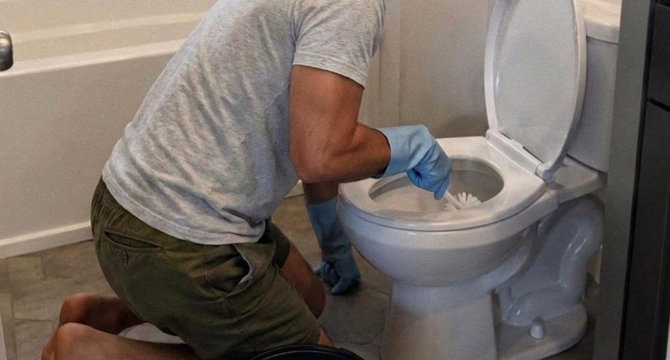
Saturday mornings in our house smelled like bleach and fresh coffee. For five years, that combination had been the soundtrack of a marriage I genuinely believed was untouchable. I would sit at the kitchen island in my robe, listening to the scrub of a brush behind the locked bathroom door, and feel like the luckiest woman alive.
Daniel had a rule. I never broke it.
My sister Megan called me every Sunday for the update.
“My princess doesn’t scrub tubs,” he told me on our honeymoon, holding my face in both hands. “That bathroom is mine. You stay out, okay?”
“Okay,” I had laughed. “Twist my arm.”
Five years later, I was still laughing about it. My sister Megan called me every Sunday for the update, and I always gave her the same one.
“He locked himself in there for almost three hours today,” I told her, swirling my mug. “Came out red-eyed from the fumes. Kissed my forehead. Made me French toast.”
The women would gasp on cue, refill my wine, ask if Daniel had a brother.
“Claire, he’s a unicorn,” Megan groaned. “You realize that, right? Unicorns aren’t supposed to exist.”
“I know.”
“My ex wouldn’t unload a dishwasher. Yours scrubs grout on his hands and knees.”
I twirled my wedding band around my finger and smiled at the ceiling. “I won the lottery.”
I told the same story at book club. The women would gasp on cue, refill my wine, ask if Daniel had a brother. He didn’t. He didn’t have much of anyone, actually. No parents living. No siblings he spoke about. A childhood he summarized in one sentence and never expanded.
Sometimes I would catch him standing at the kitchen window with his sleeves still rolled up, staring at nothing.
There was one drawer in his nightstand that stayed locked. I had asked about it once, early on.
“Old paperwork,” he said, kissing the bridge of my nose. “Boring grown-up stuff.”
I let it go. I always let it go.
Sometimes, after his Saturday cleaning, I would catch him standing at the kitchen window with his sleeves still rolled up, staring at nothing. His eyes would be pink at the edges, and he would blink hard when I touched his back.
“Bleach is brutal today,” he would say.
One Saturday, I came down the hall and noticed the bathroom door wasn’t fully shut.
“You should wear a mask, baby.”
“I will.”
He never did.
One Saturday, I came down the hall and noticed the bathroom door wasn’t fully shut. Through the gap, I saw him sitting on the closed toilet lid, a small photograph cradled between his palms like something that might break if he breathed wrong. His shoulders were shaking.
I stepped forward.
I went back to my coffee, told myself it was nothing, and never mentioned it.
The door clicked shut before I could see the face in the picture.
“Almost done, princess,” he called, his voice bright and ordinary again.
I went back to my coffee, told myself it was nothing, and never mentioned it.
Three days later, Daniel kissed me goodbye at the door, suitcase in hand, headed to the airport for a work trip to Denver.
“Don’t burn the house down, princess,” he said, smiling that careful smile I had loved for five years.
“Travel safe. Text me when you land.”
He paused at the threshold, looked back at the bathroom door, then at me, and something flickered across his face I couldn’t name.
I pressed my hand to the drywall behind the laundry hamper and felt it bulge.
Then he was gone.
I made it to noon before I heard it. A low, wet rushing sound inside the wall, like the house had started breathing.
I pressed my hand to the drywall behind the laundry hamper and felt it bulge.
“No. No, no, no.”
I called the first plumber Google offered. Hollis arrived within the hour, a gray-bearded man with kind eyes and a clipboard.
“Pipe’s burst behind the tub wall, ma’am,” he said after twenty minutes of poking around. “Bad news. The tub’s original cast iron. Sealed in with mortar older than I am.”
The grinding of metal on stone went on for almost an hour.
“Meaning?”
“Meaning I have to lift it out to get to the pipe. Whole thing comes up.”
I thought about Daniel. About the locked Saturdays. About how he would have told me to wait, to call him first, to leave it alone.
I thought about the water spreading under my feet.
“Do whatever you have to do.”
The plumber nodded and got to work. I went to the kitchen and started a pot of coffee my hands were too unsteady to drink.
The grinding of metal on stone went on for almost an hour.
In that cavity sat something wrapped in a child’s pink towel, the cotton gone gray and stiff with damp years.
Then it stopped.
The silence felt wrong. I set the coffee down.
“Ma’am?” His voice came from the bathroom, lower than before. “You need to come see this.”
I walked down the hallway barefoot, the runner squelching under my heels.
The plumber stood with his back against the sink, one hand on his chest. The tub leaned crooked against the wall behind him, exposing a shallow cavity in the subfloor.
In that cavity sat something wrapped in a child’s pink towel, the cotton gone gray and stiff with damp years.
He stepped past me into the hallway, pulling the door half-closed behind him.
“I didn’t touch it,” he said. “And ma’am, I think you know we’re going to have to call somebody about this.”
My knees went out. I sat down hard on the soaked tile.
“What is that?” I whispered.
“I don’t know. And it’s not my place to know.” He swallowed. “I’ll be downstairs. I’ll give you a minute before we decide what to do — but only a minute. Then I’m picking up the phone.”
He stepped past me into the hallway, pulling the door half-closed behind him.
Inside the towel was a small ceramic urn, pale blue, smooth as a river stone.
My hands would not stop trembling.
I peeled back one corner of the towel. Then another.
Drugs. That was my first thought. Or stolen cash. Some terrible thing my perfect husband had buried under our floor while kissing my forehead every morning.
Inside the towel was a small ceramic urn, pale blue, smooth as a river stone.
A tiny silver plate had been screwed into its base. I tilted it toward the light and read the engraving.
I called a third time, a fourth. By the eighth call, I was crying into the receiver.
“Lily. Age 4.”
I read it three times before the letters made sense.
I reached for my phone with fingers I couldn’t feel and dialed Daniel.
It rang and rang.
“Daniel, pick up. Please. There’s something under the tub. The plumber found it. I need you to call me right now.”
I hung up. I called again.
The urn sat in my lap, small and impossible.
Ringing.
I called a third time, a fourth. By the eighth call, I was crying into the receiver.
“Daniel, what is this? What did you put under our bathroom? Pick up the phone.”
Nine. Ten. Eleven.
The urn sat in my lap, small and impossible. Whatever it was, my husband had locked himself in this room with it every Saturday for five years and told me he was scrubbing grout.
I lowered the phone and stared at the little silver plate.
Twelve. Thirteen.
“Please. Please, just answer me.”
Fourteen rings. Voicemail.
I lowered the phone and stared at the little silver plate.
Then a key slid into the front door lock.
“Claire?”
He froze in the bathroom doorway. His suitcase thudded onto the hallway carpet behind him.
His voice climbed the stairs before he did. Quick, frightened footsteps. He had still been waiting at the airport when my messages came through, the plane to Denver not yet boarding.
I stood with the urn cradled against my chest. I do not remember deciding to scream.
“What is this, Daniel? What is this?”
He froze in the bathroom doorway. His suitcase thudded onto the hallway carpet behind him.
“Claire, please put that down.”
“Don’t you tell me to put anything down.” My phone was in my other hand, my thumb already moving. “I’m calling 911.”
He raised both hands, palms out, the way you approach a wounded animal.
“Claire.”
“Whose is this? Whose ashes have you been keeping in our bathroom for five years?” My voice cracked open in the middle. “Did you hurt someone? Tell me you didn’t hurt someone.”
“Claire, stop.”
“Don’t come near me.”
He raised both hands, palms out, the way you approach a wounded animal. His face had gone the same white as the plumber’s had been an hour earlier.
The bathroom went silent. Even the dripping behind the broken wall seemed to stop.
“Please,” he whispered. “Please just let me explain.”
“Explain what?”
I lifted the phone. My thumb hovered over the green button.
“That’s my daughter,” he said.
The bathroom went silent. Even the dripping behind the broken wall seemed to stop.
“What?”
The phone slipped from my fingers. It hit the wet tile with a flat slap and slid into the puddle by my foot.
“That’s my daughter.” His voice was barely there. “Her name was Lily. She died before I ever met you.”
The phone slipped from my fingers. It hit the wet tile with a flat slap and slid into the puddle by my foot.
“No,” I said.
“Claire.”
“No. You don’t have a daughter. You don’t have any children. You told me you weren’t ready, that you’d never done this before, that we should wait — you said those exact words to me on the back porch the night I asked.”
He didn’t move from the doorway. He just stood there, watching me hold the daughter I never knew he had.
“I lied.”
Two syllables. Five years.
I sank back down onto the floor with the urn still pressed against my chest. The water soaked through my jeans, freezing.
He didn’t move from the doorway. He just stood there, watching me hold the daughter I never knew he had.
“Five years,” I said. My voice did not sound like mine. “Five years of Saturdays. Five years of you locking that door.”
“Yes.”
I looked down at the little silver plate. Lily. Age 4. Some other woman’s child, once.
“The red eyes.”
“Yes.”
“The princess thing. Shooing me out. You weren’t being sweet. You were keeping me away from her.”
He closed his eyes. A single tear slid down his cheek and caught in the stubble he had grown overnight.
“I was keeping you away from her,” he agreed.
I looked down at the little silver plate. Lily. Age 4. Some other woman’s child, once. His child.
I held the small blue urn against my chest and couldn’t speak.
“Daniel.” I could barely get the name out. “Who was she?”
He slid down the doorframe and sat on the wet floor across from me, knees drawn up like a boy. And for the first time in five years of marriage, my husband began to tell me who he actually was.
“Her name was Lily,” he whispered. “She was four. A fever no one caught in time.”
I held the small blue urn against my chest and couldn’t speak.
“I couldn’t leave her behind when I moved,” he said. “I couldn’t put her on a shelf. I couldn’t scatter her. I didn’t know how. I sealed her under the new tub the week before I met you.”
I stared at him, five years of bragging collapsing in my throat.
“You sealed her under the floor,” I said.
“Every Saturday I locked the door and talked to her. I told her about you, Claire. I told her you made me laugh again.”
I stared at him, five years of bragging collapsing in my throat.
“Why didn’t you tell me?”
“Because I already failed once,” he said. “I was so afraid you’d look at me and see a man who couldn’t keep his own daughter alive.”
“Daniel.” I put my hand on his wet sleeve. “I am furious with you.”
He broke then, the way I had never seen a man break, forehead pressed to the rim of the tub, shoulders shaking.
“I know.”
“Five years. Five years of letting me think I was your whole story.”
“I’m sorry.”
“And I would have loved her,” I said, and my eyes finally spilled over. “If you had let me. I would have loved her too.”
He broke then, the way I had never seen a man break, forehead pressed to the rim of the tub, shoulders shaking.
I held his hand and watched the petals stir.
I didn’t pull him toward me. I let him grieve where he had always grieved, and I stayed.
Two weeks later, we knelt in the garden and lowered Lily into the earth beneath a young magnolia. Daniel said her name out loud, in sunlight, for the first time.
I held his hand and watched the petals stir.
The bathroom was just a bathroom now. And my husband, finally, was just a man I knew.