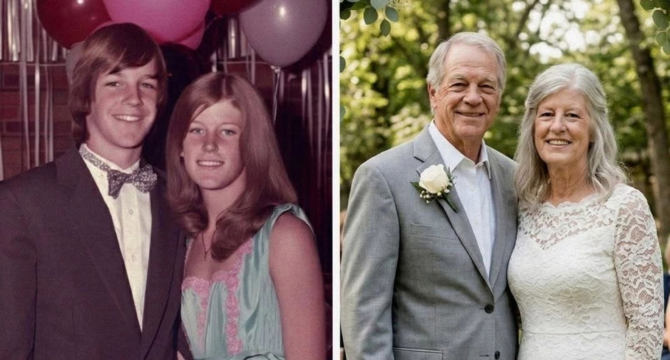
I married my childhood sweetheart Walter at seventy-one after both our spouses had died. I never expected to feel like a bride again, but after years of loneliness he reached out and we started talking. His wife had passed six years earlier, and mine had been gone for over a decade. We reconnected slowly—first messages, then coffee, then dinners where memories made us laugh in ways we hadn’t in years. It felt safe and familiar, like returning to something I once lost. Eventually Walter proposed, his hands shaking, and I said yes.
Our wedding was small but beautiful. Flowers lined the aisle, soft music played, and friends raised glasses to the idea that love could return even in later life. I wore a simple dress and smiled more than I had in years. At the reception I moved between guests, thanking them for coming, still getting used to the idea that this was real. Walter was across the room talking and laughing, and for the first time in a long time I felt content.
Then a young woman approached me. I didn’t recognize her—she looked to be in her thirties, her expression tight, eyes fixed on mine as if she had been searching for me. She stopped close enough that I could hear her voice but no one else could. “He’s not who you think he is,” she said.
The words struck me like cold water. I stared at her, waiting for an explanation, but she didn’t offer one. Her gaze was serious, almost pleading. For a moment I thought it might be a cruel joke or a misunderstanding. Walter was kind, gentle, and the man I had known since childhood. We had shared decades of memories, even if life had pulled us apart for years. I wanted to dismiss the woman’s warning, yet something in her eyes made me hesitate.
I turned slightly, searching for Walter in the crowd. He was still smiling, oblivious, raising a glass as guests congratulated him. The young woman followed my gaze, then looked back at me. “You deserve to know the truth,” she added quietly.
My heart pounded. I didn’t understand. What truth? About what? About him?
The reception continued around us—music, laughter, the clink of glasses—but everything felt distant. I tried to speak, to ask what she meant, but the words caught in my throat. Instead I looked at her again, searching for some clue, some reason she would say such a thing on my wedding day.
She didn’t elaborate. She simply waited, as if what happened next was up to me.
For the first time since I had said “I do,” uncertainty crept in. I thought about the life we had built, the years we had both lost, and the hope that had brought us together again. I didn’t want to believe there was something dark beneath it. I wanted this second chance to be real.
But the young woman’s words lingered.
“He’s not who you think he is.”