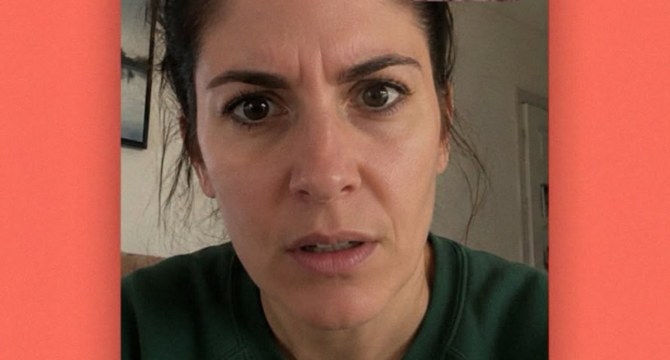
People who haven’t worked night shifts don’t fully understand what they do to a marriage. It’s not dramatic, like there’s no single breaking point or an obvious strain to point to.
It’s more like water damage. Slow, invisible, and by the time you notice it, the structure has already been compromised in ways that take real effort to repair.
Steven and I had been managing it for four years.
He worked in corporate project management, early mornings and long days, and was home by six most evenings.
Meanwhile, I worked nights at the hospital, leaving the house at 9 p.m. and returning somewhere between seven and eight the following morning, at which point he was already gone.
On paper, we lived in the same house.
In practice, we passed through it in shifts, leaving notes on the kitchen counter and half-finished coffee in the pot for the other person to find.
The FaceTime calls were his idea, early in my second year of nights.
He started calling during his drive home from work — not every day, because some evenings I was sleeping and some evenings he was caught late, but every other day reliably, a 15-minute window somewhere between 5:30 p.m. and 6 p.m. when we could actually see each other’s faces and talk about something beyond logistics.
It sounds small. It wasn’t small.
Those calls were the thread that kept us connected across a schedule that otherwise pulled us in opposite directions.
I knew his drive home the way I knew his face. Which exit he took, which stretch of road had a bad signal, and when he’d hit the turn that meant he was eight minutes from the house.
I knew that he wore his reflective aviator sunglasses on clear afternoons because the western sun on that drive was relentless, and I knew that he usually propped the phone against the dashboard mount he’d installed specifically for our calls.
I knew his commute better than I knew some rooms in our own house.
Which is why I noticed immediately when something was different.
It was a Tuesday in late September, a clear afternoon, and I was sitting at the kitchen table, feeling entirely exhausted after I’d worked through the night. I was fighting the urge to sleep before making this call.
My shift had been difficult because we had to focus on one patient situation for hours, which required more of me than I had left to give.
It was a very tiring night, and I was looking forward to seeing Steven’s face.
Even 15 minutes of him felt, on days like that, like something I could hold onto.
He answered on the second ring.
He was already in the car, sunglasses on, and smiled when my face appeared on his screen in the way that still, after nine years of marriage, made something in me settle.
“Hey,” he said. “Rough night?”
“Is it that obvious?” I asked.
“You have the look,” he said. “The one where you’re holding it together, but only just.”
He could tell how I was feeling just by looking at my face. That was the thing about a long marriage — you become fluent in each other in ways that have nothing to do with words.
We talked for a few minutes about nothing in particular.
He mentioned something about a meeting, and I mentioned a colleague.
It was comfortable, and I was beginning to feel the tension of the night shift release slightly as the road curved west and the afternoon sun came through his windshield at a different angle and hit the lenses of his glasses directly.
In the reflection, clear and unmistakable for just a few seconds before the angle shifted again, I saw the passenger seat.
But the shocking part was that it wasn’t empty.
A child was sitting in it.
A little girl, perhaps six or seven years old, with dark hair and her face turned slightly away from me.
She was looking out the side window.
She appeared completely relaxed in the way of someone entirely comfortable in that car, in that space, with that person.
The words I had been about to say caught in my throat and stayed there.
I watched Steven’s face.
He was looking at the road and talking about something that I had stopped processing.
He was completely unaware that the angle of the light had just shown me something he had clearly not intended me to see.
His expression was normal. He looked relaxed.
He glanced toward the passenger seat once, briefly, and something passed across his face that I catalogued immediately: warmth. Familiar, easy warmth, directed at whoever was sitting there.
“Mandy?” he said. “You still with me?”
“Sorry,” I said. “I’m more tired than I thought. Can we talk tonight?”
“Of course,” he said. “Get some sleep.”
I ended the call and sat at the kitchen table for a long time without moving.
I did not call a lawyer immediately, despite what I told people later.
What I did first was sit very still and try to construct an innocent explanation for what I had seen, because nine years of marriage had earned Steven at least that much from me.
I told myself maybe it was a neighbor’s child he was giving a lift to, or a colleague’s daughter in some emergency. Or even a child from the church group he occasionally helped organize events for.
But the warmth in his expression when he glanced at her told me something else.
That was not a man being accommodating to someone else’s child in an unusual circumstance. That was a man who knew this child and was comfortable with her in a way that had developed over time.
I called my lawyer friend Carol that evening.
I just needed to talk to someone I trusted, and someone who would help me think clearly rather than simply validate the worst interpretation.
Carol listened without interrupting and then told me to document anything I found before doing anything else.
She was practical, calm, and exactly what I needed.
I am grateful I called her rather than someone who would have encouraged me to act immediately on what I was feeling.
What I was feeling was the particular cold sickness of believing your life is not what you thought it was.
Over the following ten days, I became someone I did not particularly like.
I went through credit card statements for the first time in years — we had always managed our own accounts with a shared one for household expenses, and I had never felt the need to look carefully before.
There were expenses I didn’t recognize. Not large ones, not the kind that suggest a second apartment or lavish gifts, but regular small ones.
He had spent money at a children’s clothing store and a toy shop.
There were missed calls on evenings when he had told me he was working late.
There were two occasions when I came home from a night shift earlier than expected, and his car was not in the driveway, though he had not mentioned going anywhere.
Each piece of evidence was individually explainable and collectively damning, and I carried all of it quietly for over a week while behaving normally around him, which is one of the hardest things I have ever done.
I also understood that what I was doing was deeply unfair to a man who might deserve the chance to explain himself.
I followed him on a Saturday morning.
He left at 9:30 a.m., telling me he had some errands to run.
I gave him ten minutes before I started following him. He drove to a park on the east side of town that I knew existed but had never had reason to visit.
I parked where I could see the entrance and watched him walk through the gate carrying a bag — the craft supplies bag, I recognized it — and cross the grass toward a bench where a woman sat with a child beside her.
The child was the girl from the reflection. I was sure.
She had the same dark hair and was turning to look at Steven with immediate recognition.
The woman beside her was, I realized after a moment, a social worker.
She had a lanyard and a clipboard and the particular composed professionalism of someone conducting a scheduled visit rather than a social encounter.
I sat in my car for 45 minutes, watching my husband sit on a bench with a little girl, helping her with what appeared to be a drawing project, while a social worker took notes.
The child showed him the drawing when she was done, and he looked at it with the same expression I had seen in the sunglasses’ reflection. Complete and genuine warmth.
I drove home, and I was in the kitchen when he came back.
“Tell me the truth,” I said, before he had taken his jacket off. “All of it.”
He turned to look at me, and one glance at my face told him something was wrong. He knew I had finally discovered the secret he’d been hiding.
He sat down.
“How much do you know?” he asked, looking straight into my eyes.
“I know that I saw a child in your car and saw you visit a park with a social worker. I saw receipts for things that don’t belong to our lives.” I sat across from him. “Steven, who is she?”
He didn’t answer right away.
As he sat there quietly, I saw something I hadn’t expected. He wasn’t looking guilty or concerned about his secret being exposed.
Instead, he looked relieved. It looked like someone had taken a burden off his shoulders that he had been carrying alone for a long time.
“Her name is Lily,” he began. “She’s six years old.”
I kept looking at him.
“Mandy, she’s your sister’s daughter,” he said while looking at his hands.
I wasn’t sure if I’d heard him right.
“My what?” I blurted out.
“Your sister’s daughter,” he repeated.
My sister, Dana, had been out of my life for seven years. She had lost touch with us after her addiction and circumstances had made it impossible for her to keep in touch with her family.
We had tried, my parents and I, in the repeated and heartbreaking way of people who love someone they cannot reach.
At some point, the contact had simply stopped, and the silence had eventually become easier to maintain than the alternative.
“Dana is gone,” Steven said.
I looked at him.
“She passed away eight months ago,” he continued. “I found out through an old mutual contact of hers who tracked me down because he didn’t know how to reach you.” He paused. “She had a daughter, Mandy. Lily has been in foster care since Dana died. She has no family willing to take her.”
I pressed both hands flat on the table.
“I didn’t tell you immediately because—” He stopped, reconsidering his words. “Because the last time Dana came up, it took you three weeks to come back from it. And I didn’t want to tell you your sister was gone and that she had left a child and that the child was in foster care, all in the same conversation before I had any answers or any plan.”
He looked at me directly. “I wanted to know who Lily was first. Whether she was okay. What she needed. I wanted to be able to tell you everything at once instead of handing you grief without any hope attached to it.”
I opened my mouth, but nothing came out. I didn’t know what to say.
“I’ve been attending supervised visitation sessions,” he said. “Building a relationship with her slowly, so she’d have someone familiar if we decided to… you know… if you wanted to,” he reached across the table and covered my hand with his. “I was going to tell you this weekend. I had it all planned. The documentation, the social worker’s contact, everything.”
He went to the bedroom and came back with a folder I had not known existed.
He set it on the table between us.
Inside were photographs of Lily, the DNA confirmation connecting her to my family, correspondence with the foster care agency, and the social worker’s notes.
At the back was a photograph I recognized.
It showed Dana at perhaps 20, before everything fell apart, laughing at something off-camera with the full, uncomplicated laugh I had spent seven years trying not to think about too directly.
I picked up the photograph and held it.
“She looks like her,” I said finally. “Lily. She has Dana’s coloring.”
“She has your eyes,” Steven said quietly. “Both of you.”
I met Lily the following Saturday, at the same park, sitting on the same bench.
She was cautious with me, assessing me with a seriousness that sat behind her eyes even when she smiled. She showed me a drawing — she had been keeping a sketchbook that Steven had bought her, pages filled with houses and animals and figures that told small stories.
“Steven said you work at a hospital,” she said.
“I do,” I said. “I’m a nurse.”
She considered this. “Do you help people get better?”
“I try to,” I said.
She nodded slowly, as if this answered something more than the literal question. Then she went back to her drawing, and Steven sat beside me on the bench.
I looked at this child who was the last remaining piece of my sister and felt something that was grief and gratitude so thoroughly mixed that I couldn’t separate them.
We brought Lily home four months later.
The guest room became hers, slowly and then all at once. First, there were a few things, then a drawer, and then the full arrival of a child with a suitcase.
Lily came into our house with careful, watchful eyes of someone waiting to find out whether this one was going to last.
I wanted to tell her that this one was definitely going to last.
Steven knew that before I did, which is why he spent six months building something quietly rather than handing me rubble.
I have not entirely forgiven myself for the ten days I spent gathering evidence against a man who was, the entire time, trying to bring my family back to me.
But I am working on it.
And Lily is helping, in the way that children help with things — without knowing they’re doing it, by simply being present and requiring the kind of attention that leaves very little room for anything else.