It was supposed to be a quiet Saturday.
My husband had taken our two kids on a fishing trip the day before, so for the first time in months, I had the house entirely to myself.
I spent the morning drinking coffee, watching old movies, and enjoying the rare silence.
The sink was empty, the laundry was done, and no one was asking me where their socks had disappeared to.
It felt wonderful.
Around noon, I settled onto the couch with another cup of coffee and switched channels, trying to find an old comedy I hadn’t seen in years.
Just as I started relaxing, I heard voices outside.
At first, I barely noticed them.
Our neighborhood was usually peaceful, but people often stopped to chat while walking their dogs or tending their gardens.
I ignored it.
Then, the voices grew louder.
They were not excited or angry.
They were just numerous.
Curious, I stood up and peeked through the front window.
The mug nearly slipped from my hands.
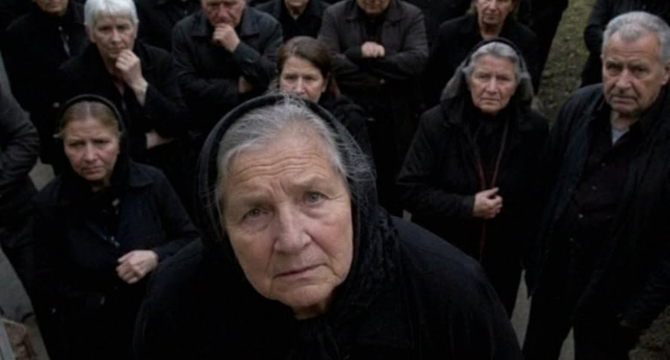
My driveway and front yard were filled with elderly people, all dressed entirely in black.
There had to be at least 30 of them.
Some held flowers.
Others stood quietly with their heads lowered.
The entire scene looked less like a neighborhood gathering and more like a funeral procession.
My heart began pounding as I rushed to the front door.
The moment I stepped outside, every conversation stopped.
Dozens of unfamiliar faces turned toward me at the same time.
The silence that followed was almost worse than the voices had been.
Then an elderly woman, probably around 70 years old, slowly stepped forward.
She was dressed in black from head to toe, wore a black scarf over her gray hair, and leaned heavily on a wooden cane.
She looked at me for several seconds before speaking in a calm voice.
“Elizabeth… your name is Elizabeth, isn’t it?”
“Yes?” I answered, my voice shaking. “What’s going on? What does all of this mean?”
The woman took one more slow step toward me.
Then, she opened her mouth to answer.
“My name is Martha,” she said gently. “We’re here because someone in this house has been part of our story for 35 years.”
For a moment, I simply stared at her.
“What?”
She nodded toward my home.
“We’ve come a long way. We didn’t want to frighten you.”
“I think you’re a little late for that,” I said.
Several of the older men shifted awkwardly, while a few women exchanged uncomfortable glances.
Martha sighed.
“I understand.”
“No,” I replied, taking a cautious step backward. “I don’t understand anything. Who are all of you? What are you talking about?”
She rested both hands on the top of her cane.
“We’re from Ashton.”
I frowned.
“I’ve never heard of Ashton.”
“It’s a small town about three hours from here.”
“Okay,” I said slowly. “And why are 30 strangers standing in my yard?”
“Because we have spent years looking for answers.”
Her words only confused me more.
“I think you’ve made a mistake.”
“I hope we have,” Martha admitted.
Behind her stood people of different ages, though most were well into their 60s or older.
Every single one wore black clothing.
One elderly man clutched a bouquet of white lilies.
None of them looked angry.
If anything, they looked nervous.
I glanced toward my neighbors’ homes.
Ruth, from across the street, stood on her porch, pretending to water flowers while openly staring.
A teenage boy had stopped riding his bike and was recording everything with his phone.
Within minutes, more curtains began moving.
The whole neighborhood was watching.
I folded my arms.
“If this is some kind of prank, it’s not funny.”
“It isn’t,” Martha answered.
“Then tell me exactly what you want.”
Before she could respond, another elderly woman stepped forward.
She looked slightly younger than Martha and had kind blue eyes.
“My name is Agnes,” she said softly. “We’re not here to hurt anyone.”
“Then why are you dressed like you’re attending a funeral?”
The question seemed to ripple through the group.
Several lowered their eyes.
Martha answered.
“Because we’ve been mourning.”
“Mourning who?”
She hesitated.
“For many years, we believed we were mourning someone who had died.”
A chill crawled up my spine.
“And now?”
“Now we’re not so sure.”
The silence stretched between us.
I looked from one face to another.
They all seemed exhausted.
Not physically, but emotionally.
It was as if they were people who had carried the same burden for decades.
“I think you should leave,” I finally said. “If you’re looking for someone, you have the wrong house.”
Martha slowly reached into the pocket of her coat.
My pulse quickened.
She pulled out a folded piece of paper.
“I’d like you to look at something.”
“I don’t think that’s a good idea.”
“You don’t have to take it.”
She unfolded the paper herself.
It wasn’t a letter.
It was an old newspaper clipping, yellowed with age.
She held it carefully so I could see.
A grainy black-and-white photograph showed several people standing in front of what looked like a church.
I didn’t recognize anyone.
“What am I looking at?” I asked.
“The woman in the middle.”
I studied the picture.
She appeared to be in her early 30s.
Dark hair.
Gentle smile.
Simple dress.
“I don’t know her.”
Martha nodded.
“We expected that.”
“Then why show me?”
“Because she knew someone named Elizabeth.”
I frowned.
“So?”
“That woman disappeared nearly 35 years ago.”
I blinked.
“I’m sorry that happened, but I don’t understand what that has to do with me.”
Martha carefully folded the clipping again.
“We’re trying to find the truth.”
“I’m afraid I can’t help you.”
She looked disappointed, but not surprised.
“May I ask you a question?”
“I guess.”
“Were you adopted?”
The words caught me completely off guard.
“Yes,” I answered automatically.
Then, I immediately regretted saying it.
It wasn’t a secret.
My husband, Ben, knew.
My children knew.
A handful of close friends knew.
But I rarely discussed it with strangers.
Martha exchanged a glance with Agnes.
Neither woman smiled.
Neither looked triumphant.
If anything, they seemed even sadder.
“Who told you that?” I demanded.
“We didn’t know,” Martha admitted. “It was only a possibility.”
My heartbeat quickened.
“I don’t know anything about my birth family.”
“I believe that.”
“My parents adopted me when I was a baby.”
“They loved you?”
“Very much.”
She nodded.
“I’m glad.”
Her answer surprised me.
She wasn’t trying to challenge my parents or diminish the life I’d had.
She genuinely sounded relieved.
“My parents passed away years ago,” I said quietly.
“I’m sorry.”
“So am I.”
For several seconds, neither of us spoke.
Finally, I cleared my throat.
“If this is about my biological parents, I can’t help you.”
“We’re not asking you to.”
“Then what do you want?”
Martha looked at every person standing behind her before answering.
“We only want permission to tell you why we came.”
I glanced toward the street again.
Now, there were even more neighbors watching.
Ruth had crossed over to the sidewalk.
Two delivery drivers had slowed down to stare.
I could practically hear the gossip spreading.
I rubbed my forehead.
“This isn’t exactly the place for a conversation.”
“We know,” Agnes said.
“We looked for another way.”
“There isn’t one.”
I looked back at the house.
Ben and the kids wouldn’t be home until Sunday evening.
For the first time since they’d left, I wished they were here.
At least Ben would know what to say.
Instead, I was standing alone in front of 30 strangers who somehow knew I’d been adopted.
I should have closed the door.
I should have called the police.
Instead, I heard myself ask the one question I couldn’t seem to stop thinking about.
“If I let you explain,” I said carefully, “will you finally tell me why everyone is dressed for a funeral?”
Martha’s eyes filled with tears.
She gripped her cane a little tighter before answering.
“Because for 35 years, we believed we were grieving one woman.”
She paused, swallowing hard.
“But after what we recently discovered, we’re terrified we’ve been grieving the wrong one.”
I took a slow breath before answering.
“Come inside,” I said quietly.
Several people looked surprised.
“You don’t all have to come in,” I added quickly. “There isn’t enough room.”
Martha nodded.
“Only a few of us.”
She turned toward the group.
“The rest of you, please wait here.”
Nobody complained.
Most simply remained standing in silence, still holding their flowers.
I led Martha, Agnes, and an elderly man carrying the bouquet of white lilies into my living room.
They settled carefully onto the couch while I sat across from them.
For several seconds, none of us spoke.
Finally, Martha rested her cane beside her chair.
“Thank you for hearing us out.”
“I’m still not sure I should be.”
“I understand.”
She carefully unfolded the old newspaper clipping again and laid it on my coffee table.
“The woman in this photograph was named Grace.”
I looked down at the faded picture.
“Who was she?”
Martha smiled sadly.
“She was one of us.”
Agnes folded her hands in her lap.
“We all lived in Ashton. 35 years ago, it was a much smaller town than it is now. Everyone knew everyone else’s business.”
I could already tell where this was going.
“Grace became pregnant,” Agnes continued. “She wasn’t married.”
Martha lowered her eyes.
“People judged her.”
Neither woman tried to soften those words.
They didn’t make excuses.
“Some whispered behind her back,” Martha admitted. “Some stopped inviting her to church gatherings. Others crossed the street rather than speak to her.”
The elderly man beside her cleared his throat.
“I was one of them.”
His confession surprised me.
“My name is Walter,” he said. “I never said anything cruel to her face, but I didn’t defend her, either.”
His voice cracked.
“I’ve regretted that for a very long time.”
I looked from one face to another.
“So what happened to Grace?”
Martha drew a slow breath.
“One morning, she disappeared.”
“Just disappeared?”
She nodded.
“Not long afterward, a burned-out car was found outside town.”
My stomach tightened.
“It belonged to another woman who had gone missing around the same time,” Martha explained. “Back then, identifying remains wasn’t as advanced as it is now. People assumed the body was Grace’s.”
“And no one questioned it?”
“The sheriff did what he could,” Walter answered quietly. “But evidence was limited. Eventually, everyone accepted that Grace had died.”
Agnes wiped at the corner of her eye.
“The church held a funeral.”
I thought about the dozens of people standing in my yard.
The black clothing.
The flowers.
The bowed heads.
“We all wore black,” Martha whispered.
I glanced toward the window.
“So that’s why…”
“Yes.”
Walter looked at his hands.
“We buried an empty coffin.”
The room fell silent.
“Grace had no close family left in Ashton,” Agnes continued. “The church organized everything. We told ourselves we had honored her.”
“But we hadn’t,” Martha said.
I frowned.
“What changed?”
Without answering immediately, Martha reached into her handbag.
This time, she removed several carefully protected envelopes.
Their paper had yellowed with age.
“We found these four months ago.”
She handed me the top letter.
The envelope was addressed simply:
Pastor Samuel.
“The church was renovating an old storage room,” Martha explained. “A box had been pushed behind a cabinet decades ago. Nobody knew it was there.”
Inside the box were several letters.
One had never been mailed.
It was from Grace.
With trembling fingers, I unfolded the fragile pages.
The handwriting was neat and careful.
The first lines caught my attention immediately.
“If you’re reading this, it means I left before I found the courage to say goodbye.”
I swallowed.
Martha continued speaking while I silently scanned the page.
“Grace wrote that she couldn’t stay in Ashton anymore.”
I kept reading.
“People think my daughter deserves the same shame they believe belongs to me.”
My heart skipped.
Daughter.
Martha watched my expression carefully.
“She named her baby in that letter.”
My eyes searched farther down the page.
Then, I found it.
“Her name is Elizabeth.”
My breath caught.
The room blurred for a moment.
“No…”
“It’s true,” Agnes whispered.
I continued reading.
“I would rather spend the rest of my life wondering who she became than watch her grow up believing she was unwanted.”
Tears filled my eyes.
“I’m arranging for a private adoption. If someone kind raises her, she’ll have a better life than I can give her here.”
I pressed my hand over my mouth.
My entire life, I had wondered why my birth mother had given me away.
I had imagined fear.
Or regret.
Maybe even rejection.
But these words…
These words sounded like love.
“I wasn’t abandoned,” I whispered.
“No,” Martha replied softly.
“You were protected.”
The tears I’d been holding back finally spilled down my cheeks.
“My adoptive parents loved me,” I managed to say.
“We hoped they did.”
“They were wonderful.”
Martha smiled through her own tears.
“Then Grace’s greatest wish came true.”
I looked down at the letter again.
Near the bottom was another sentence.
“Please don’t let anyone tell my daughter that I didn’t love her.”
I couldn’t stop crying.
For years, I had told myself it didn’t matter.
That my parents were the only parents who counted.
They were.
They always would be.
But somewhere inside me had always lived a little girl who wondered why she wasn’t enough.
Now I knew.
It had never been about not being enough.
It had been about giving me more than Grace believed she could.
“How did you find me?” I finally asked.
“The letters mentioned the adoption agency,” Martha explained.
“Not by name, but by city. A volunteer at our church spent months researching old records. Eventually, we located the agency.”
“The agency never gave us your information,” Martha added. “They agreed only to forward our letter. Whether you answered was entirely your decision.”
“It took a long time,” Walter added. “There were legal barriers. Privacy rules. We respected them.”
Agnes nodded.
“When the agency finally agreed to forward a letter explaining why we were searching, we learned your first name had never been changed.”
I remembered a letter arriving several weeks earlier.
I hadn’t opened it.
It looked like junk mail from an unfamiliar organization.
“It was from you?”
Martha smiled gently.
“Yes.”
“I threw it into a drawer.”
“We weren’t offended.”
“I never imagined it would be something,” I admitted.
Silence settled over the room once again.
Finally, I asked the question that had been lingering in my mind from the beginning.
“Why did everyone wear black today?”
Martha looked toward the front door, where dozens of elderly people still waited outside.
“For 35 years,” she said quietly, “we believed we were coming to mourn Grace.”
She paused, gripping her cane.
“But today wasn’t really about her funeral.”
I waited.
She looked directly into my eyes.
“We came to bury our shame.”
Then, she slowly removed the black scarf from her head.
No one spoke.
Walter finally broke the silence.
“We judged a frightened young mother instead of helping her. For years, we told ourselves there was nothing we could have done. We were wrong.”
Agnes nodded.
“We let gossip become louder than kindness.”
Martha reached across the coffee table and gently took my hand.
“We can’t apologize to Grace.”
Her voice trembled.
“But we hoped… maybe… we could apologize to her daughter.”
The weight of those words settled over me.
These strangers hadn’t traveled all this way because they expected something from me.
They had come because they needed to admit they had failed someone who deserved compassion.
A car door slammed outside.
I looked through the window.
Ben’s truck had pulled into the driveway much earlier than expected.
Our children jumped out first, laughing as they carried fishing rods toward the house.
Then, they noticed the crowd.
Ben hurried toward the porch, his expression turning from confusion to concern.
Later, he told me they had decided to cut the fishing trip short because heavy rain was moving into the area.
I stepped outside before he could ask a single question.
“I’m okay,” I assured him.
He searched my face.
“You’ve been crying.”
“I know.”
The children wrapped their arms around me.
I hugged them tightly.
“They’re friends,” I said softly. “People who came to tell me about someone very important.”
Ben looked at Martha, then back at me.
“Should we invite them in?”
Martha stepped back onto the porch and quietly asked everyone to come forward.
One by one, the visitors walked to the front steps and gently placed their flowers beside my door.
“These were meant for Grace,” Martha said, her voice carrying across the yard. “Today, we leave them with her daughter instead.”
Several of my neighbors had gathered along the sidewalk by then.
No one spoke.
They simply watched as each person quietly bowed their head before returning to the driveway.
I smiled through fresh tears.
“I think it’s time.”
A few minutes later, the flowers that had looked so frightening in my front yard rested peacefully across my dining room table.
The visitors stayed only long enough to introduce themselves and share quiet memories of Grace.
Before leaving, Martha placed the letters into my hands.
“These belong to you.”
I hugged her carefully.
“Thank you.”
“No,” she whispered. “Thank you for giving us the chance to ask for forgiveness.”
I watched them walk slowly back toward their cars, dressed in black no longer because they were mourning a death, but because they were finally laying decades of guilt to rest.
That evening, after the house grew quiet again, Ben sat beside me while I read Grace’s letters one more time.
She had never stopped loving me.
She had simply loved me enough to let me go.
For years, I believed part of my story had been missing.
Now, I understood that it had been waiting for me all along.
The house was quiet again, just as it had been that morning.
Only this time, the silence didn’t feel empty.