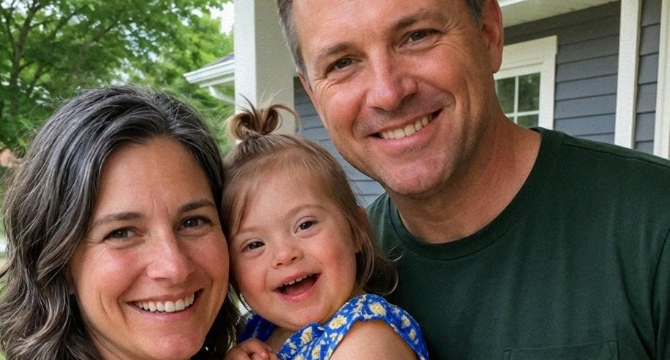
I thought bringing Adele home would be the beginning of a beautiful new chapter for our family. I never imagined that a whispered conversation in the middle of the night would expose the truth behind it all.
The couch was buried under a mountain of warm laundry. I folded the same pair of jeans for the third time because my mind kept drifting. The dishwasher hummed the way it did every night around 10.
Upstairs, James, six, and Miranda, four, were finally asleep, which meant the house was mine for maybe an hour.
I’m Mary. Forty-two, married for 15 years, with two kids.
My mind kept drifting.
Harold came in from the garage.
He’d been out there again, on his phone, which was becoming a habit I hadn’t decided how to feel about yet.
My husband sat next to me on the couch and didn’t reach for the remote. That’s how I knew something was coming.
“Mary,” he said. “I want to talk to you about something.”
“If it’s the water heater, I already called about it.”
He’d been out there again.
“It’s not the water heater.” Harold put his hand on my knee. “I’ve been thinking a lot lately. I want us to adopt a child.”
I stopped folding. I looked at him as if he’d started speaking Portuguese.
“Harold, we already have two children of our own. It’s a wonderful idea, but we have a mortgage and a car payment. James needs braces next year. Miranda outgrows her shoes every three months.”
“I know all of that.”
“I want us to adopt a child.”
“Then what are you saying?”
My husband didn’t answer right away.
He looked at the folded shirts, at the ceiling, at his own hands. Anywhere but at me.
“I’ve always dreamed of giving a child a real home,” he finally said. “A family. Someone who wouldn’t have one otherwise. I feel it, Mary. I feel it strongly right now.”
“Why right now?”
“I feel it strongly right now.”
“I don’t know. Maybe Ray dying made me think.”
Ray was Harold’s college friend. He had a heart attack last spring and was gone before the ambulance made it up the driveway.
My husband had been quieter since, and I’d let him be, because that’s what you do for the person you’ve slept next to for 15 years.
“Honey,” I said gently. “That’s grief talking.”
He had a heart attack last spring.
“Maybe. But it doesn’t feel like it. It feels like something I’m supposed to do.”
I set the jeans down. I studied his face.
The little scar over his eyebrow from crashing his bicycle at 19. The way his jaw tightened when he wasn’t telling me the whole story. His jaw was tight now.
“Have you been looking into this?” I asked.
“It feels like something I’m supposed to do.”
“A little.”
“How little?”
“I’ve made some calls to agencies. Just asking questions.”
The garage calls finally made sense. That was why he’d been standing out by the recycling bin with his phone pressed to his ear every night that week while I put the kids to bed alone.
“You’ve been doing this for weeks, and you’re telling me tonight?”
The garage calls finally made sense.
“I didn’t want to bring it up until I was sure…”
Harold looked at me finally. His eyes were wet, and I hadn’t seen him cry since his mother’s funeral.
“…sure that I meant it,” he said. “Please, Mary. Just think about it. That’s all I’m asking.”
I told him I would. What else was I going to say to a man who was crying because he wanted to save a child?
“I didn’t want to bring it up until I was sure…”
Later, in bed, I heard my husband get up and slip back downstairs, phone in hand.
I stared at the ceiling and wondered, for the first time in years, who exactly he was becoming.
For weeks after that first conversation, Harold wouldn’t let the idea of adoption rest.
Every morning he had a new article printed out on the counter. Every evening he had another story about a child waiting somewhere for a family.
I heard my husband get up.
I kept telling him we had our children to think about. I told him the numbers didn’t add up.
He kept nodding as if he heard me, and then the following morning there’d be another article.
One night, I finally set my coffee down and looked at him.
“Okay. Okay, Harold. We’ll visit a home. Just visit. That’s all I’m agreeing to.”
He hugged me so tightly that it startled me. I told myself that was a good man reacting to good news.
I told him the numbers didn’t add up.
The children’s home was a low brick building off the highway, painted a cheerful color.
A woman met us at the front desk and introduced herself as Denise.
“You must be Harold and Mary. Come on back. I’ll walk you through,” the caregiver said as Harold shook her hand.
I noticed his palm was damp.
A woman met us at the front desk.
Denise led us down a hallway lined with children’s artwork.
Harold didn’t look at it. He was scanning the rooms we passed, his eyes moving quickly, as if he were searching for one specific face.
“How many children are here right now?” I asked.
“Twenty-six,” Denise said. “Ages two to 12. Would you like to start with the younger ones?”
“Yes,” Harold said before I could answer.
Harold didn’t look at it.
We turned into a bright playroom. Kids were scattered on rugs and beanbags. In the far corner, near the window, a little girl sat by herself, drawing.
Harold stopped walking.
“That one,” he said quietly. “Who’s that one?”
Denise looked over. “Oh, that’s our Adele. She’s four. Adele has Down syndrome, and the other kids, well, they can be shy around her. She’s a sweetheart, though.”
A little girl sat by herself.
Harold was already walking toward her. He knelt beside her chair as if he’d done it a hundred times.
“Hi, sweetheart. What are you drawing?”
Adele held up a paper covered in loops of purple crayon. My husband smiled at it as if it were a masterpiece hanging in a museum.
He turned to me from the floor.
“Mary. This is her. This is the one.”
“What are you drawing?”
“Harold,” I kept my voice low. “She’s wonderful, but we just walked in. We haven’t met anybody else.”
“I don’t need to.”
“That isn’t how this works.”
“Honey, please. Adele is the one for us. I can just feel it.”
Denise glanced between us, polite but curious.
I felt heat crawling up my neck. I gave a small, tight smile and told Denise we’d need a minute.
“That isn’t how this works.”
In the hallway, I whispered, “Why her, Harold? Out of every child in this building, why does it have to be her right this second?”
“Because I looked at her and I knew,” he said. “The way you knew with James the second you held him.”
That answer worked on me. I stood there in that hallway, and I built him a story I could live with.
Ray had died suddenly in the spring. He was 44 years old. Harold hadn’t been the same since.
“I looked at her and I knew.”
He’d started taking calls in the garage and saying things like, “What are we even doing all this for?”
This was a good man trying to turn a loss into something that mattered. That’s why he was emotional and why he’d fixated on the one child no one else had chosen.
“Okay,” I said. “Okay, Harold.”
He’d started taking calls in the garage.
The adoption paperwork took months.
There was a home study, interviews, and then the waiting.
We brought Adele home in October.
She didn’t sleep through the night, not for weeks. That little girl would wake up crying, small and scared, and I was the one she wanted. Harold would sit up and offer, but Adele reached for me.
She didn’t sleep through the night.
I ordered a video baby monitor. It was so I could get to Adele faster on the bad nights.
I set the little camera on the shelf above her dresser and angled it toward her bed. I hadn’t mentioned it to Harold.
The following night, the house was dark when something pulled me out of sleep. A man’s voice, low and careful, coming through that tiny speaker at 2 a.m.
I ordered a video baby monitor.
I fearfully reached for Harold. His side of the bed was empty and already cold.
I sat up and grabbed the monitor.
On the screen, Adele was curled on her side, one small hand tucked under her cheek, sound asleep. Standing right next to her bed, in the soft glow of her nightlight, was my husband. His phone was pressed to his ear, his shoulders hunched as if he were trying to make himself smaller.
His side of the bed was empty.
He kept glancing down at Adele, the way you do when you’ve slipped into a room to check on a child who’s stirred, and you don’t want to wake them.
I turned the volume up as far as it would go because he was whispering. I hadn’t gotten around to telling him about the monitor yet.
Who could he be talking to so late?
He kept glancing down at Adele.
“She doesn’t suspect a thing,” Harold whispered.
My whole body went still.
There was a long pause. I could hear him breathing. Then his voice again, a bit harder now, the way he sounded when he’d already made up his mind about something.
“I have Adele. Our plan worked.”
My whole body went still.
I couldn’t move.
The word “plan” kept looping through my head as if it were the only word left in the English language.
Another pause. My husband shifted his weight, glanced at the door as if he were calculating whether he could make it to the garage without Adele waking.
“No, Mary bought all of it. Every word.”
My blood ran cold.
“No, Mary bought all of it.”
I don’t know how to describe what happens inside a person when a sentence like that lands. It was as if every memory I had of the last six months rearranged itself in one second.
The articles Harold had left on my nightstand.
The way his eyes went straight to Adele’s corner at the children’s home.
The late calls in the garage.
I pressed my hand to my mouth so I wouldn’t make a sound.
It was as if every memory I had of the last six months rearranged itself.
My husband nodded at something the other person said.
Then, quieter, almost tenderly, “I know. I know. Just give me time. I’ll figure out when.”
Time for what?
I didn’t wait to hear more.
I set the monitor down on the sheets.
I slid out of bed barefoot and walked past our closet and down the hallway without turning on a single light.
“I’ll figure out when.”
At the top of the stairs, I stopped and just breathed for a second.
Almost two decades together, two kids later, I had a husband in a four-year-old’s bedroom whispering about a plan that he’d devised with someone unknown to me.
Downstairs, I pulled the big rolling suitcase out of the pantry closet where we kept it.
Then I pulled down the two smaller ones we used for the kids.
I pulled the big rolling suitcase out.
I moved through the house on autopilot.
Miranda’s ballet leotards. James’s inhaler. The little stuffed elephant Miranda still slept with, even though she said she didn’t. I packed underwear, socks, chargers, and the kids’ toothbrushes from the guest bathroom.
My hands were shaking so hard I dropped the toothbrush cup twice.
“Think, Mary,” I whispered to myself. “Just think.”
I couldn’t.
I packed underwear.
My brain kept skipping like a scratched record.
She doesn’t suspect a thing. I have Adele. Our plan worked.
Who was on the other end of the phone? A woman? A man? Someone who wanted Adele back? Someone who wanted money? Someone who’d been coaching my husband through the biggest deception of our marriage?
I zipped all the suitcases.
Who was on the other end?
I stood in the entryway in my pajamas with three bags lined up by the front door, my car keys already in my fist, and I looked up at the stairs.
James’s room was on the left. Miranda’s was on the right. Adele’s little door was at the end, just past the bathroom, the one with the paper butterfly Miranda had taped up to welcome her.
I could get my children out in 10 minutes.
My sister lived 40 minutes away. She’d open the door in her robe and ask no questions until morning.
I could get my children out.
But Adele.
Adele, who woke up crying because she didn’t understand where she was yet. Adele, who’d been in our house for six weeks and had finally started reaching for me instead of flinching. Adele, who was, no matter what the surrounding adults had done, a child who’d done absolutely nothing wrong.
I stood at the bottom of the stairs with my car keys biting into my palm, and I stared in the direction of her bedroom door.
I set the keys down on the hall table.
A child who’d done absolutely nothing wrong.
Then I carried the suitcases to the bottom step, sat down, and waited.
Adele was probably still asleep upstairs, and I couldn’t be a woman who slipped away in the dark from her daughter’s father without making him face me.
A few minutes later, Harold froze on the landing when he saw me.
“Mary, what is this?”
“I heard you. On the phone. In Adele’s room.”
I couldn’t be a woman who slipped away.
My husband’s face went gray. He sank onto the step above mine and didn’t try to lie.
“Harold. Just say it.”
“She’s mine,” he whispered. “Her mother’s name was Patricia. It was one summer years ago. I ended it because I love you. I swear I never knew about her until her sister, Lillian, called me a few months ago, in March.”
I thought I was going to stop breathing.
“Just say it.”
“And instead of telling me, you built a whole story?” I asked.
“I was terrified. I made the coward’s choice. Every day I made it again.”
I didn’t scream. I didn’t have it in me. I just looked at the man I’d married and saw a stranger holding my life in his hands.
Upstairs, Adele called for me, soft and sleepy. “Mama?”
I went to her. She reached up, and I lifted her without thinking.
“I was terrified.”
I had been at my sister’s house for two weeks when I met Lillian in a diner off the interstate.
Harold had given her my number and told her I wanted to meet.
Adele’s aunt slid a photograph across the table with shaking hands.
“Patricia asked that Adele know her father one day. I couldn’t take her in myself, and I thought I was doing right by my sister. I should have tried contacting you first. I’m so sorry.”
I met Lillian.
I realized Lillian wasn’t a schemer. She was just a woman who’d tried to do her best after losing her sister and being saddled with a child she couldn’t care for.
I filed for separation the following month.
Harold didn’t fight me on anything.
He signed what I asked him to sign and thanked me for agreeing to stay in Adele’s life.
I filed for separation.
Months later, in a smaller house, I stood in the kitchen doorway.
Adele sat at the table with her crayons. James guided her hand. Miranda picked out the colors.
I lost a marriage built on lies. But I gained a daughter I chose.
That, I finally understood, was the difference.