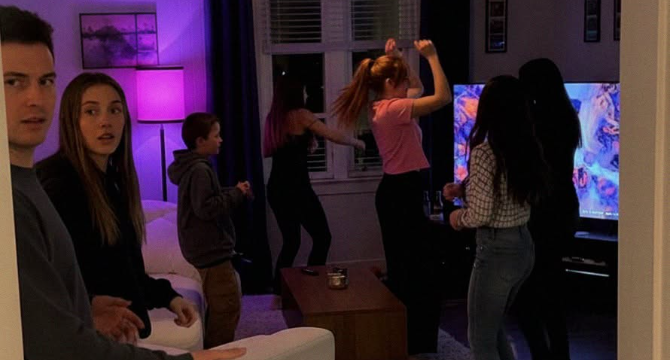
We came home early and found fourteen teenagers surrounding our nonverbal son in the living room. I was ready to call the police — until I saw what he was holding.
Leo was holding a microphone.
Not a toy.
A real microphone connected to the speaker beside our television.
My seven-year-old son stood in the middle of 14 teenagers, wearing blue noise-reducing headphones and gripping the microphone with both hands.
Everyone was watching him.
My husband, David, reached for my arm.
“Anne, wait.”
I barely heard him.
Four unfamiliar cars were parked outside.
Shoes covered our entryway.
Pizza boxes and soda cans crowded the kitchen island.
A group of strangers had taken over our house while our children were supposed to be sleeping.
And my nonverbal autistic son was standing at the center of it.
Maya froze near the couch.
She was 17, with dark curls and the same gentle smile she wore every time she babysat.
That smile was gone.
“Mrs. Carter,” she said. “You’re home early.”
“What is happening?”
Maya glanced at Leo.
A tall boy with a hearing aid knelt several feet in front of him. He held another microphone.
He tapped his chest twice.
“My turn.”
Leo lifted his microphone.
His lips parted.
No sound came out.
The boy waited.
Nobody laughed.
Nobody checked a phone.
After several seconds, Leo tapped his chest twice.
The boy smiled.
“Leo’s turn.”
Leo pressed a large yellow button on the microphone.
A recorded voice came through the speakers.
“Again.”
The room erupted in applause.
Not loud applause.
Fingertips pressed into palms.
A soft flutter that barely made a sound.
Leo smiled.
My anger stopped moving for one second.
Then my five-year-old daughter, Emma, ran toward us wearing a paper crown.
“Mommy! You’re early!”
I caught her.
“Are you okay?”
She frowned.
“Yes.”
“Did anyone hurt you?”
“No.”
“Did anyone give you anything?”
She held up a juice box.
“Apple juice.”
David locked the front door behind us.
“Maya, why are there strangers in our house?”
Maya swallowed.
“I can explain.”
“You invited a party here while babysitting our children.”
“It isn’t a party.”
Music still played softly through the speakers.
Colored tape crossed our living-room floor. Picture cards covered the coffee table.
HAPPY.
SAD.
STOP.
MORE.
MY TURN.
Bins held textured balls, puzzles, toy cars, and plastic animals.
Near the stairs, someone had built a tent from blankets. A sign above it read:
QUIET SPACE. ONE PERSON AT A TIME.
The room looked chaotic.
It also looked planned.
That did not make it acceptable.
“Everyone out,” I said.
The teenagers began gathering their things.
Leo dropped the microphone, then he screamed.
The sound tore through the room.
He ran to the front door and pressed himself against it.
“No,” Emma said. “They can’t go yet.”
I stared at her.
“Go upstairs.”
“But Leo hasn’t done the last game.”
“Emma.”
Her eyes filled.
Maya stepped forward.
“Please don’t make everyone leave all at once.”
I turned on her.
“You do not get to tell me what to do in my own house.”
“I know.”
“You invited strangers here without permission.”
“Fourteen,” she said automatically.
I looked at her.
She lowered her eyes.
“Sorry.”
The boy with the hearing aid stood.
“My name is Jonah. We’re from Maya’s peer mentor club.”
“I don’t care where you’re from.”
He nodded.
“Okay.”
“We thought you knew,” he said.
I looked at Maya.
She shook her head.
“No. That’s on me.”
“Why would they think we knew?”
Maya’s face crumpled.
“Because I told them you did.”
The room went silent.
I had trusted Maya for almost two years.
She lived three houses down with her mother, Denise.
She knew Leo’s routines.
She knew he liked toast cut into four squares.
She knew the vacuum terrified him, but the blender did not.
She had never asked us for money.
When I insisted, she said watching Leo and Emma did not feel like work.
Now she had lied to 14 people and brought them into my home.
“Call your mother,” I said.
Maya wiped her cheek.
“She’s working.”
“Call her anyway.”
The teenagers moved into the kitchen.
Leo remained against the door, breathing hard.
Maya crouched several feet from him.
“Leo, change.”
She held up a picture card showing two doors.
One open.
One closed.
“Friends stay for five minutes,” she said. “Then friends leave.”
Leo hit the closed door with his palm.
“Stay,” a device around his neck said.
I hadn’t noticed the tablet resting against his chest.
On the screen were large buttons with words and pictures.
MORE.
STOP. HELP. DRINK. MOM. DAD. EMMA. MAYA.
I touched the edge.
“Where did this come from?”
“The club.”
“Leo doesn’t have a communication device.”
“I know.”
“We’ve been waiting eight months.”
“I know.”
“How does he know how to use it?”
She did not answer.
My stomach tightened.
“How long has this been happening?”
“Six Sundays.”
Six Sundays.
David and I had gone out six times in two months.
Dinner.
A work event. His brother’s birthday.
Coffee because our marriage counselor said we needed time that did not revolve around therapies and insurance appeals.
Every time, Maya smiled and said the children had been wonderful.
“What happened after we left?” I asked.
“At first, only Jonah came.”
Maya met Jonah through her school’s peer mentor program. His younger brother was autistic and used a communication device.
She asked whether he knew games that could help Leo practice taking turns.
The first Sunday, Jonah brought picture cards.
The next, he brought the tablet.
Later, two more students joined them.
One knew basic sign language. Another volunteered with a sensory theater group.
They built games around Leo’s interests.
Toy cars became a turn-taking activity. Animal cards became matching exercises.
The microphone let him select recorded words.
The blanket tent gave him somewhere quiet to go.
Emma participated too.
“Why didn’t you tell us?” David asked.
Maya looked at me.
“I tried.”
“When?”
“The first night Jonah came.”
I remembered her standing on our porch after dinner.
She said, “Leo did something new tonight.”
I had been tired.
Emma was crying because she had lost a sock.
I told Maya we could talk another time.
She tried again the next week.
That night, Leo had thrown his dinner plate.
When Maya said she wanted to invite someone from school, I told her Leo did not need to become anyone’s community-service project.
I remembered the exact words.
Maya had gone quiet.
“I should have asked again,” she said. “I should never have done this without permission.”
“No,” I said. “You shouldn’t have.”
She nodded.
“But when Jonah came, Leo used the word ‘more’ for the first time.”
“He knows that word.”
“He understands it. He had never asked us for it.”
That distinction cut deeper than I expected.
Leo understood hundreds of words.
He followed instructions.
He recognized every route between our house and school.
But spoken language had never come.
For years, strangers assumed silence meant absence.
I knew better.
Still, knowing he understood me did not mean I always understood him.
“The next week, he chose ‘stop,'” Maya continued. “Then ‘again.’ Last Sunday, he selected Emma’s picture after she left the room.”
Emma beamed.
“He missed me.”
I looked at her.
“Did Maya tell you to keep this secret?”
Her smile vanished.
Maya answered.
“Yes.”
My gratitude died before it could fully form.
“You told my five-year-old to lie.”
“I called it a surprise.”
“You taught my children to hide what happened while we were gone.”
“I know.”
“Do you understand how dangerous that is?”
“Yes.”
“No, you don’t.”
My voice broke.
“You do not have a child who cannot tell you if someone touched him. You do not study every bruise because he cannot explain where it came from.”
Maya began crying.
“I would never hurt him.”
“I believed that this morning.”
The words struck her.
David placed a hand on my shoulder.
I pulled away.
I was angry at Maya.
I was also angry at myself.
Four cars outside.
Fourteen teenagers in my home.
My son using a device I had fought to obtain.
My daughter keeping secrets because she thought they were surprises.
I had missed all of it.
“Who paid for the food?” I asked.
Jonah raised his hand.
“The club.”
“And the tablet?”
“We held a fundraiser.”
“That costs thousands.”
“It’s refurbished,” he said. “We installed communication software.”
“Who set it up?”
“Our faculty advisor and Leo’s speech therapist.”
Every thought in my head stopped.
“His therapist knows?”
Maya looked frightened.
“Ms. Chen helped us choose the symbols.”
I called her.
It was nearly ten, but she answered.
“Anne?”
“Did you know Maya was bringing teenagers into my house?”
Silence.
“I knew she was doing peer sessions with Leo. She said you approved them.”
Maya covered her face.
“Are you saying you didn’t?” Ms. Chen asked.
“No.”
She apologized immediately. She had only advised Maya about communication tools. She had never attended a session.
She believed we knew.
When I ended the call, Maya looked smaller.
“I didn’t think she’d help if she knew I hadn’t asked.”
“That should have told you not to do it.”
“I know.”
Leo pressed a button.
“Sad.”
Everyone looked at him.
He stared at Maya. Then he pressed her picture.
“Maya.”
She sat on the floor and cried.
Leo left the door and walked to her.
For years, I had waited for my son to say he loved me.
I had imagined hearing “Mom” across a playground or beside his bed.
Instead, I watched him press the picture of someone who had lied to me.
Then he touched “sad.”
It was not what I had dreamed.
It was communication.
Clear. Specific.
His.
I sat on the floor.
“Leo, Mom is here.”
He looked at the tablet.
His finger hovered over my picture.
Then he pressed “angry.”
A few teenagers laughed before catching themselves.
I almost did too.
“Yes,” I said. “Mom is angry.”
He pressed “Maya.”
“I am angry with Maya.”
Then he selected “stay.”
David crouched beside us.
“Five minutes. We finish the game, then everyone leaves.”
He looked at me.
I nodded.
The teenagers returned to the living room.
They sat in a wide circle, leaving space around Leo.
Jonah picked up the microphone.
“Last game.”
Each person played an animal sound. Leo had to choose the matching picture.
A dog barked. Leo chose the dog.
A horse neighed. He chose the horse.
Then came an elephant.
Leo selected the lion.
Nobody corrected him.
Jonah waited; Leo looked at both cards.
Then he moved his finger to the elephant.
Soft applause filled the room.
Leo rocked on his toes.
Happy.
Not displayed.
Included.
When the game ended, the teenagers packed everything.
One girl handed me a binder.
Inside were six weeks of notes.
Dates. Activities. Leo’s choices. Signs of stress. What helped. What failed.
On the first page, Maya had written:
“Leo is not a project. The goal is not to make him act less autistic. The goal is to give him more ways to be heard.”
I read it three times.
Then I closed the binder.
Maya’s mother arrived wearing hospital scrubs.
Denise listened without interrupting.
When I finished, she turned to Maya.
“You lied to them.”
Maya nodded.
“You brought people into their house.”
Another nod.
“You involved their children in a secret.”
“Yes.”
Denise looked at me.
“I am so sorry.”
I believed her.
That did not repair anything.
We agreed Maya would not babysit again.
Before she left, she knelt beside Leo.
“I have to go.”
Leo pressed “stay.”
She cried.
“I can’t.”
He pressed “again.”
Maya looked at me. Part of me wanted the door closed forever.
Another part remembered the binder.
“Not tonight,” I said. “Maybe another day.”
For the next week, Leo carried the tablet everywhere.
He asked for crackers.
Then water.
Then the red car.
On Wednesday, he pressed “Dad” and “work” after David left.
On Thursday, he selected “Maya” six times.
Ms. Chen came to our house that weekend.
She apologized again, then showed us how to add new words.
SAFE.
HURT.
YES.
NO.
SECRET.
SURPRISE.
We taught both children the difference.
A surprise has an ending.
A secret about touching, fear, or danger must always be told.
Maya meant well.
That did not make secrecy safe.
Three weeks later, we invited her back.
Not as a babysitter but as part of a supervised session.
Only four students came.
David and I stayed. So did Ms. Chen.
Before they began, Maya stood in our living room.
“I’m sorry I lied.”
“I know.”
“I thought if you saw what Leo could do, you would forgive how I did it.”
“Helping him did not give you the right to decide for us.”
“I understand.”
I handed her the binder.
“Then help us do it properly.”
Six months have passed.
The group meets twice a month at the community center.
Parents attend.
Volunteers are screened.
Sessions have schedules, emergency contacts, and written consent.
The school district gave the program a small grant after Jonah presented it to the board.
Leo still uses the refurbished tablet.
His insurance-approved device finally arrived, but he prefers the old one.
It has Maya’s picture on it.
Last Sunday, Jonah handed Leo the microphone.
“Your turn.”
Leo pressed a button.
A recorded voice said, “Friends.”
Then he chose another.
“Again.”
Soft applause moved around the circle.
I cried.
Not because those teenagers rescued my son from loneliness.
Leo was never broken.
He did not need rescuing.
I cried because they had slowed down long enough to meet him where he was.
Maya made a serious mistake.
She brought strangers near vulnerable children, entered our home without permission, and taught our children to keep something from us.
Her intentions do not erase that.
But her mistake existed beside something beautiful.
She looked at a boy most people spoke around and asked what might happen if everyone finally waited for his answer.
The night we came home early, I thought I had caught a babysitter betraying our trust.
I had.
Just not in the way I first believed.
She had broken one kind of trust while helping my son build another.
The first had to be repaired.
The second had to be protected.
And for the first time in Leo’s life, he had the words to tell us the difference.