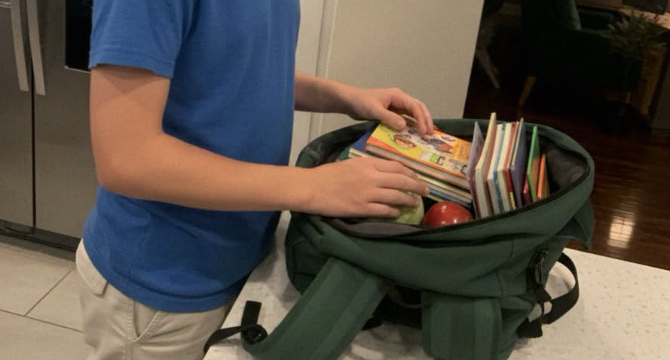
Every afternoon, my son quietly unpacked groceries he refused to explain. When I followed him to the bicycle racks, I learned why he thought we were running out of food.
When I saw what my son gave them in return, I felt sick.
Noah opened the front pocket of his backpack and handed each child a white envelope.
The boy took his first.
Then the girl holding the eggs.
Then the third child, who had brought bread and cheese.
Their names were written across the envelopes in Noah’s careful handwriting.
The children glanced around before putting them away.
It looked practiced.
Like they had done this before.
I stepped out from behind the parked cars.
“Noah.”
His whole body froze.
The girl almost dropped the eggs.
“Mom?”
I walked toward them.
“What is in those envelopes?”
No one answered.
Noah moved in front of the other children.
He was protecting them from me.
“Give them back,” he whispered.
The girl slowly opened her envelope.
Inside were two trading cards.
Not ordinary cards.
They came from the collection Noah had built with my father.
Dad had started buying them for him when Noah was five. Every birthday, Christmas, and visit, he brought another pack.
After Dad died, Noah kept the cards in a blue binder beneath his bed. He would not even let his younger sister touch them.
The card in the girl’s hand was one of his favorites.
I knew because Dad had written the date on the protective sleeve.
“You traded Grandpa’s cards for groceries?” I asked.
Noah stared at the pavement.
“Yes.”
“Why?”
He said nothing.
I reached for the grocery bag.
He pulled it away.
“Please don’t take it.”
“Noah, why are you doing this?”
His chin trembled.
“Because Dad lost his job.”
For a moment, I thought I had misunderstood him.
“Your father did not lose his job.”
“Yes, he did.”
“He lost some hours.”
“No, Mom. He lost all of them.”
I stared at my 11-year-old son as school buses pulled away behind us.
My husband, Daniel, had told me the warehouse cut his schedule from 40 hours to 26.
He said it was temporary.
We canceled subscriptions, stopped ordering takeout, and delayed anything we did not need.
Money was tight, but I believed we were stable.
Noah looked at me as if I were the child.
“Dad doesn’t go to work anymore,” he said.
“Of course he does.”
“He parks at the library.”
My stomach tightened.
“How do you know?”
“Mrs. Patel drove me home when I missed the bus. Dad’s truck was there. I saw job applications inside.”
Maybe he had stopped at the library before work.
Maybe Noah had misunderstood.
I held on to those thoughts until he continued.
“He prints applications there every day.”
One of the boys touched Noah’s shoulder.
His name was Mateo.
“You don’t have to tell her everything here,” he said.
That was when I realized these children knew more about my family than I did.
“How long has this been happening?” I asked.
Noah whispered, “Three weeks.”
Three weeks.
Every afternoon, my son had carried groceries into our kitchen.
For three weeks, I had watched him fill our cabinets without understanding that he thought he was keeping us fed.
“Who bought this food?”
Mateo answered.
“Our parents. Some came from our houses. Some came from the church pantry.”
The girl lifted the eggs.
“My mom gets extras from the restaurant where she works.”
“And the meat?”
“My uncle owns a grocery store,” the third child said.
Noah wiped his face.
“I didn’t steal anything.”
“I never said you did.”
“You thought it.”
He was right.
“Give Noah his cards back,” I said.
The children immediately returned the envelopes.
Noah shook his head.
“No.”
“Those cards belonged to Grandpa.”
“That’s why they’re worth something.”
That sentence nearly broke me.
He was not thinking about the afternoons he spent sorting them with my father.
He was thinking about how many meals they could buy.
I crouched in front of him.
“We are going home.”
“Are you mad?”
“I don’t know what I am.”
“I was only trying to help.”
“I know.”
“Then don’t tell Dad.”
“Why?”
Noah stared at his shoes.
“Because he cries in the garage.”
I stopped breathing.
Daniel did not cry where anyone could see him. At my father’s funeral, he had turned away and covered his face because he thought grief should be private.
“He thinks nobody knows,” Noah said. “I heard him tell Uncle Chris he was supposed to take care of us.”
I looked at the groceries.
Cereal.
Canned vegetables.
Eggs.
Bread.
Cheese.
Nothing special.
Nothing a child should have to negotiate for.
Then Mateo spoke again.
“We noticed Noah wasn’t eating lunch.”
I turned toward my son.
“You’ve been skipping lunch?”
He looked away.
“He put food from his tray into napkins,” Mateo said. “Apples. Crackers. Anything he could carry.”
The apples wrapped in his gym shirt had come from Noah’s own lunch.
He had been going hungry to bring food home.
My knees weakened.
I sat on the low wall near the bicycle racks.
“Why did you think we needed this?”
Noah looked confused.
“I heard you and Dad.”
“When?”
Daniel and I had argued in the kitchen after midnight.
The bill was higher than expected.
Daniel kept saying we needed more time. I said we were one bad week away from trouble.
I meant we might have to use our emergency savings.
Noah heard disaster.
“I saw you put food back at the store,” he said.
I remembered.
Salmon.
Cookies.
A brand of coffee I decided was too expensive.
“I was staying within our budget.”
“You said we couldn’t afford it.”
“I said it cost too much.”
“That’s the same thing.”
To an 11-year-old, maybe it was.
“Dad said he wasn’t hungry three nights in a row,” Noah continued.
Daniel had been giving his food to the children.
I believed him when he said stress had affected his appetite.
Then Noah looked at me.
“You stopped eating breakfast.”
“I drink coffee.”
“That’s not breakfast.”
Every sacrifice Daniel and I thought we had hidden had become evidence in our son’s mind.
“Why didn’t you ask me?” I said.
“Because you would say everything was fine.”
He answered immediately.
I had said those exact words many times.
Everything is fine.
We are handling it.
You do not need to worry.
Children know when adults are lying.
They simply do not know why.
Mateo’s mother arrived ten minutes later, still wearing blue medical scrubs.
Her name was Sofia.
When she saw me, she closed her eyes.
“I was going to call you.”
“But you didn’t.”
“Noah begged me not to.”
She sat beside me.
“He told Mateo your family was running out of food.”
“We are not running out of food.”
My voice came out sharper than I intended.
Sofia stayed calm.
“I believed he was scared.”
She showed me two messages sent to Daniel.
Both asked whether we needed support.
Daniel had replied:
“Thank you, but we’re doing fine.”
“Please don’t involve the children.”
“He knew?” I asked.
“He knew Noah was worried.”
Then she hesitated.
“Daniel came to my house last week and returned two bags of food.”
I looked at Noah.
“You said Dad didn’t know.”
“He didn’t know about the new plan.”
The children had started bringing smaller amounts from different families.
One bag at a time.
Things that could disappear into our cabinets without Daniel noticing.
My 11-year-old had created a distribution system to get around his father’s pride.
I did not know whether to be impressed or horrified.
Mostly, I felt ashamed that he thought he had no other choice.
Sofia touched my arm.
“Claire, none of us think badly of you.”
“I think badly of me.”
“Don’t.”
“My son has been going hungry.”
“Your son has been afraid. Those are not the same thing.”
They did not feel different in that moment.
I thanked the children and loaded the groceries into my car.
Then I drove Noah home.
Daniel’s truck was not there.
I checked our location-sharing app.
The library.
I called him.
He answered after the third ring.
“Hey.”
“Where are you?”
“Work.”
“Which loading dock has a public library?”
Silence.
Then he exhaled.
“I can explain.”
“Come home.”
He arrived 20 minutes later.
When he saw the groceries on the kitchen table, he went still.
Then he saw Noah.
“No.”
That one word held shame, fear, and defeat.
I placed the messages from Sofia in front of him.
“How long?”
“Twenty-three days.”
“You have been unemployed for 23 days?”
“Yes.”
“And every morning, you leave dressed for work.”
“I’ve been applying everywhere.”
“That was not my question.”
His jaw tightened.
“I didn’t want the kids to know.”
“Noah knows. He has been skipping lunch.”
Daniel looked at him.
“What?”
“He has been trading Grandpa’s cards for groceries.”
Daniel gripped the back of a chair.
Noah began to cry.
“I was helping.”
Daniel crossed the room and pulled him close.
“This was never supposed to be your job,” he whispered.
Noah pressed his face into Daniel’s shirt.
“But you said it was yours.”
Daniel froze.
“I heard you tell Uncle Chris,” Noah said. “You said taking care of us was your job, and you failed.”
Daniel looked at me.
“I was angry.”
“You were lying,” I said.
“I thought I could find something before anyone noticed.”
“I noticed,” Noah whispered.
Daniel sat down.
The man I had been married to for 14 years looked smaller than I had ever seen him.
He explained that the warehouse had eliminated his position.
His supervisor gave him two weeks of severance and promised a reference.
Daniel used the severance to keep paying bills.
Every morning, he drove to the library and applied for jobs.
He took temporary work when he could.
He unloaded trucks.
Cleaned offices.
Helped a moving company for one weekend.
He hid the extra money inside what he usually deposited from work.
“Why didn’t you tell me?” I asked.
“I saw how scared you were when they cut my hours last year.”
“Of course I was scared.”
“I thought if I told you, you would carry it every second.”
“So you carried it alone and let Noah carry it with you.”
“I didn’t know.”
“That is what happens when nobody tells the truth.”
My voice shook.
“You thought silence protected us. Noah thought silence protected you. Now our child believes food has to be smuggled into his own house.”
Daniel covered his face.
Noah stood beside him.
For a moment, I saw the lesson forming inside my son.
A man loses his job.
A man hides it.
A man gives away his food.
A man cries in the garage.
A man calls that protection.
I would not let that become Noah’s idea of love.
“We are going to talk about money,” I said.
Daniel lowered his hands.
“In front of him?”
“Especially in front of him.”
I showed Noah our checking account.
Our savings.
The mortgage.
The power bill.
Not every detail.
Enough.
I explained that we were not rich, but we were not about to lose our home.
We had four months of emergency savings if we were careful.
My job covered most essential bills.
We had health insurance.
We could ask for help before the refrigerator was empty.
“Then why did Dad say we were in trouble?” Noah asked.
“Because adults sometimes feel ashamed before they are actually unsafe.”
Daniel looked at him.
“I was scared people would think I failed.”
“Did you?”
“No.”
“Then why did you lie?”
Daniel took a long breath.
“Because I thought losing my job made me less useful.”
Noah frowned.
“You still make dinner.”
A laugh escaped me.
Then Daniel began to cry.
This time, he did not turn away.
Noah hugged him.
Our seven-year-old daughter, Lily, appeared in the hallway.
She looked from Daniel to Noah.
“Why is everyone crying?”
I opened my arms.
“Come here.”
She climbed into my lap.
I told her Dad was looking for a new job and that we would be careful with money for a while.
“Are we poor?” she asked.
“No,” I said. “But even if we needed help, that would not make us bad.”
She thought about it.
“Can we still have pancakes?”
Daniel laughed through his tears.
“Yes. Pancakes are safe.”
That evening, the four of us ate together.
No one claimed not to be hungry.
The next morning, we met with the school counselor.
Trading valuable cards had to stop.
So did skipping lunch.
The counselor helped us enroll in a temporary grocery-support program for families facing job loss.
My first instinct was to refuse.
Then I looked at Noah.
Pride had already cost him enough.
We accepted.
I called every parent who had sent food.
I thanked them.
I returned what we did not need and accepted what made sense.
That balance was harder than either refusing everything or taking everything.
Sofia invited us to dinner that weekend.
The children sat at the table.
No envelopes.
No secret bags.
Just dinner.
Daniel apologized to the parents for shutting them out.
I apologized for assuming the worst when I saw the exchange.
Then Noah brought out the blue binder and returned every card.
Mateo pushed his envelope back.
“You should keep them.”
Noah shook his head.
“It wasn’t a fair trade.”
Mateo smiled.
“No. The cereal was generic.”
Everyone laughed.
Even me.
Two weeks later, Daniel found a new job.
It paid less, but the hours were steady.
He did not pretend everything was fixed.
He showed Noah his first pay stub.
Then they planned dinners together based on what we could afford.
Daniel also stopped crying in the garage.
He still had difficult days.
The difference was that he came inside and told me.
Sometimes Noah heard us discussing money.
Now we explained enough that he did not have to imagine the rest.
Noah still carries a heavy backpack.
Now it is mostly books.
Sometimes I find an apple inside.
I always ask whether he ate lunch.
He rolls his eyes.
Then he answers.
A few days ago, I found a can of soup pushed to the back of our pantry.
It was the first thing Noah had brought home.
The label was bent, and our last name was written across the top in black marker.
“Why did you write on it?” I asked.
“So nobody at school would accidentally take it back.”
I held the can in both hands.
“You really thought we needed it that badly?”
He nodded.
“I thought if I brought one thing home every day, maybe you wouldn’t notice we were running out.”
I pulled him close.
“We were never running out of food.”
“I know that now.”
I wanted to throw the can away.
Instead, I placed it on the highest shelf.
Not as proof that we had almost gone hungry.
We had not.
I kept it because children listen when adults whisper.
They notice the bills hidden beneath newspapers, the food left on plates, and the tears saved for garages.
We thought Noah was protected because we never told him the truth.
Instead, we left him alone with clues.
He filled the silence with the worst story he could imagine.
My son did not bring groceries home because he was dishonest.
He did it because every adult around him believed love meant quietly carrying fear for someone else.
We are teaching him something different now.
Love can mean sharing.
It can mean asking.
It can mean accepting help without believing you have failed.
Sometimes it means opening the pantry and admitting what is there.
And sometimes it means telling an 11year-old the truth before he starts selling his memories to save you.