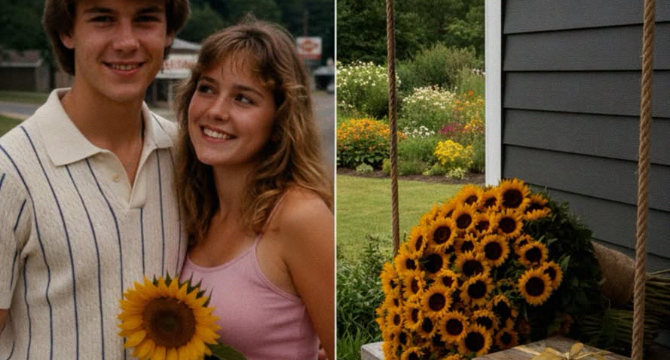
On my 60th birthday, I opened my door to find exactly 60 sunflowers. Only one person had ever promised me that many—Danny, my childhood sweetheart, who died the year we were 15. Then I spotted a weathered box behind them, and what I found inside made my hands shake.
The morning of my sixtieth birthday arrived quiet and gray, the way most of my mornings had settled since the divorce.
I sat at my kitchen table with a cup of tea, listening to the house breathe around me.
Three years of living alone had taught me that silence could be a kind of mercy.
My daughter called before I even finished my tea.
The morning of my sixtieth birthday arrived quiet and gray
“Happy birthday, Mom. We’re still on for dinner tonight, right?”
“Of course,” I said. “Nothing fancy. Just my favorite people and a slice of cake.”
“You always say that. Sixty is a big deal, you know.”
I laughed softly.
“Sixty is just a number for a woman nobody buys flowers for anymore.”
I didn’t know it yet, but before that morning was over, I would eat my words.
“A woman nobody buys flowers for anymore.”
She went quiet for a second.
“Don’t talk like that. You spent enough years believing you didn’t deserve better.”
She was right, though I would never fully admit it.
I married a man who cheated on me more times than I let myself count.
And I forgave him again and again, because the thought of being alone frightened me more than the betrayal did.
She was right, though I would never fully admit it.
It took years before I finally found the courage to walk away.
After we hung up, my thoughts wandered where they rarely did.
They wandered to Danny, my childhood sweetheart.
The boy who made me a promise I’d spent forty-five years trying to forget.
We had grown up three houses apart.
The boy who made me a promise I’d spent forty-five years trying to forget.
We were best friends before either of us understood what love even meant.
That was the summer we were both fifteen, the summer everything felt endless.
We passed a roadside flower stand one afternoon.
I joked about growing old and being forgotten.
“When I turn sixty,” I told him, “I’ll be an old woman nobody bothers buying flowers for.”
I joked about growing old and being forgotten.
Danny stopped walking.
He looked genuinely offended.
“Then I’ll bring you sixty sunflowers,” he said. “One for every year.”
I rolled my eyes.
“You’ll forget me by then.”
“Never.” He held out his hand. “Shake on it.”
“Then I’ll bring you sixty sunflowers,”
I shook his hand, laughing at how serious his face was.
He did not laugh back.
“I mean it,” he said. “Sixty sunflowers. I promise.”
We thought age and memory were the biggest challenges that promise would face.
Then came the Fourth of July.
We thought age and memory were the biggest challenges that promise would face.
A fireworks accident sparked a terrible fire during a neighborhood celebration.
Danny never made it home.
When you lose someone like that it changes you.
For years, I had nightmares filled with roaring fire and smoke that stole my breath.
And I learned that a promise made by a dead boy can haunt you.
I learned that a promise made by a dead boy can haunt you.
I never told a soul about the sunflower promise.
Not my parents, not my friends, not the man I eventually married.
It felt too sacred, too fragile to share.
Now, on the day when Danny was supposed to keep that promise, I was certain there was nobody but me who knew about it.
I assumed there was nobody who would keep it.
I never told a soul about the sunflower promise.
I finished my tea and set the cup in the sink.
I decided to fetch the newspaper before the day fully began.
It was a small ritual, one of the little routines that kept me anchored.
I crossed the living room, still lost in memories of a boy who had been gone for forty-five years.
I reached for the front door, expecting nothing but the paper and the cool morning air.
If I’d known what was waiting outside, I might have been afraid to open the door.
Lost in memories of a boy who had been gone for forty-five years.
I twisted the handle and pulled it open.
And whatever I had braced myself for, it was not what waited on the other side.
The morning light spilled across my porch.
I stood there unable to move.
Sunflowers.
Everywhere.
I stood there unable to move.
They covered the steps.
They leaned against the railing.
They spilled across the welcome mat in a wild burst of yellow.
My heart raced so wildly I thought I was having a heart attack.
I pressed a hand to my chest.
Then I started counting under my breath.
They covered the steps.
“One, two, three,” I whispered, moving down the row. “Fifty-eight, fifty-nine, sixty.”
Exactly sixty.
My knees nearly gave out beneath me.
There was no way this could be a coincidence.
I gripped the doorframe and lowered myself to sit on the top step.
Exactly sixty.
“This isn’t possible,” I breathed.
I had never told a single soul about that promise.
The secret had lived only inside me, tucked away with the memory of a fifteen-year-old boy and a roadside flower stand.
A boy who took that promise to his grave long ago.
“This isn’t possible,”
That was when I noticed something tucked behind the largest bundle of stems.
A weathered wooden box, small and worn.
It was tied with a faded yellow ribbon.
The flowers frightened me.
The box frightened me more.
I reached for it slowly.
I noticed something tucked behind the largest bundle of stems.
Part of me thought it might vanish if I moved too fast.
That this would all turn out to be some kind of crazy hallucination.
“Easy now,” I told myself. “Easy.”
I carried it inside with both hands, cradling it against me like something fragile and alive.
I set it on the kitchen table and sat down before my legs could betray me again.
I carried it inside with both hands
For a long moment I only stared at it.
“Open it,” I whispered. “Just open it.”
My fingers fumbled with the ribbon.
It took three tries before the knot came loose.
Inside, resting on a bed of old cloth, was a single folded note.
“Just open it.”
I lifted it out and unfolded it carefully.
I still believed there had to be an ordinary explanation.
Then I saw the handwriting.
I would have known that messy scrawl anywhere.
Danny’s handwriting.
A sound escaped me that was half sob, half gasp.
I would have known that messy scrawl anywhere.
The first line read:
If you’re reading this, I kept my promise after all.
“No…” I shook my head. “You’re dead. You’re dead… this can’t be real.”
Tears blurred the ink before I could read another word.
My mind raced with terrible possibilities.
“You’re dead. You’re dead… this can’t be real.”
“Is this a joke?” I whispered to the empty kitchen. “Is someone playing a cruel joke on an old woman?”
The thought turned my grief into something sharp and angry.
Who would take the one pure memory I had left and twist it into mockery?
Who could, when nobody knew about that promise but me?
That was when the sound came.
Knock. Knock. Knock.
“Is someone playing a cruel joke on an old woman?”
Three slow, distinct knocks against my front door.
The note slipped from my fingers and drifted to the floor.
I froze, staring toward the hallway.
“Who’s there?” I called, but my voice came out too thin to carry.
No answer.
Three slow, distinct knocks against my front door.
Only silence, thick and waiting.
I rose slowly, my heart hammering against my ribs.
“Get ahold of yourself,” I whispered. “It’s just the door.”
But nothing about this morning was “just” anything.
I crossed the room on unsteady legs, each step feeling longer than the last.
When I finally wrapped my trembling fingers around the handle, my whole body was shaking.
I crossed the room on unsteady legs,
I had no idea who stood on the other side.
I drew one shaky breath and pulled the door open.
A man stood on my porch, older than I remembered but unmistakable.
The shape of his eyes, the set of his jaw.
He looked exactly like Danny would have looked at sixty.
A man stood on my porch, older than I remembered but unmistakable.
And for a moment, that resemblance fooled me.
My heart did a funny little skip.
Then reality caught up to me.
“You’re Danny’s brother,” I whispered.
“I am. I’m sorry to frighten you like this.”
My hand stayed frozen on the door.
My heart did a funny little skip.
“You sent these,” I said. “The sunflowers. The box. How did you know?”
He glanced at the sea of yellow behind him and gave a sad, tired smile.
“May I come in? This is going to take a while, and you look like you need to sit down.”
I stepped back and let him into my kitchen.
The note lay on the table where it had slipped from my fingers.
“How did you know?”
“I was clearing out our mother’s house last month. She passed in the spring.” He pulled in a slow breath. “In the back of her closet, I found a shoebox of Danny’s things. And inside it was this.”
He nodded toward the folded note.
“He wrote the promise down,” he continued. “Sixty sunflowers. Your name. And your birthday. He’d counted the years out.”
My tears came fast and silent.
“In the back of her closet, I found a shoebox of Danny’s things.”
“He was fifteen,” I said.
“He meant it. That was Danny.” His voice cracked. “After I found it, I couldn’t just put it back in the box. I looked you up.”
“You looked me up,” I repeated.
“Just your address.” He met my eyes carefully. “I’m sorry if I’ve overstepped, but… Danny talked about you constantly. He wanted to marry you.”
“I couldn’t just put it back in the box.”
“When I found this note… It brought all of that back,” he continued, smiling sadly. “I thought it would be nice if I kept the promise for him. I thought he’d like that.”
I reached across the table and picked up the note.
I finally read it all the way through.
Just a boy promising a girl the world in the currency of flowers.
For forty-five years, I’d believed that promise existed only in my memory.
I was wrong.
A boy promising a girl the world in the currency of flowers.
“He would’ve kept it himself if he could. I have no doubt about that.”
He sniffed.
“Danny thought you were the kind of person someone keeps a ridiculous promise for.”
I wiped my face.
“I’m sixty years old and I’m just realizing that a boy who died at fifteen loved me more honestly than the man I gave most of my adult life to.”
“He would’ve kept it himself if he could. I have no doubt about that.”
He said nothing.
He let me sit with it.
“For decades I thought settling was the safe choice,” I went on. “That accepting less was how you kept from getting hurt. But these flowers are hurting me right now. And they’re the tenderest thing anyone’s done for me in my whole life.”
“Danny wouldn’t have wanted them to hurt.”
“But these flowers are hurting me right now.”
“They don’t hurt because of him,” I said. “They hurt because of what I let myself accept afterward. Because I forgot this was even possible.”
I stood and walked to the door, looking at each stem, each bright open face.
“A promise made with tenderness shouldn’t cost you more pain than the person keeping it,” I said. “Danny taught me that when I was fifteen. And I spent forty-five years unlearning it.”
“I forgot this was even possible.”
His brother rose and touched my shoulder gently.
“You remembered it now,” he said. “That’s what matters.”
“It took long enough.”
“Better late.” He smiled. “That’s what Danny always said. Better late than a broken promise.”
I laughed through my tears.
For the first time in years, it felt clean.
I thought that would be the biggest event that happened that day, but my birthday dinner proved me wrong.
“That’s what matters.”
My children arrived that evening, stepping into a kitchen filled with flowers.
“Mom, where did all these come from?” my daughter asked, her eyes wide.
Before I could finish, a familiar voice came from the doorway.
“Who did you beg for these?”
My ex-husband appeared in the doorway, uninvited, glancing at the flowers with a smirk.
Before I could finish, a familiar voice came from the doorway.
I looked at him, and for the first time, I felt nothing but calm.
“Nobody begged. A boy promised me these when I was fifteen. He kept his word better in death than you ever did in life.”
His smirk faltered.
“You’re being dramatic. Come on, I came to wish you a happy birthday.”
“He kept his word better in death than you ever did in life.”
“You came to remind me I was small,” I said quietly. “But I’m not that woman anymore.”
“So this is how it is?”
“This is exactly how it is. Please leave.”
He stared, waiting for the fear that always kept me obedient.
It never came.
He turned and walked out.
“But I’m not that woman anymore.”
My son squeezed my shoulder.
“Are you okay, Mom?”
“I’m better than okay,” I whispered.
I gathered the sunflowers into my arms, and I understood something at last.
Danny’s love never asked me to hurt.
“I’m better than okay,”
It never made me smaller.
For decades I had confused endurance with love, believing suffering was the price of not being alone.
I turned to my children and the two friends who had carried me through the divorce.
“These are yours,” I said, dividing the stems among them. “You stood beside me while I rebuilt myself.”
For decades I had confused endurance with love
I kept one sunflower for me.
“And this one,” I smiled through my tears, “is proof I finally know what I deserve.”
They wrapped me in an embrace, and the years of quiet shame loosened their grip.
That night, as I placed my single flower in a glass of water by the window, I realized the past had not returned to hold me.
It had come to set me free.