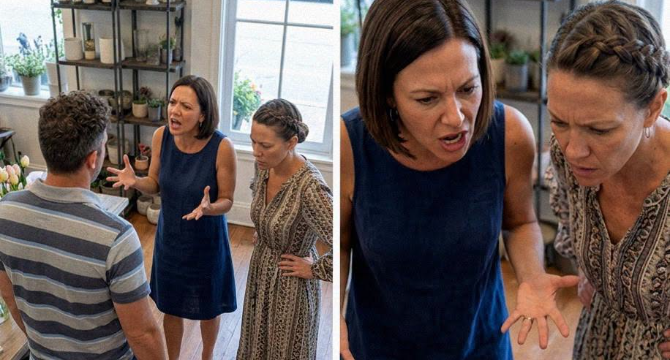
A woman lost her patience with a man who was taking too long to choose flowers for his wife and mocked him in front of the entire shop. Seconds later, she noticed something beside his leg that explained why he had been carefully examining every single flower.
My daughter tugged my sleeve and whispered, “Mom, that lady is being mean.”
We were third in line at the flower shop on Saturday, holding tulips that had been dripping down my wrist for ten minutes.
The shop was one of those tiny neighborhood places where everything smells green and wet the second you walk in.
Buckets lined the walls.
Roses near the register.
Lilies in the back.
Tulips everywhere because it was spring.
My daughter, Ava, is eight and incapable of whispering quietly when something interesting is happening.
I looked where she was looking.
At the front of the shop, a man in a gray T-shirt was going through the buckets one stem at a time.
Lifting a tulip.
Turning it slowly between his fingers.
Running his thumb up the stem.
Bringing it close to breathe it in.
Then setting it back exactly where it had been.
His wife stood a few feet behind him with her arms crossed.
She didn’t step in.
She didn’t hurry him.
She just watched.
Their little girl was already holding the ones he’d picked, pink and yellow, wrapped in both arms against her chest.
Behind me, a woman in a green sundress checked her phone.
Then checked it again.
She sighed.
Loudly.
The man kept going.
Stem by stem.
Not rushing for anybody.
At first, I’ll admit, I wondered what he was doing too.
Not in an annoyed way.
More curious.
He was clearly taking his time with each flower, and I couldn’t tell whether he was looking for bruising or scent or some tiny imperfection I didn’t know enough about flowers to notice.
Ava whispered, “Why does he smell every one?”
“I don’t know.”
“Maybe he’s a flower scientist.”
“Maybe.”
She accepted that immediately.
Eight-year-olds are wonderful that way.
The woman behind us did not.
She checked her phone again.
Her heel tapped against the tile.
The cashier kept looking up, then down, probably trying to decide whether to say something.
The man picked up a red tulip.
Ran his thumb over the petals.
Smelled it.
Put it back.
The woman behind me let out another sigh.
Ava looked at me.
“That was louder.”
“I noticed.”
Two more minutes passed.
Then three.
The man’s wife still didn’t interfere.
That stood out to me.
If my husband had been taking that long to choose tulips, I probably would’ve started offering opinions.
Not because I’m controlling.
Because I am terrible at waiting.
But this woman didn’t move.
She watched him with this tiny smile on her face.
Not impatient.
Not embarrassed.
Just patient.
Their daughter shifted the bouquet in her arms.
“Dad, these are getting heavy.”
“Almost done, bug.”
His voice was cheerful.
He reached for a yellow tulip.
Behind me, the woman in green muttered something under her breath.
I didn’t catch it.
Ava did.
Her eyes widened.
“Mom.”
“Don’t.”
“I didn’t say anything.”
“You were about to.”
She looked offended.
The man continued.
He lifted another tulip.
Turned it.
Touched the petals.
Smelled it.
And that was apparently the breaking point.
The woman in the green sundress stepped around me.
“Are you brain-dead or just incredibly slow?”
The entire flower shop went silent.
The cashier’s hand stopped on the register.
The man froze with a yellow tulip halfway to his face.
His wife’s expression disappeared.
Ava grabbed my arm.
The woman kept going.
“Some of us actually have somewhere to be today. Just grab one and move.”
The man lowered the flower.
Very carefully.
He set it back in the bucket.
Then he straightened it so the stem lined up with the others.
That detail has stayed with me.
Someone had just humiliated him in front of an entire shop, and his first instinct was still to put the flower back properly.
His daughter stepped out from behind him.
She was maybe six.
She had the tulips clamped under one arm.
And with her free hand, she pointed straight at the woman.
“Say it again.”
Her mother whispered, “Lucy.”
But the girl didn’t move.
“Say it again.”
The woman in green actually laughed.
Not nicely.
“Oh, wonderful.”
Then the man turned around toward her voice.
Slowly.
Not fast.
Not angry.
The way you turn when you’re placing where a sound came from.
And that’s when she saw it.
So did I.
A white cane was folded against his leg.
Red tip.
It had been resting there the entire time.
Six feet from the woman.
Ten minutes while she sighed behind him.
I hadn’t noticed it either.
The woman made a sound.
Not a word.
Just air.
Her face changed completely.
The man reached out until his hand found his daughter’s shoulder.
“It’s okay.”
Lucy was still glaring.
“Dad, she called you—”
“I heard.”
He squeezed her shoulder gently.
“Put your hand down.”
She lowered it.
Slowly.
Then he turned his face toward the woman.
“I’m blind.”
He said it the way you’d tell someone the time.
No drama.
No accusation.
Just a fact.
The woman’s mouth opened.
Nothing came out.
The man gestured toward the buckets.
“I can’t see which ones are pretty, so I have to feel them.”
He picked up the yellow tulip again.
His fingers moved lightly over the petals.
“The petals tell you if they’re fresh. If they’re soft at the edges, they’ve been sitting too long.”
Then he lifted it toward his face.
“And the good ones still smell like something.”
His wife came forward then.
She slipped one hand around his arm.
And suddenly I understood why she’d been standing back with her arms crossed.
She wasn’t ignoring him.
She was letting him.
That realization hit me almost as hard as the cane.
She could’ve stepped in.
Could’ve chosen for him.
Could’ve made it faster.
She had deliberately done none of those things.
The man smiled slightly.
“My wife usually helps me do this.”
His wife laughed under her breath.
“Usually?”
“Fine. Always.”
A few people smiled.
The tension loosened by half an inch.
Then he added, “But these aren’t for me to receive.”
He tipped his head toward his wife.
“They’re for her.”
Then toward his daughter.
“And for her.”
Lucy lifted the bouquet a little higher.
The woman in green looked at the floor.
“I didn’t know.”
The man nodded.
“I know.”
“I just thought…”
She stopped.
He waited.
She clearly had no version of that sentence that helped.
The man looked toward his wife.
“Is she still there?”
His wife nodded.
“Yes.”
He faced the woman again.
“I know I’m slow.”
His voice was still calm.
“I’ve been slow my whole life.”
The shop had gone completely quiet again.
“Every day, somebody helps me. People hold doors. They tell me where the empty chair is. They take my elbow when there’s construction on the sidewalk.”
He smiled.
The woman didn’t say anything.
“Strangers read signs for me,” he continued. “Waiters read menus. My daughter tells me when I’ve put on two different socks.”
Lucy protested.
“That was one time.”
“Three.”
“Two.”
His wife said, “Four.”
Everyone laughed softly.
Even the cashier.
Then the man continued.
“I’m grateful for all of it.”
He paused.
“But once a year, I want to be the one who gives something.”
His wife’s face changed.
I looked at her.
She was crying now.
Quietly.
He lifted the yellow tulip.
“Not the one who’s taken care of.”
He ran his thumb along the stem.
“I want to hand my wife something I chose myself.”
The woman in green’s face had gone red all the way to her ears.
The man smiled toward his wife.
“She always says I buy terrible anniversary gifts.”
“That is not what I say.”
“That is exactly what you say.”
“I said the electric can opener was unromantic.”
“It was useful.”
Lucy sighed dramatically.
“Dad.”
He laughed.
Then his expression softened.
“Twelve minutes for this.”
He held up the tulip.
“That’s what it costs me to hand my wife something I picked myself.”
Nobody moved.
The woman in green looked like she wanted the floor to open.
“I didn’t…” she said.
Then stopped.
Started again.
“I didn’t see.”
Her eyes dropped to the cane.
“I’m so sorry.”
The man nodded once.
“I’m so, so sorry,” she said.
And here’s the part I’ve thought about every week since.
He smiled.
“That’s alright.”
The woman looked up.
“You were in a hurry,” he said.
A pause.
“Everybody’s in a hurry.”
Then he held the yellow tulip out toward her voice.
“Here.”
She stared at it.
“Take this one.”
She didn’t move.
He smiled again.
“It’s the best one in the shop. I checked all of them.”
The woman looked like she might cry.
“I can’t take that.”
“Why not?”
“It’s for your wife.”
His wife spoke for the first time in several minutes.
“He can pick another.”
The woman looked at her.
Then at him.
Still, she didn’t reach for it.
So Lucy did.
She took the tulip from her father and marched straight over to the woman.
Then she pressed it into her fingers.
The woman closed her hand around the stem.
She held it as if it might break.
“Thank you.”
The man nodded.
“You’re welcome.”
She left without buying anything.
Nobody said a word as she walked out.
Through the shop window, I watched her stop on the sidewalk.
She stood there in the heat with her phone in one hand and a single yellow tulip in the other.
For a long time, she didn’t move.
Then the man turned back toward the flowers.
“Where was I?”
Lucy answered immediately.
“Yellow ones.”
“Excellent assistant.”
His wife stepped backward again.
That caught my attention.
She resumed exactly where she’d been before.
A few feet away.
Arms crossed.
Waiting.
Not helping unless he asked.
The man returned to the buckets.
Stem by stem.
He touched another flower.
Smelled it.
Put it back.
Nobody sighed this time.
Not one person.
The cashier didn’t rush him.
The customers behind us didn’t complain.
We all just waited.
And weirdly, it didn’t feel long anymore.
Maybe because now we understood what the time meant.
He chose three more flowers.
Then he handed the final bouquet to his wife.
She pressed her face into them.
“Well?” he asked.
“They’re perfect,” she said.
“You’re legally obligated to say that.”
“I’m not.”
Lucy said, “Mom, smell the pink one.”
Her mother did.
Then kissed her husband on the cheek.
“Happy anniversary.”
“Tomorrow.”
“Close enough.”
They paid and left.
As the door closed behind them, Ava leaned against my arm.
“Mom?”
“Yeah?”
“Why was that lady so mean?”
I thought about giving her the easy answer.
Because she was impatient.
Because she didn’t understand.
Because some people are rude.
All true.
None complete.
“She thought she knew what was happening,” I said.
Ava frowned.
“But she didn’t.”
“No.”
“Then why did she say anything?”
That is the kind of question children ask that adults spend years avoiding.
“I don’t know.”
Ava considered that.
Then looked at the tulips in my hand.
“We picked ours fast.”
“We did.”
“Maybe ours are bad.”
I laughed.
“They’re fine.”
“How do you know?”
I looked at the petals.
Then, because I couldn’t help myself, brought one to my nose.
Ava copied me.
“It smells green.”
“What does green smell like?”
“That.”
Fair enough.
We paid.
When we got outside, the woman in the green dress was gone.
The yellow tulip wasn’t lying on the sidewalk.
I noticed that.
I hope she kept it.
Not as some permanent punishment.
That’s not really what stayed with me.
The man didn’t humiliate her.
That would’ve been easy.
Everyone in the shop was already on his side the second we saw the cane.
He could’ve embarrassed her.
He could’ve asked whether she felt stupid.
Could’ve told her exactly what kind of person says something like that to a stranger.
Instead, he gave her the best flower in the shop.
And somehow, that was worse.
Not crueler.
Just harder to escape.
Anger gives you something to defend yourself against.
Kindness makes you sit alone with what you did.
I kept thinking about his wife too.
The way she stood back.
At first, I’d interpreted it as passivity.
Why wasn’t she helping?
Why was she letting him take so long?
Then I understood that not helping was the gift she was giving him.
There’s a strange assumption we make about care.
That more is always better.
More help.
More intervention.
More efficiency.
But sometimes helping someone with everything means accidentally taking away the few things they wanted to do themselves.
She knew that.
So she waited.
She let him touch every stem.
Let him smell every flower.
Let the line grow.
Because it wasn’t about tulips.
It was about agency.
Choice.
The dignity of getting to give instead of always receiving.
I thought about the cane too.
It had been visible.
That part bothers me.
Not because the woman missed it.
Because I did too.
I’d been standing there almost as long as she had.
I had watched the man touch flowers one by one and built my own harmless little explanation.
Maybe he was picky.
Maybe he knew a lot about flowers.
Maybe he was just slow.
I hadn’t been cruel.
But I hadn’t understood either.
And understanding usually comes much later than judgment.
That’s probably why I remember his exact words.
“Twelve minutes for this. That’s what it costs me.”
Twelve minutes.
Such a small amount of time.
Long enough to irritate a stranger.
Short enough to give his wife something he had chosen with his own hands.
A few days later, Ava asked whether blind people could cook.
“Yes.”
“Drive?”
“Usually not.”
“Pick clothes?”
“Yes.”
“Flowers?”
I looked at her.
“You know that one.”
She smiled.
Then she said, “He picked the best one.”
According to him, anyway.
I hope he was right.
I hope that woman took the yellow tulip home.
I hope she put it in water.
And every time she looked at it, I hope she remembered not that she’d been embarrassed in a flower shop, but how little she knew when she decided she knew enough to be cruel.
Because that’s the part I carried home too.
Most of us don’t walk around trying to hurt strangers.
We’re just hurried.
Distracted.
Certain.
And sometimes certainty is enough.
We see somebody moving slowly and assume they don’t care that we’re waiting.
We see somebody doing something differently and assume they’re doing it badly.
We see help withheld and assume nobody cares enough to offer it.
Then the missing piece appears, and the entire story changes.
The man at the flower shop didn’t need everyone to feel sorry for him.
That wasn’t what he wanted.
He wanted twelve minutes.
Twelve minutes to choose tulips for his wife.
Twelve minutes to be the giver.
And once we understood that, none of us minded waiting.