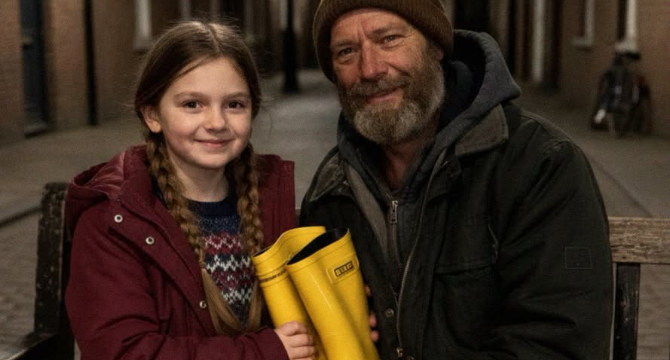
A homeless man returned the boots my daughter had given him and asked one strange question. What we found hidden inside them had been there for years.
He pressed the boots into Mia’s hands.
“Look under the insole. Right now.”
I stepped between him and my daughter.
“How do you know where we live?”
The man immediately backed away.
“I followed the address.”
“What address?”
He pointed at the boot Mia was holding.
“Inside.”
Mia sat down on the hallway floor before I could stop her.
She tugged out the damp insole.
Underneath was a folded piece of paper.
Not paper, exactly.
A thin strip of laminated card.
My stomach tightened.
Mia pulled it free.
There was handwriting on one side.
A name.
A phone number.
And two words in thick black marker:
IF FOUND.
I stared at it.
“What is that?”
The man looked at me.
“I was hoping you knew.”
I didn’t.
Mia turned it over.
The other side had a photograph.
A little girl.
Maybe four years old.
Dark curls.
Big brown eyes.
Standing beside a hospital bed.
I knew that face.
Not the child.
The woman beside her.
My mother.
I grabbed the card.
“What the hell?”
Mia looked up.
“Mom?”
I barely heard her.
My mother had been dead for six years.
The picture was old. Maybe 25 years old.
She looked younger than I remembered her, but there was no question.
That was Mom.
And she had one hand on the little girl’s shoulder.
The man on my porch whispered, “That’s what I thought.”
I looked at him.
“You know her?”
He stared at the photograph.
“Her name was Susan.”
My skin went cold.
“How do you know my mother’s name?”
He looked at me for a long moment.
Then said, “Because she saved my sister’s life.”
Everything inside me stopped.
Mia stood.
“Your sister is the girl?”
He nodded.
“Her name was Emily.”
I looked at the photograph again.
“Why was this inside my daughter’s boot?”
“I don’t know.”
“How did you find it?”
“When I took the boots off.”
He glanced down at his feet.
He was wearing worn sneakers now, several sizes too large.
“Mia’s boots weren’t comfortable, but they kept my feet dry. When I got to the shelter, one of the insoles started lifting.”
He found the laminated card taped beneath it.
“I recognized Susan immediately.”
I stared at him.
“From 25 years ago?”
“Twenty-eight.”
His voice softened.
“You don’t forget someone who sits with your little sister while your family is told she might die.”
I opened the front door wider.
“Come inside.”
He hesitated.
“It’s okay.”
Then I looked at Mia.
“You too.”
She smiled as if inviting strangers with mysterious photographs into our living room was a completely normal Wednesday.
The man sat on the edge of the couch.
“I’m David.”
“I’m Rachel.”
“I know.”
I stiffened.
He quickly pointed at the card.
“Your last name is written under the phone number.”
I looked again.
There it was.
Rachel Morgan.
My maiden name.
And under it, an old phone number I hadn’t used since college.
My hands started shaking.
“This was meant for me.”
David nodded.
“Looks that way.”
“But why would it be inside Mia’s boots?”
Mia raised her hand.
“Grandma gave them to me.”
I turned.
“What?”
“The boots.”
I stared at her.
“No, she didn’t.”
“Yes, she did.”
“Mia, Grandma died before you were born.”
She rolled her eyes.
“I know. You gave them to me from Grandma’s box.”
And then I remembered.
Last fall.
I had finally gone through the last three plastic tubs from my mother’s apartment.
Clothes.
Recipe books.
Old holiday decorations.
At the bottom of one bin had been a pair of small yellow rain boots.
Not children’s boots exactly.
Women’s size five.
My mother had tiny feet.
Mia had loved them.
“Can I wear these?”
“They’re old.”
“They’re cool.”
She wore them anyway.
I hadn’t checked under the insoles.
Not once.
I sat down.
“Oh my God.”
David watched me.
“You really didn’t know?”
“No.”
He looked relieved.
“Good.”
“Why good?”
“Because for a minute I thought Susan had told you everything.”
“What everything?”
His expression changed.
He looked at Mia.
“Maybe this isn’t a conversation for—”
“She’s seven, not invisible.”
Mia crossed her arms.
David almost smiled.
I said, “Mia, why don’t you get your coloring stuff?”
“You’re trying to make me leave.”
“Yes.”
“Okay.”
No argument.
That worried me more than if she’d protested.
She disappeared into the kitchen.
I leaned toward David.
“Tell me.”
He looked at the photograph.
“My sister Emily was born with a heart defect.”
I said nothing.
“We didn’t have much money. My father worked construction. My mother cleaned houses.”
David had been nine.
Emily was four.
She needed surgery.
The family was drowning in bills.
Then Emily’s condition deteriorated quickly.
She was admitted.
Doctors told them she needed a procedure at a larger children’s hospital.
“Insurance wouldn’t cover everything,” David said. “My parents were fighting with everyone.”
“Where does my mother fit in?”
“She was a nurse.”
“I know.”
My mother had worked in pediatric nursing for almost thirty years.
“She was assigned to Emily.”
That part made sense.
The rest didn’t.
David rubbed his palms together.
“Susan started helping my parents.”
“Helping how?”
“Calling charities. Filling out forms. Finding transportation. She even drove my mother to an appointment once because Dad couldn’t leave work.”
That sounded exactly like Mom.
She was the kind of person who came home complaining about hospital administrators and then spent an hour filling out paperwork for someone else’s family.
David continued.
“Then the hospital told us the transfer was approved.”
I waited.
“It wasn’t.”
“What?”
“My parents found out later that a large part of the cost had been paid privately.”
My chest tightened.
“By my mother?”
“That’s what they eventually learned.”
“How much?”
David shook his head.
“I don’t know the exact number. A lot.”
“Mom didn’t have money.”
“Maybe not.”
He reached into his coat.
“She had this.”
He handed me another photograph.
My mother standing beside a car.
An old green Mustang.
I laughed from shock.
“That’s Grandpa’s car.”
“My father bought it.”
I stared at him.
“What?”
“From Susan.”
My grandfather had left that Mustang to my mother.
She loved it.
I remembered riding in it as a child.
Then one day it disappeared.
Mom told me the transmission died and the repairs weren’t worth it.
“She sold that car?”
“To my dad.”
“Why?”
“She told him she needed cash.”
David looked at me.
“My father later realized she sold it for less than half what it was worth, then somehow the same amount of money appeared toward Emily’s care.”
I closed my eyes.
“Of course she did.”
I could see Mom doing it.
And never telling anyone.
“What happened to Emily?”
David looked down.
“She lived.”
Relief hit me even though I had never met her.
“She had the surgery. There were complications, but she recovered.”
“Where is she now?”
His silence answered before he did.
“She died 11 years ago.”
“I’m sorry.”
“Car accident.”
He gave a small, bitter smile.
“After all that.”
I didn’t know what to say.
David continued.
“She became a teacher. Got married. Had a son.”
He pulled out his phone.
A picture appeared.
A woman in her early 30s holding a toddler.
Same brown eyes.
“She had a good life.”
I handed the phone back.
“So why did Mom hide this card in her boots?”
“I think I know.”
He turned the laminated card over.
There was something faint along one edge.
Tiny writing.
I hadn’t noticed it.
David read:
If David ever finds me, tell him it wasn’t his fault.
I looked up.
His face had gone pale.
“What wasn’t your fault?”
He didn’t answer.
“David.”
He stood.
“I should go.”
“No.”
“I shouldn’t have come.”
“You came to my house and handed me a message my dead mother hid for you. You don’t get to leave at that sentence.”
He stared at me.
Then sat again.
“When Emily got sick, I was angry.”
“You were nine.”
“I was jealous.”
He said it like a confession.
“Everything became Emily.”
My parents stopped coming to my school things.
Birthdays got canceled.
Dad worked constantly.
Mom lived at the hospital.
I was sent between relatives.”
He swallowed.
“One day I told Emily I hated her.”
My heart hurt.
“I told her I wished she would just die so everything could go back to normal.”
He looked toward the kitchen, where Mia was humming.
“She was four.”
“You were nine.”
“Old enough.”
“No.”
He looked at me.
“Rachel—”
“You were a child whose whole family had disappeared into a crisis you couldn’t understand.”
“I still said it.”
“Yes.”
His eyes filled.
“The next morning she almost died.”
There it was.
David had connected two unrelated things in the way children do.
He had said something terrible.
Then something terrible happened.
“So you thought you caused it.”
“For years.”
“Did Emily know?”
“Yes.”
“Did she blame you?”
“No.”
He laughed weakly.
“She barely remembered it.”
“And Mom knew?”
“She found me crying in a stairwell.”
I could picture it.
My mother sitting beside a nine-year-old boy who thought his words had almost killed his sister.
“What did she tell you?”
“That angry words aren’t magic.”
My throat tightened.
That sounded like her too.
“She said loving someone doesn’t mean you’re never angry at what their pain does to your life.”
I wiped my eyes.
“Then why the message?”
David looked at the boots.
“Because I disappeared.”
“What do you mean?”
“Not literally.”
After Emily recovered, the family moved.
David grew up.
Got into trouble.
Dropped out of school.
Worked construction.
Then his mother died.
His father died five years later.
Emily kept trying to pull him back into the family.
He pushed her away.
“Why?”
“Because she became proof of everything I wasn’t.”
“She was your sister.”
“She was good at life.”
His voice cracked.
“Teacher. Husband. House. Baby.”
“And you?”
Then Emily died.
David spiraled.
He stopped answering anyone.
Eventually, there was nobody left to call.
“How long have you been homeless?”
“Almost three years.”
“Does Emily’s husband know?”
“Probably not where I am.”
“Your nephew?”
“He’s fourteen now.”
I stared at him.
“You have family.”
David’s face hardened.
“They don’t need me.”
“Did they say that?”
“No.”
“Then who did?”
He looked away.
I recognized it.
The same thing he had done at nine.
Turning guilt into a sentence and then treating the sentence like fact.
I looked at the card again.
“If David ever finds me, tell him it wasn’t his fault.”
“Your mother must have expected me to come back someday.”
“Maybe she hoped you would.”
“But why hide it?”
That was the question.
Then I remembered something else from Mom’s belongings.
A stack of journals.
I had never read them.
They were in my attic.
I stood.
“Wait here.”
Ten minutes later, I came back carrying a dusty box.
David looked nervous.
“What is that?”
“My mother’s journals.”
Mia returned at exactly that moment.
“I knew you were doing something interesting.”
I sighed.
“Fine. Sit.”
We searched by year.
Twenty-eight years ago.
Mom’s handwriting filled the pages.
Most of it was ordinary.
Hospital shifts.
My school.
Bills.
Her dislike of our neighbor’s barking dog.
Then I found Emily.
May 17.
Emily C. transferred today. David cried in the stairwell again. He thinks his anger made her worse. Nine-year-olds should not be allowed to carry adult guilt.
David covered his face.
I kept reading.
June 2.
Car is gone. Rachel furious because I told her it finally died. I hate lying to her. Will explain someday when she’s old enough to understand that some choices need privacy more than applause.
I laughed through tears.
“She lied to me about the car.”
David whispered, “I’m sorry.”
“No. This is very Mom.”
Then I found a later entry.
Nearly fifteen years afterward.
Saw David today.
He looks tired. Would not let me buy him lunch. Says Emily is doing well. He is not.
I looked at him.
“You saw her again.”
He nodded.
“Once.”
“You didn’t mention that.”
“I forgot.”
“You don’t forget seeing the woman who saved your sister.”
He flinched.
“Okay. I didn’t want to say.”
“Why?”
“She recognized me outside a grocery store.”
Mom had written:
He asked why I helped Emily.
I told him because she needed help.
He asked why I helped him.
I told him because he did too.
He laughed like he didn’t believe me.
Then the final line:
Put the old card under the insole of the yellow boots. Silly place, but if I ever find David again, I’ll give it to him. If not, maybe Rachel will find it one day and understand why the car had to go.
I stopped reading.
Mia whispered, “Grandma put it there for you.”
“Partly.”
I looked at David.
“And partly for him.”
He was crying now.
Quietly.
Mia climbed down from the chair.
Then she walked over and held out the yellow boots.
David stared.
“These are yours,” she said.
He laughed through tears.
“They really don’t fit.”
“I know.”
“Your feet are very small.”
“They are.”
“Why?”
The room went silent.
I started to interrupt.
David answered first.
“I was born with something called clubfoot. Doctors fixed a lot of it when I was little, but my feet stayed small and walking hurts sometimes.”
Mia nodded.
“Okay.”
That was it.
No pity.
No staring.
Just okay.
Then she said, “You can keep them anyway.”
David looked at me.
I smiled.
“Apparently they’re family property now.”
He shook his head.
“No.”
He handed them back to Mia.
“I think they did what they needed to do.”
That sentence stayed with me.
The next morning, I called Emily’s husband.
David begged me not to.
I told him I would not give away his location without permission.
But I asked whether I could tell them he was alive.
After an hour, he said yes.
His brother-in-law, Mark, cried on the phone.
He said they’d been searching for David on and off for years.
Then he asked the question David was terrified of.
“Does he want to see Noah?”
I looked at David.
He whispered, “Not yet.”
I told Mark the truth.
“Not yet.”
Mark said, “Tell him we’ll take not yet.”
Three weeks later, David entered a housing program connected to the shelter.
Not because we rescued him.
We didn’t.
The shelter had offered before.
He had always refused.
This time, he said yes.
He also started treatment for alcohol addiction.
Two months later, he met Noah.
I wasn’t there.
Neither was Mia.
That belonged to them.
But afterward, David sent me a photograph.
He and Noah were sitting on a park bench.
Between them was a sketchbook.
Remember how I said David had been drawing on cardboard when Mia first saw him?
He was good.
Very good.
Noah loved art too.
Under the photo, David wrote:
He has Emily’s hands.
I cried.
Of course I did.
Mia still has the boots.
She outgrew them last month.
I offered to buy her new ones.
She asked whether we could keep the yellow pair on the shelf in our entryway.
“Why?”
She shrugged.
“They’re busy.”
I knew what she meant.
Those boots had belonged to my mother.
She sold the car she loved to help a little girl survive.
She comforted a boy nobody realized was drowning beside his sick sister.
Years later, she hid a message under an insole because she still hoped that boy might come back.
Then my daughter put those same boots on her own feet.
And on a cold, rainy afternoon, she noticed a barefoot man at a bus stop when every adult around him had learned not to look.
I used to think kindness was mostly about giving people things.
Money.
Food.
Shoes.
Now I think sometimes kindness is simply refusing to let someone become invisible.
Mia did that for David before she knew his name.
Mom had done the same thing 28 years earlier.
And somehow, without either of them planning it, the same pair of yellow rain boots connected those two moments.
Last week, David came over for dinner.
He has an apartment now.
Small.
Not glamorous.
His own.
He brought Mia a new sketchbook.
She showed him the boots sitting by the door.
“Still busy?” he asked.
“Taking a break.”
He laughed.
Before leaving, he crouched beside them.
Then he slipped something under one insole.
Mia immediately caught him.
“What was that?”
“Nothing.”
She narrowed her eyes.
We waited until after he left.
Of course we did.
Under the insole was a new laminated card.
On one side, David had drawn three people.
My mother from the old photograph.
Himself.
And Mia in her raincoat.
On the back, he had written:
“Susan noticed me when I was nine.”
“Mia noticed me when I was 41.”
“Some people save your life by refusing to walk past you.”
Mia read it twice.
Then she looked at me.
“Can we leave it there?”
“Why?”
She slid the insole back into place.
“In case somebody needs to find it someday.”
So that’s where it is.
Inside a pair of rain boots that no longer fit anyone in this house.
And for once, I know exactly what’s underneath the insole.