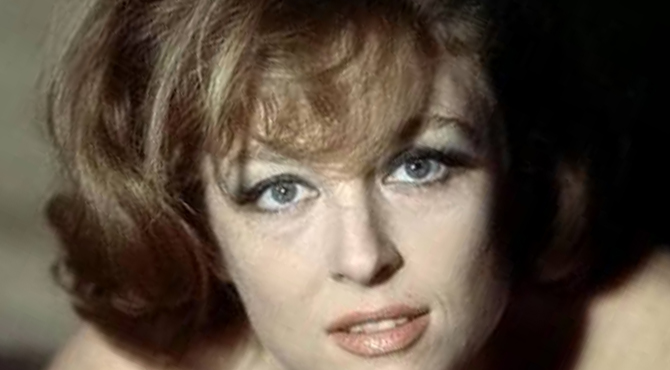
There are some actresses whose names remain forever connected with a particular era of cinema. Their faces belong to treasured memories, their performances to another time, and yet their presence never truly disappears. Nicole Courcel was one of those remarkable actresses.

Born Nicole Marie Jeanne Andrieu on October 21, 1931, in Saint-Cloud, France, Nicole Courcel became a familiar and respected figure in French cinema during the 1950s and 1960s. Elegant, expressive, and gifted with a natural screen presence, she built a long and varied career in film, television, and theatre.
When she died in Paris on June 25, 2016, at the age of 84, French cinema lost an actress whose career had stretched across more than five decades.
The Beginning of a Remarkable Career
Nicole Courcel began studying drama at the Cours Simon in Paris before entering the world of professional acting.
Her breakthrough came in 1949 when celebrated director Jacques Becker cast her in the film “Rendez-vous de juillet.” She played Christine Courcel, and the surname of the character became the professional name by which she would be remembered throughout her career.
The film introduced audiences to a young actress with an appealing combination of beauty, intelligence, and natural charm.
It was the beginning of a career that would take her through some of the most important periods in French cinema.
Working Alongside Jean Gabin
One of the memorable early chapters of Courcel’s career came with Marcel Carné’s “La Marie du port” in 1950.
The film gave the young actress the opportunity to appear alongside Jean Gabin, one of the great stars of French cinema.
Courcel possessed an understated screen presence. She did not need exaggerated gestures or theatrical performances to attract attention. Her expressions and quiet manner could communicate vulnerability, warmth, determination, and emotion.
That natural quality became one of the characteristics that audiences appreciated throughout her career.
A Star of French Cinema
The 1950s became an important decade for Nicole Courcel.
She appeared in films directed by respected filmmakers and gradually established herself as one of the recognizable actresses of postwar French cinema.
Among her notable films was Sacha Guitry’s “Si Versailles m’était conté,” released in 1954.
She also appeared in the popular comedies “Papa, maman, la bonne et moi” and “Papa, maman, ma femme et moi,” directed by Jean-Paul Le Chanois.
These productions showed her ability to move comfortably between drama and comedy.
Courcel was not confined to a single type of role. She could portray romantic characters, dramatic figures, sophisticated women, and ordinary people with equal naturalness.
Her versatility helped her maintain a successful career as French cinema continued to evolve.
A Passion for Theatre
Although cinema made Nicole Courcel widely known, acting was never limited to the movie screen.
She also developed an important career in theatre.
In 1954, she appeared in the French production of Arthur Miller’s “The Crucible,” playing Abigail Williams. The production featured major performers including Yves Montand and Simone Signoret.
Theatre demanded a different kind of discipline from film. Instead of relying on the camera to capture subtle expressions, performers had to communicate directly with an audience night after night.
Courcel embraced this challenge and continued to work on stage during her career.
Her theatrical work demonstrated the depth of her abilities and established her as a serious actress beyond the world of popular cinema.
“Sundays and Cybele”
Another important film associated with Nicole Courcel was Serge Bourguignon’s “Sundays and Cybele,” released in 1962.
The film became an international success and won the Academy Award for Best Foreign Language Film at the 1963 Academy Awards.
For Courcel, the film represented another significant chapter in a career that was already firmly established.
By this point, she had demonstrated that she could work successfully in different genres and alongside some of the most respected names in European cinema.
A Career That Continued to Evolve
As the French film industry changed during the 1960s and 1970s, Nicole Courcel continued to find new opportunities.
She appeared in productions including “The Night of the Generals,” “L’aventure c’est l’aventure,” and “The Slap.”
She also became increasingly active in television.
This ability to adapt was an important part of her longevity. While many performers associated with the golden age of cinema gradually disappeared from the screen, Courcel continued working as audiences and entertainment itself changed.
She successfully moved from the cinema of the postwar years into the growing world of French television.
A Familiar Face on Television
For later generations of viewers, Nicole Courcel became particularly familiar through television.
She appeared in numerous television films and series, including “Les Boussardel,” “Les Thibault,” and “Allô, Béatrice !”
She also took on the title role in a television adaptation of Gustave Flaubert’s “Madame Bovary.”
Television allowed Courcel to reach audiences who may not have known her earlier work in cinema.
Her career therefore became something of a bridge between generations. Older audiences remembered her from the great period of French postwar filmmaking, while younger viewers encountered her through television.
More Than an Actress
Nicole Courcel’s life extended beyond her professional achievements.
She was the mother of journalist and television personality Julie Andrieu. In 1980, Courcel published “Julie tempête,” a collection of memories connected with her daughter.
She also supported causes involving children and was associated with L’Enfant bleu, an organization dedicated to protecting children.
These aspects of her life remind us that the woman behind the actress was much more than the characters she portrayed on screen.
A Career Spanning Generations
One of the most remarkable things about Nicole Courcel’s career was its longevity.
She began working in cinema in the late 1940s, at a time when France was rebuilding itself after the Second World War.
She became a recognizable actress during the golden period of French popular cinema, worked with celebrated directors and performers, appeared on stage, adapted to the changing film industry, and eventually became a familiar presence on television.
Her career crossed several generations of French entertainment.
From “Rendez-vous de juillet” and “La Marie du port” to “Si Versailles m’était conté” and “Papa, maman, la bonne et moi,” and from “Sundays and Cybele” to her later television appearances, her filmography provides a fascinating glimpse into the changing world of French cinema.
Remembering Her Legacy
Nicole Courcel may not have achieved the same level of international fame as some of her contemporaries, but her contribution to French cinema deserves to be remembered.
She belonged to a generation of performers who helped define the character of French screen entertainment during the decades following the war.
Her performances reflected changing ideas about love, family, youth, relationships, and society.
She had a distinctive ability to bring warmth and humanity to her characters. Whether appearing in a comedy, drama, television production, or on the stage, she brought the same commitment to her craft.
Her career left behind an impressive body of work and a lasting connection with audiences.
Farewell to Nicole Courcel
Nicole Courcel died in Paris on June 25, 2016, at the age of 84.
With her passing, another link to the golden age of French cinema was lost.
But an actress’s legacy does not disappear when the final curtain falls.
Every time one of her films is shown again, every time an old television production is rediscovered, and every time someone becomes curious about the stars of classic French cinema, Nicole Courcel’s work has an opportunity to live again.
That is perhaps one of the greatest gifts an actor can leave behind.
The years pass. Styles change. Audiences change. The world of cinema changes.
But performances remain.
Nicole Courcel gave audiences decades of memorable work across film, television, and theatre. She was part of an extraordinary generation of French performers whose careers helped shape the cultural memory of the twentieth century.
Today, she deserves to be remembered not simply as an actress from another era, but as a talented and enduring artist whose work remains part of the history of French cinema.
The lights may have gone out, but the screen still remembers.
And so do we.
Rest in peace, Nicole Courcel (1931–2016).
Your films remain, your performances remain, and your place in the history of French cinema remains.
You are remembered.