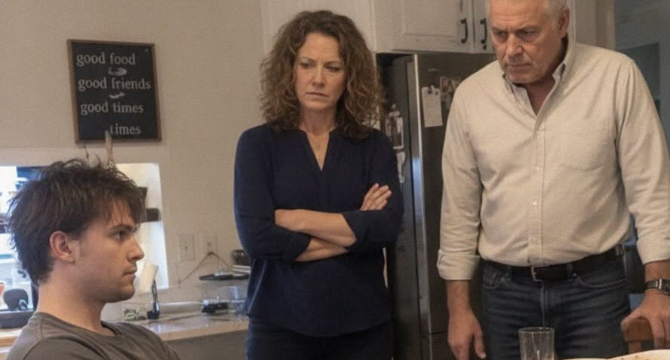
I knew my father could be judgmental, which was exactly why I’d asked Ethan for one unusual favor before meeting my parents. I thought I was preparing for an uncomfortable dinner. I wasn’t prepared for Dad to prove my worst suspicion before dessert was even over.
My father looked at Ethan’s shoes before he looked at his face.
“Are those dirty?”
We had been inside my parents’ house for maybe eight seconds.
Ethan glanced down at his sneakers.
They were old gray canvas, worn white at the toes.
He had deliberately left his good shoes at my apartment.
“A little,” he said.
My father looked at me.
I pretended not to notice. That was harder than it sounds, because the shoes had been my idea.
Three days earlier, I’d stood in Ethan’s bedroom while he held up two shirts.
“Which one?”
“The faded blue one.”
He smiled.
“You really want me to look broke.”
“I want Dad to meet you before he meets your money.”
“I am ordinary.”
“Your father owns 14 hotels.”
“Seventeen.”
I threw a sock at him.
Ethan laughed, but I didn’t.
“Please.”
His smile disappeared.
He knew why I was asking.
Ethan and I had started talking about marriage.
Nothing official. No ring. No date.
But enough that meeting my parents didn’t feel casual anymore.
If I was going to build a life with him, I needed to know what happened when the man my father met didn’t look impressive.
My father, Richard, had spent the last five years becoming someone I sometimes didn’t recognize.
Not cruel.
Not exactly.
Just impressed by all the wrong things.
What neighborhood people lived in.
What car they drove.
Where their children went to school.
Whether someone’s job sounded important when he repeated it later.
The strange part was that my father hadn’t grown up with money.
He’d grown up with almost none.
When I was little, he used to tell me about the brown leather shoes his mother bought him when he was 12.
One pair.
She polished them every Sunday night because they had to last.
Three years of school.
Church.
Weddings.
His first job interview.
“Never decide what somebody’s worth by what they’re wearing, Soph,” he’d tell me. “You don’t know how far those shoes had to walk.”
I loved that story.
I loved the man who told it.
Lately, I wasn’t sure where he’d gone.
A month earlier, I’d listened to him dismiss my cousin’s warehouse job with that little laugh he used whenever somebody’s paycheck didn’t impress him.
I remember thinking, “If Ethan walked in here without his money, what would Dad see?”
So when I finally told my parents I was bringing Ethan to dinner, I asked him to keep things simple.
No mention of his father.
No money.
No driver.
He normally drove a ten-year-old Honda when we were together anyway, but that afternoon he’d taken it for service.
“Then how am I getting there?” he’d asked.
“I’ll pick you up.”
Ethan stared at me.
“And Jeffrey can pick you up afterward.”
Then he started laughing.
“This is insane.”
“I know.”
“You understand that?”
“Completely.”
He kissed my forehead.
“Faded blue shirt?”
“Please.”
“Worn sneakers?”
“Definitely.”
“Anything else?”
“Just be yourself.”
That part, at least, wasn’t a test.
My mother appeared behind Dad and hugged me.
Then she smiled at Ethan.
“You must be Ethan.”
“It’s nice to meet you, Mrs. Bennett.”
Dad finally offered his hand.
“What exactly do you do?”
Not hello.
Not nice to meet you.
Ethan shook it anyway.
“I work in property development.”
Dad’s eyebrows rose slightly.
“Sales?”
“Mostly restoration and redevelopment.”
“For who?”
“A family company.”
“Big company?”
Ethan glanced at me.
“Pretty big.”
Dad nodded as though he’d received confirmation of something.
We went inside.
Dinner was roast chicken, potatoes, green beans, and 45 minutes of my father interviewing my boyfriend as if he’d applied for a loan.
Where did he live?
Did he rent?
What kind of car did he drive?
What was his five-year plan?
Did property development provide “stable income”?
Ethan answered every question calmly.
He never lied.
He just didn’t volunteer anything.
“My daughter’s ambitious,” Dad said eventually.
“I know.”
“Always has been.”
“I know that too.”
“So naturally, we worry about whether the person she’s with can keep up.”
“Dad.”
“What?”
“Stop.”
He lifted both hands.
“I’m making conversation.”
Ethan took another bite of potato.
My mother tried changing the subject.
“So, Ethan, Sophia says you like old buildings.”
His face brightened.
“I do.”
“What kind?”
“Mostly hotels, actually. Old ones people want to tear down.”
That was the first real question anyone had asked him all evening.
He started telling Mom about a hotel built in 1912 that his team was restoring instead of demolishing.
For three minutes, dinner became normal.
Then Dad asked, “And you actually make money doing that?”
I put my fork down.
Ethan did too.
“I do all right.”
Dad leaned back.
“That usually means no.”
“Dad.”
“What car did you say you drive?”
“I didn’t.”
“What do you drive?”
“A Honda.”
“What year?”
Ethan looked at me again.
“2016.”
Dad gave a small laugh.
I knew that laugh.
I’d heard him use it when discussing my cousin’s warehouse job.
My stomach tightened.
Ethan didn’t react.
After dinner, Mom brought out pie.
Dad poured coffee.
I kept hoping he’d run out of questions.
Instead, he looked at Ethan’s sneakers again.
“Can I give you some advice?”
“Dad, don’t.”
“I’m talking to him.”
Ethan folded his hands.
“Sure.”
“A man needs to think seriously about what he can provide before he gets serious about somebody’s daughter.”
The room went quiet.
Ethan’s expression changed.
Not anger.
Something more tired.
“I can provide for myself.”
“That’s not what I said.”
“I know.”
Dad looked at me.
“Sophia, you’re 26. You’re building a career. You’ve worked too hard to attach yourself to someone without prospects.”
I felt my face burning.
“You’re embarrassing yourself.”
“No, I’m protecting my daughter.”
“From what?”
He pointed at Ethan.
“From this.”
Ethan looked down at himself.
The faded shirt.
Old jeans.
Worn sneakers.
Then he looked at me.
That hurt more than anything Dad had said.
Dad stood.
“My daughter will not be with someone who can’t even provide for himself.”
“Dad.”
“I think you should leave.”
Mom whispered, “Richard.”
“No. I’m serious.”
He pointed toward the front door.
“Get out of my house.”
For several seconds, nobody moved.
Then Ethan pushed back his chair.
“As you wish.”
He picked up his phone.
I stood too.
“I’m leaving with him.”
“Sophia.”
“No.”
Ethan touched my arm.
“It’s okay.”
“It isn’t.”
“I know.”
He tapped his phone and waited.
“Jeffrey? You can bring the car around to the front entrance.”
Dad frowned.
“What car?”
Ethan put his phone away.
“Let’s step outside.”
We did.
Dad came because he was suspicious.
Mom came because she looked terrified.
I came because my hands were shaking.
Ethan stood beside me on the front walk.
Less than two minutes later, headlights turned onto the street.
The black Bentley stopped in front of the house.
Jeffrey stepped out wearing a dark suit and opened the rear door.
Nobody spoke.
Dad stared at the car.
Then at Ethan.
“Whose car is that?”
“My father’s.”
Dad frowned.
“Who is your father?”
Ethan told him.
My father’s face changed.
Not dramatically.
That made it worse.
Everyone in our city knew the name.
His company owned hotels, office towers, apartment buildings, and half the redevelopment projects Dad liked reading about in the business pages.
Dad looked back at Ethan.
“That’s your father?”
“Yes.”
Dad stared at him.
“The 1912 hotel downtown?”
Ethan nodded.
“My father’s company bought it last year.”
Dad’s mouth opened slightly.
I’d heard him talk about that restoration over breakfast.
The silence lasted maybe three seconds.
Then something extraordinary happened.
My father smiled.
“Ethan, why didn’t you say something?”
I felt sick.
Dad stepped toward him.
“Come back inside. We obviously got off on the wrong foot.”
Mom didn’t say anything.
Somehow, that hurt too.
Ethan looked at him.
“What changed?”
Dad’s smile faltered.
“I misunderstood your situation.”
Ethan looked down.
Then he lifted one foot slightly.
“My shoes didn’t.”
Nobody spoke.
“My job didn’t change,” Ethan continued. “My car didn’t change. The way I treat Sophia didn’t change.”
Dad’s face reddened.
“That’s not what I meant.”
“I know exactly what you meant.”
There was no satisfaction in Ethan’s voice.
That was the worst part.
He’d seen this before.
I knew he had.
The first time we’d met, I’d spent two months thinking his father owned a small construction company.
When Ethan finally told me the truth, he’d looked almost apologetic.
“People get weird,” he’d said.
I hadn’t understood then.
I did now.
Dad turned to me.
“You deliberately deceived us.”
“About what?”
Dad stared at me.
“You had him come here dressed like this.”
“Yes.”
“Why?”
“Because Ethan and I have been talking about getting married.”
Dad went still.
Mom’s hand flew to her mouth.
“Married?” she said.
Dad looked from me to Ethan. “You’re serious?”
“Very.”
“Sophia, why didn’t you tell us?”
“Because we haven’t decided anything yet.”
Mom stepped closer. “But you were thinking about marrying him, and this is how you chose to tell us?”
“No. I was hoping tonight would give me a reason to tell you.”
Dad’s expression hardened.
“What does that mean?”
“This wasn’t just me introducing you to my boyfriend. I needed to know what kind of people I was asking him to call family.”
That silenced him.
I looked through the open front door.
Past him.
Toward Dad’s study.
And I remembered the cabinet.
“Do you still have those old brown shoes Grandma bought you?”
Dad’s expression changed.
Mom looked at me.
“Sophia.”
“Are they still in the cabinet?”
Dad said nothing.
I walked inside.
The cabinet was in his study.
Those shoes had been there my entire childhood, tucked on the bottom shelf beneath old photographs and tax files.
I opened the door.
They were still there.
Brown leather.
Cracked near the toes.
One sole repaired twice.
I carried them outside.
Ethan looked confused.
Dad didn’t.
I set the shoes on the front step between us.
“Grandma bought these when you were 12.”
Dad’s jaw tightened.
“Don’t.”
“She polished them every Sunday because you only had one pair.”
“Sophia.”
“You wore them for three years.”
“I know my own story.”
“Then why did you forget it?”
He looked away.
I felt tears coming now.
Not angry tears.
Those would have been easier.
“You used to tell me never to decide what somebody was worth by what they were wearing.”
Dad stared at the shoes.
“You said I didn’t know how far their shoes had walked.”
Ethan looked at him.
Then at me.
My voice broke.
“What would you have said if somebody had looked at these and decided you weren’t good enough for their daughter?”
Dad didn’t answer.
He couldn’t.
For the first time all evening, he looked small.
Mom sat down on the front step.
Dad rubbed a hand over his face.
Finally, Ethan spoke.
“My father’s money doesn’t make what you said to me worse.”
Dad looked at him.
“It just made you want to take it back.”
That landed.
Dad’s shoulders dropped.
Ethan glanced toward the Bentley.
“That’s why I don’t lead with my father’s name.”
“Why?” Mom asked quietly.
“Because I like knowing which version of someone I’m talking to.”
Dad closed his eyes.
I understood then why Ethan had agreed to my ridiculous plan so easily.
This hadn’t been new to him.
People had been changing in front of him for years.
Dad had simply done it faster.
Ethan squeezed my hand.
“We should go.”
I nodded.
Dad didn’t try to stop us.
As Jeffrey opened the car door, Dad finally said, “Ethan.”
Ethan turned.
Dad looked down at his old shoes.
Then back at him.
“I was wrong before I knew who your father was.”
Ethan nodded once.
We left.
For nine days, my father didn’t call me.
On the tenth, my phone buzzed while I was at work.
It was a photograph.
His old brown shoes were sitting on the kitchen table.
Underneath, Dad had written five words.
“I forgot who wore these.”
I stared at that message until my eyes blurred.
Then I called him.
He answered immediately.
“I’m sorry, Soph.”
“I know.”
“No. Let me say it. I spent so long being proud that I wasn’t that poor kid anymore, I became the kind of man who would’ve looked down on him.”
A month later, Ethan agreed to have dinner with my parents again.
He wore jeans.
The same faded blue shirt.
And the same worn gray sneakers.
When Dad opened the door, his eyes dropped automatically.
I saw it happen.
So did Ethan.
Dad looked at the shoes for one second.
Then he raised his eyes.
“Come in, Ethan.”
That was all.
No Bentley.
No family name.
No questions about money.
Halfway through dinner, Dad put down his fork. “You said you restore old buildings because you hate seeing them torn down.”
Ethan looked at him carefully.
“Yeah.”
“How did you get into that?”
For a moment, Ethan didn’t answer.
Then he smiled.
He told Dad about being 16 and walking through an abandoned hotel with his grandfather.
About seeing names carved into a ballroom wall.
About wondering how many weddings had happened there before someone decided the building wasn’t worth saving.
Dad listened.
Actually listened.
Twenty minutes later, they were still talking about old buildings.
Under the table, Ethan reached for my hand.
And when Ethan stood to leave, Dad walked him to the door.
His eyes passed over those worn sneakers one last time.
Then he shook Ethan’s hand.
“Come back anytime.”
On the drive home, Ethan looked at me.
“You know I’m throwing these shoes away eventually.”
I laughed.
“No, you’re not.”
“Why?”
I looked down at them.
“Because you have no idea how far they’ve had to walk.”