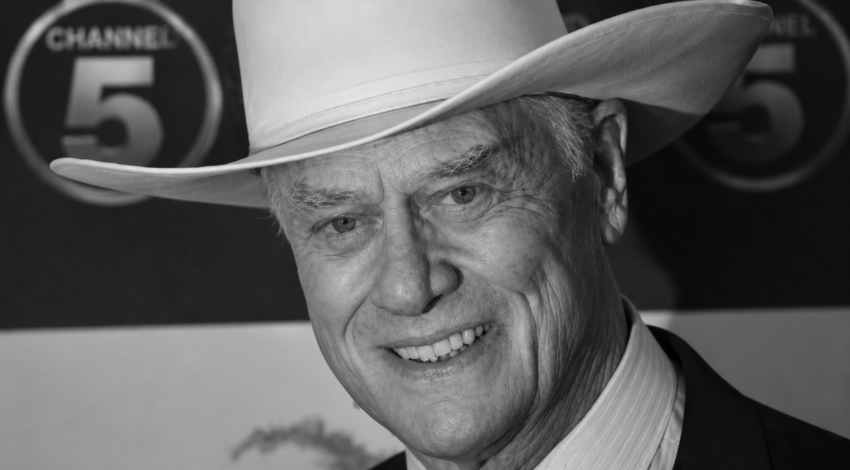
Fourteen years after Larry Hagman’s death, his smile remains instantly recognizable. For some viewers, it belongs to the charming astronaut who discovered a genie. For others, it is the knowing grin of J.R. Ewing—the oilman whose schemes made Dallas essential viewing. On November 23, we remember an actor who gave audiences two unforgettable characters and decades of entertainment.
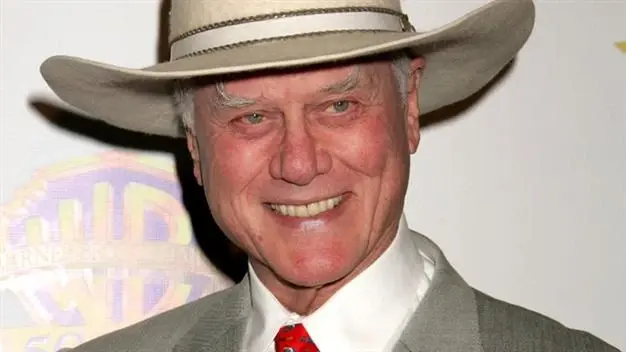
Hagman died on November 23, 2012, in Dallas, Texas, at the age of 81. His family attributed his death to complications from cancer.
His passing brought an extraordinary career to a close. Yet watching his performances today, it is easy to understand why audiences kept returning: he could make a quiet reaction funny, a friendly smile suspicious, and an ordinary conversation feel like the beginning of trouble.
The Astronaut Who Became a Household Favorite
Before the cowboy hats and boardroom battles of Dallas, Hagman found television fame as Major Anthony “Tony” Nelson in I Dream of Jeannie.
The NBC comedy, which aired from 1965 to 1970, paired him with Barbara Eden as Jeannie, a magical companion whose efforts to help frequently complicated his life.
Hagman’s performance gave the fantasy its everyday footing. Tony was an astronaut accustomed to discipline and responsibility, suddenly faced with situations that no training could explain.
His bewildered expressions, comic timing and attempts to maintain control became central to the show’s appeal. Alongside Eden, he helped create a television partnership that remains familiar through generations of reruns.
For viewers who grew up with the series, seeing him again can bring back memories of watching television with parents, siblings or children.
J.R. Ewing and the Phenomenon of Dallas
When Dallas premiered in 1978, Hagman introduced audiences to a very different man.
As J.R. Ewing, he played a wealthy Texas oilman whose ambition repeatedly damaged the people closest to him. J.R. manipulated business rivals, exploited weaknesses and treated family loyalty as something that could bend to his own interests.
Hagman made him compelling through small choices: a pause before an answer, an amused glance, a smile that suggested he knew more than he intended to reveal.
The character’s appeal depended on that combination of charm and menace. Audiences could disapprove of J.R.’s behavior while eagerly waiting to see his next move.
His scenes with Linda Gray as Sue Ellen and Patrick Duffy as Bobby helped give the Ewing family’s conflicts their emotional force. Beneath the wealth and spectacle were recognizable tensions involving trust, marriage, resentment and loyalty.
The Question That Kept Viewers Waiting
Few television storylines became as widely discussed as “Who shot J.R.?”
The 1980 cliffhanger left viewers wondering who had attacked Hagman’s character. The mystery carried beyond the screen, becoming a conversation among friends, colleagues and families while audiences waited for the answer.
It remains a defining example of television’s ability to create a shared experience.
At the center stood Hagman, whose performance had made J.R. important enough for viewers to care intensely about what happened to him—even after watching him hurt so many others.
A Career Built Through Years of Work
Born in Fort Worth, Texas, on September 21, 1931, Larry Martin Hagman was the son of actress and Broadway star Mary Martin.
His early career included theater, military entertainment work and television. Before his best-known sitcom role, he appeared in the daytime drama The Edge of Night. His film work included Fail-Safe and In Harm’s Way.
He also worked behind the camera, directing episodes of both I Dream of Jeannie and Dallas.
Those experiences reveal the working actor behind the celebrity: someone whose career developed across different formats and whose familiarity with a production extended beyond his own scenes.
Recognition and a Final Return to Southfork
Hagman received Primetime Emmy nominations for his performance in Dallas in 1980 and 1981. His portrayal of J.R. became the role most closely associated with his name, even as viewers continued to enjoy his earlier comedy work.
In 2012, he returned to the character in TNT’s continuation of Dallas.
For longtime fans, the return offered another opportunity to see him inhabit the world of the Ewings. He had completed work on episodes for the revival’s second season before his death.
There was a particular pleasure in watching an older J.R. remain capable of commanding a scene with a few carefully delivered words.
Remembering the Man Behind the Characters
Away from his screen career, Hagman shared a long marriage with Maj Axelsson, whom he married in 1954. They had two children, Heidi and Preston.
His life also included serious health challenges, including a liver transplant in 1995. He returned to work afterward, adding further years to a career that had already brought him international recognition.
On his death anniversary, his legacy is found most clearly in the performances themselves. Tony Nelson still offers the warmth and comedy of a familiar favorite. J.R. Ewing still has the power to make viewers lean forward, wondering what he is about to do.
Fourteen years after his passing, Larry Hagman remains part of television’s shared memory.
Rest in peace, Larry Hagman. Thank you for the laughter, the suspense and the characters we continue to remember.